
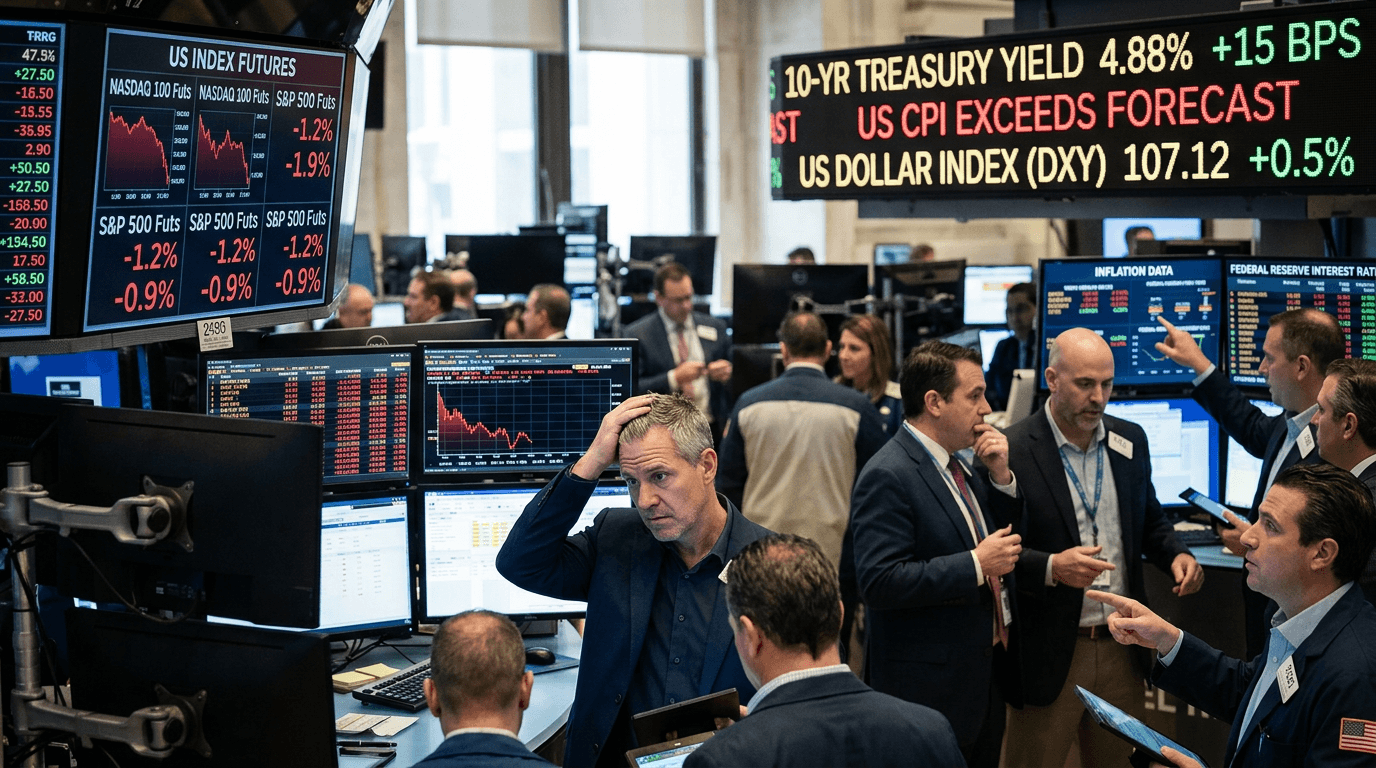
U.S. index futures started the session on the back foot, with contracts tied to the S&P 500, Dow Jones Industrial Average, and Nasdaq 100 edging lower as elevated Treasury yields and renewed inflation jitters dampen risk appetite[4][12]. The combination of higher yields and sticky inflation expectations is tightening financial conditions, pressuring growth stocks and other duration-sensitive assets while supporting the U.S. dollar over riskier corners of the market[2][9].
Market Snapshot: Futures Under Pressure
The soft tone in futures reflects a market grappling with the idea that the era of easy money is firmly over, at least for now[2][12]. Benchmark 10-year Treasury yields are hovering near recent highs around the mid-4% range, while 30-year yields have spent their longest stretch above 5% since the run-up to the global financial crisis, underscoring a structural repricing of long-term rates[1][2][11].
Higher yields feed directly into equity valuations by raising the discount rate used to value future cash flows, which hits long-duration assets like technology and high-growth names hardest[4][12]. When those sectors carry a large weight in indices such as the S&P 500 and Nasdaq 100, even modest shifts in yields can ripple quickly through futures pricing and intraday sentiment[1][4].
The weakness in futures is also occurring against a backdrop of markets that recently pushed to, or near, record highs on enthusiasm around artificial intelligence and resilient corporate earnings[1][12]. When positioning is optimistic and valuations are rich, any renewed stress from yields or inflation can prompt a sharper-than-usual reset in expectations, particularly via index futures where institutions hedge and rebalance exposure efficiently[1][9].
Why Higher Yields Weigh On Equities
To understand why rising yields are such a headwind, it helps to break down the mechanics. A higher risk-free rate raises the hurdle for all assets; investors can earn more by simply holding government bonds, so equities need stronger earnings growth or cheaper valuations to remain attractive[2][11]. This relative shift becomes especially powerful when long-term yields move quickly, as they have during recent bond selloffs driven by inflation concerns and heavier government borrowing[2][14].
For equity futures, this shows up as a repricing of index-level earnings expectations and multiples. If the discount rate rises but earnings forecasts do not, the logical adjustment is a lower valuation multiple, which pulls futures down even before cash markets open[4][12]. This effect is most pronounced for sectors whose cash flows extend far into the future—technology, communication services, speculative growth—because more of their value is derived from distant earnings that are heavily discounted when yields rise[4][12].
The bond-equity link also runs through corporate financing costs. Higher yields translate into more expensive debt issuance, tighter credit conditions, and potentially weaker buyback activity, all of which can weigh on equity indices over time[2][14]. Futures markets are highly sensitive to these shifts in expectations, making them a real-time barometer of how investors perceive the trade-off between higher yields and future growth.
Inflation Fears Back In Focus
The yield move is not occurring in a vacuum; it is closely tied to a resurgence in inflation anxiety. A combination of factors—including spiking energy prices, renewed tariff measures, and heavy investment in capital-intensive technologies such as artificial intelligence—is reviving concerns that inflation could remain above central bank targets for longer than previously hoped[9][14]. These pressures are pushing investors to demand higher compensation for holding long-term bonds, pushing yields up and prices down[2][9].
Market-based measures of inflation expectations and various “inflation fear” indicators have climbed back toward levels last seen before the global financial crisis, reflecting skepticism that price pressures will fade quickly[11][14]. This matters because central banks, including the Federal Reserve, may delay or scale back rate cuts if inflation remains sticky, effectively keeping policy tighter for longer[3][14].
Equity markets have already shown how sensitive they are to this narrative. In recent months, episodes of rising yields tied to inflation worries have triggered broad-based equity pullbacks, with all three major U.S. indices at times shedding more than 1% in a single session as investors rotate into safer fixed-income assets[12]. The current softening in futures is another iteration of that pattern: higher yields, higher inflation fears, and a cautious stance toward risk[9][12].
Currency And Duration-sensitive Assets
When U.S. yields rise relative to global peers, the U.S. dollar tends to strengthen as foreign capital flows toward higher returns in Treasury markets[2][9]. That dynamic appears to be in play again, with elevated yields and persistent inflation concerns improving the relative appeal of dollar-denominated assets versus lower-yielding currencies and riskier markets[2][9].
A stronger dollar and higher yields together create a challenging mix for duration-sensitive assets. Growth equities, long-dated corporate bonds, real estate investment trusts, and parts of the emerging-market complex all face pressure as the cost of capital rises and global financial conditions tighten[4][14]. For investors, this environment demands a more selective approach to risk, with greater focus on balance sheet strength, cash flow visibility, and sectors that benefit from higher rates, such as certain financials.
Implications For Traders And Simulated Finance
For active traders and participants in simulated finance environments, this backdrop offers both risk and opportunity. Elevated volatility around macro data releases, central bank communications, and sudden shifts in yields can create short-lived dislocations in index futures, sector spreads, and cross-asset relationships[3][12][14]. Traders who understand how these macro drivers interact are better positioned to design strategies that respond to changing conditions rather than being caught off guard.
One practical approach is to track the interplay between equity index futures and key yield benchmarks such as the 2-year and 10-year Treasury notes. Sudden moves in front-end yields often reflect shifting expectations for Fed policy, while changes at the long end signal evolving views on growth and inflation[2][3][14]. Simulated environments allow traders to test how different strategy templates—trend-following, mean reversion, volatility breakout—perform under various yield and inflation regimes before committing real capital.
Risk management also becomes more critical when yields and inflation expectations are in flux. Futures traders can experiment with position sizing, stop-loss placement, and portfolio hedging using bond futures, volatility indices, or sector rotation to mitigate drawdowns during adverse macro shocks[4][12]. SimFi platforms provide a controlled space to rehearse these decisions in real time, helping traders build muscle memory around rapid changes in macro conditions without financial consequences.
Key Takeaways
1. Elevated U.S. Treasury yields and revived inflation fears are weighing on S&P 500, Dow, and Nasdaq futures, underscoring how sensitive equity valuations remain to the cost of money[2][4][12].
2. Rising yields raise discount rates, pressure growth-heavy indices, and make government bonds more competitive versus equities, leading to softer futures and more cautious positioning[2][4][11].
3. Inflation drivers—from higher energy prices to renewed tariffs and robust investment spending—are complicating the path toward lower rates, keeping markets on edge about future policy and growth[9][14].
4. A stronger dollar and higher yields are creating headwinds for duration-sensitive assets globally, reinforcing the need for careful sector and asset-class selection in both live and simulated portfolios[2][9][14].
5. For traders, especially those using simulated finance platforms, this environment is an opportunity to deepen understanding of macro linkages, stress-test strategies, and refine risk management before deploying real capital[4][12].
Conclusion
Soft U.S. futures in the face of elevated bond yields and persistent inflation fears highlight a market at an important crossroads, where growth optimism meets the hard reality of higher funding costs and uncertain price dynamics[2][9][12]. The balance between these forces will shape not only short-term index moves but also the medium-term trajectory of risk assets, currency markets, and global capital flows.
For traders and investors alike, the message is clear: this is a time to respect macro risk, stay data-driven, and adapt quickly as conditions evolve. Using simulated environments to explore “what if” scenarios around yields, inflation, and policy paths can turn a challenging macro landscape into a powerful learning laboratory—one that prepares market participants to navigate the next phase of the cycle with greater confidence and discipline[4][12][14].