
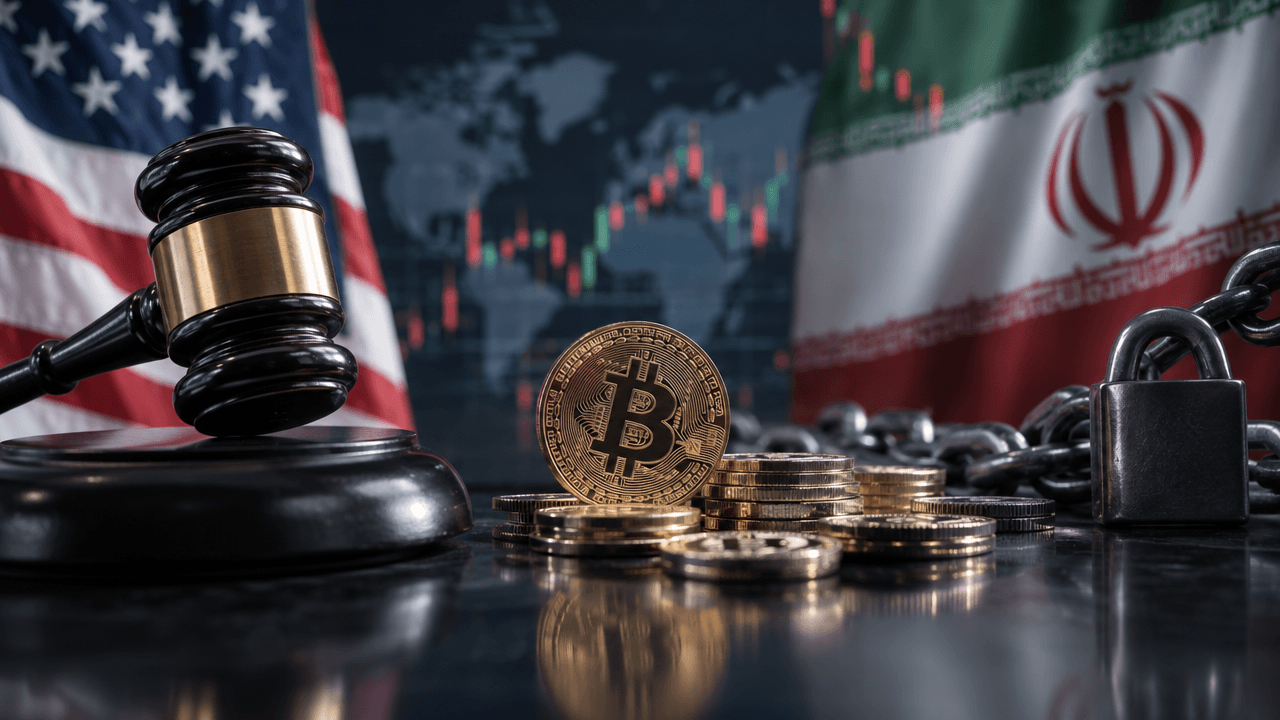
The U.S. move against Iranian crypto exchange BitBank is a clear reminder that digital assets sit squarely inside the geopolitical and regulatory landscape, not outside of it.[1][3][12] For traders, funds, and platforms, this is more than a localized enforcement action—it illustrates how quickly a single sanctions designation can reshape liquidity paths, counterparty risk, and the narrative around crypto’s role in global finance.[1][14][15]
Bitbank Sanctions: What Happened
On September 17, the U.S. Treasury’s Office of Foreign Assets Control (OFAC) sanctioned Iranian crypto exchange BitBank, alleging that the platform was used to transfer hundreds of millions of dollars in bitcoin to Iran’s Islamic Revolutionary Guard Corps (IRGC) between June and July.[1][3][12][15] BitBank is described as a priority digital assets venture controlled by Iranian financier Babak Zanjani, who was already under U.S. sanctions.[3][8][9]
The designation is part of “Operation Economic Outcast,” Washington’s broader campaign aimed at disrupting Iranian financial networks and sanctions‑evasion schemes.[1][3][13] Alongside BitBank itself, OFAC also sanctioned its software developer, Pishtaz Simorgh Electronic Trade Company, and three Zanjani associates—Hossein Ali Zaker Hossein, Mohammad Mahdi Zaker Hossein, and Seyed Adel Heidari.[4][14][15]
According to Treasury, BitBank was not only routing bitcoin to the IRGC but also processing payments linked to Hormuz Safe, an Iranian maritime‑insurance scheme that collects fees for safe passage through the Strait of Hormuz.[4][8][13][14] By tying a specific digital‑asset platform to strategic shipping lanes and a sanctioned military organization, Washington is signaling that crypto rails used for critical infrastructure payments will attract heightened scrutiny.[4][8][14]
Under the sanctions, all property and interests in property of BitBank and the designated parties subject to U.S. jurisdiction are blocked, and U.S. persons are generally prohibited from dealing with them.[2][10][15] Any entities owned 50% or more by one or more blocked persons are also covered, extending the reach of the measures into affiliated corporate structures and counterparties.[2][3][15]
Why This Matters For Crypto Markets
For the broader crypto market, the BitBank case reinforces a trend: regulators are increasingly targeting the infrastructure enabling cross‑border digital‑asset flows, not just individual wallets.[3][10][12] Exchanges, OTC desks, custodians, and software providers are now in direct focus when their services intersect with sanctioned actors, regions, or schemes.[3][9][15]
The allegation that hundreds of millions of dollars in bitcoin moved to the IRGC over a short window highlights the scale at which sanctioned entities can operate when they gain access to lightly regulated platforms.[1][12][13] This undermines the idea that sanctions‑evading activity is always small or fragmented; instead, concentrated flows can emerge through specific nodes, which then become prime targets for enforcement.[3][14][15]
Market‑wise, official confirmation that a major sanctions‑evading operation ran through bitcoin is likely to add pressure to ongoing policy debates around crypto’s role in illicit finance.[10][12][14] Expect renewed calls for stricter KYC/AML, enhanced blockchain analytics, and potentially tighter rules for cross‑border exchange operations, especially in high‑risk jurisdictions.[3][9][15]
At the same time, the action reminds traders that regulatory risk can be as impactful as macro or technical factors in shaping liquidity conditions. When exchanges or key intermediaries are suddenly cut off from parts of the global system, local markets can see fragmented liquidity, wider spreads, and heightened slippage—as well as abrupt changes in on‑ and off‑ramp availability.
Risks For Traders And Platforms
For individual traders, the immediate risk is direct or indirect exposure to sanctioned entities, even unwittingly. If you use platforms that have loose controls around counterparties or jurisdictional access, you may face locked funds, frozen accounts, or forced offboarding if those venues end up on a sanctions list or lose major banking relationships.
Platforms face a more complex risk stack. The BitBank case shows that regulators will look beyond legal registration and target the actual flow of funds, ownership structures, and software providers behind the scenes.[3][4][9] Exchanges that rely on third‑party technology or white‑label solutions must understand who ultimately controls that infrastructure and whether any components sit in higher‑risk networks.
Even DeFi participants should pay attention. While smart contracts themselves are neutral, front‑ends, governance bodies, and centralized components (like oracles or bridges) can attract scrutiny when they appear to facilitate large‑scale sanctions evasion or support designated entities. Compliance is no longer just a “CeFi problem”; it is an ecosystem‑wide consideration.
In practice, this means traders and platforms need clearer frameworks for:
- Jurisdictional risk mapping
- Counterparty screening and ongoing monitoring
- Response plans for sudden regulatory actions
- Communication strategies when enforcement news hits
Lessons For Simulated Finance And Risk Management
For SimFi participants, the BitBank sanctions are a textbook example of a “non‑market” shock that can have market‑like consequences. It is precisely the kind of scenario that should be integrated into simulated trading environments and risk drills.
In a simulated setting, traders can explore how a sudden sanctions announcement might affect liquidity in related assets: bitcoin pairs, regional stablecoins, and tokens commonly used for cross‑border flows. They can test how spreads, depth, and volatility respond, and how quickly sentiment shifts from “routine news” to “regulatory shock.”
Risk managers can design scenarios where key venues become unavailable, forcing rerouting of execution to alternative exchanges with different fee structures, latency profiles, and regulatory requirements. Simulating the impact on slippage, margining, and collateral management helps teams prepare for real‑world disruptions.
SimFi platforms also offer a safe space to explore compliance‑aware trading strategies. For example, simulated exercises can incorporate:
- Filters that exclude high‑risk jurisdictions or entities
- Stress tests where specific addresses or platforms are suddenly blocked
- Adjustments in position sizing when regulatory uncertainty spikes
By treating regulatory events like BitBank’s designation as part of the normal risk landscape rather than rare outliers, traders build more resilient playbooks.
Key Takeaways For Your Trading Playbook
The BitBank sanctions carry several practical lessons for active market participants:
- Regulatory risk is path‑dependent: where assets flow and who controls the rails matters as much as price action.[3][10][12]
- Concentrated illicit flows are likely to draw attention: hundreds of millions in BTC to a sanctioned military organization is exactly the profile regulators are watching.[1][12][13]
- Infrastructure is in the crosshairs: exchanges, developers, and associated entities can all be designated, not just “bad actors” in isolation.[3][4][15]
- Preparedness beats prediction: you cannot forecast every enforcement action, but you can rehearse your response via simulation and scenario analysis.
Conclusion
The U.S. sanctions on BitBank mark another step in the tightening nexus between crypto markets, national security, and international policy.[1][3][14] For the industry, the message is clear: digital assets are now embedded in the global sanctions architecture, and enforcement can move swiftly when regulators connect the dots between platforms, flows, and strategic objectives.[3][8][15]
For traders and platforms, the opportunity lies in turning this reality into an edge. By integrating regulatory scenarios into risk frameworks, leaning on robust compliance, and using simulated environments to stress‑test strategies, market participants can navigate an increasingly complex landscape with greater confidence and discipline.