
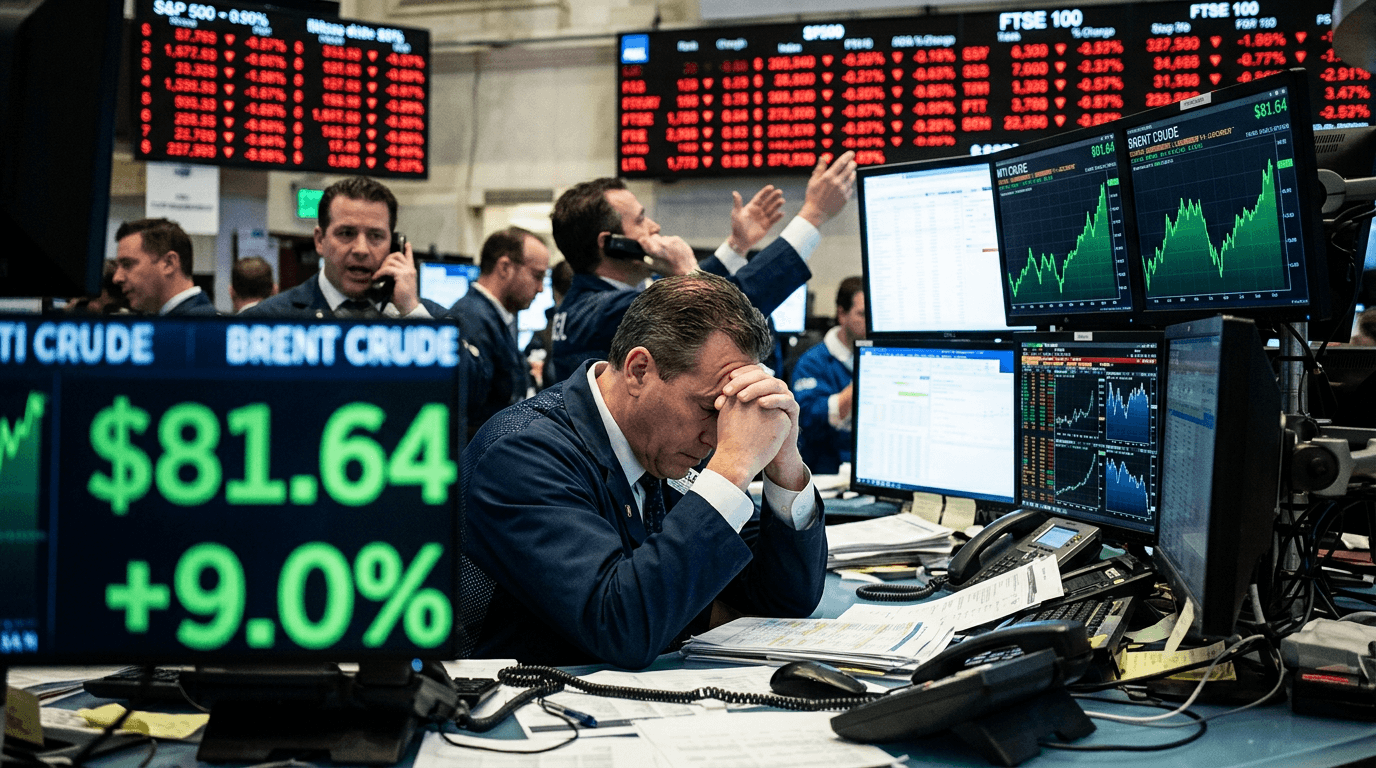
The U.S. stock market experienced a sharp selloff on Tuesday as crude oil prices surged nearly 9% to $81.64 per barrel for West Texas Intermediate crude, marking the highest levels since summer 2024. This wasn't a typical market correction driven by earnings disappointment or Fed commentary. Instead, it represented a fundamental shock to the global economy: the escalating military conflict between the United States and Iran has transformed abstract geopolitical risk into concrete supply disruption, forcing investors to rapidly reassess valuations across all asset classes.
The Oil Shock Reshaping Markets
The mathematics of this supply disruption are brutal and straightforward. The Strait of Hormuz, a narrow waterway connecting the Persian Gulf to the Gulf of Oman, handles approximately 20% of the world's daily oil supply. With Iran effectively closing this critical chokepoint through military action and the targeting of commercial vessels, roughly 10 to 11 million barrels per day have been removed from the global market. For context, this represents an enormous supply gap that cannot be quickly replaced through alternative sources or strategic reserves.
West Texas Intermediate jumped 9% to $81.64, but this tells only part of the story. Brent crude, the global benchmark, climbed even more sharply to $85.85 per barrel. More concerning for long-term market implications, some sources indicate oil has already pushed past $111 to $112 per barrel in worst-case scenario pricing. Whether these elevated levels hold depends entirely on the duration and intensity of the military conflict and whether shipping lanes can be reopened and secured.
Equity Market Reaction: The Immediate Fallout
The stock market's response was swift and severe. The Dow Jones Industrial Average declined 2.25%, while the S&P 500 and NASDAQ each fell more than 1%. This wasn't panic selling; it was rational repricing of future earnings under a new economic regime where energy costs are structurally higher.
Higher oil prices function like a tax on economic activity. Airlines face immediate margin compression as jet fuel costs spike. Transportation companies absorb higher diesel costs. Manufacturing facilities see increased operating expenses. Consumer goods companies anticipate reduced demand as households redirect spending from discretionary items to cover higher gasoline and heating costs. Semiconductor stocks experienced particular pressure, as investors grew concerned about disruption to global supply chains and weakening consumer demand for electronics.
The equity selloff reflects a fundamental economic principle: positive supply shocks lift markets because companies enjoy lower input costs and higher margins. Negative supply shocks do the opposite. The closure of the Strait of Hormuz represents one of the most negative supply shocks imaginable for the global oil market, and equity valuations must adjust downward to reflect this new reality.
Gasoline Prices And Consumer Impact
The crude oil surge has already translated into sharply higher gasoline prices at the pump. The national average reached $3.58 per gallon, up 60 cents in just one month. In severely affected regions, consumers face prices exceeding $4 per gallon, levels last seen in August 2022. The speed of this transmission has been stunning: one week gasoline averaged $2.98, and the next week it jumped to $3.25, a 9% increase in seven days.
This matters for equity markets because higher energy costs directly reduce consumer purchasing power. Lower discretionary spending cascades through retail, entertainment, and hospitality sectors. The Fed faces an uncomfortable dilemma: raising rates to combat inflation could trigger recession risk, while keeping rates low risks accelerating price increases further up the economic chain.
Inflation Fears Take Center Stage
This energy crisis echoes the 1970s stagflation era, when oil embargoes triggered simultaneous inflation and economic weakness. The International Energy Agency has characterized the Strait of Hormuz closure as the "largest supply disruption in the history of the global oil market." Such language is not hyperbole.
Markets are now pricing in sustained elevated oil prices rather than a temporary spike. This has profound implications for inflation expectations, Fed policy, and real interest rates. Bond markets sold off globally as investors reassessed yield assumptions in a higher-inflation environment. Currency volatility increased as traders grappled with differing inflation trajectories across major economies.
What Traders And Investors Should Monitor
For market participants, several critical variables warrant close attention. First, track any developments regarding Strait of Hormuz security or reopening. Every day of closure represents roughly 10 million barrels of supply removed from the market. Second, monitor Fed communications carefully, as central banks must balance inflation control against recession risks. Third, watch for corporate guidance revisions as companies adjust earnings expectations for higher energy costs. Fourth, pay attention to demand destruction signals, such as airline capacity reductions or manufacturing slowdowns, which could eventually moderate oil prices downward.
Conclusion
The 9% oil surge to $81.64 represents more than a commodity price movement. It signals that geopolitical events with real economic consequences are no longer theoretical exercises for academics but immediate challenges for portfolio managers and traders. The stock market's decline reflects this harsh reality. As the conflict continues with no clear resolution in sight, traders should prepare for ongoing volatility across energy, equities, and currency markets.