
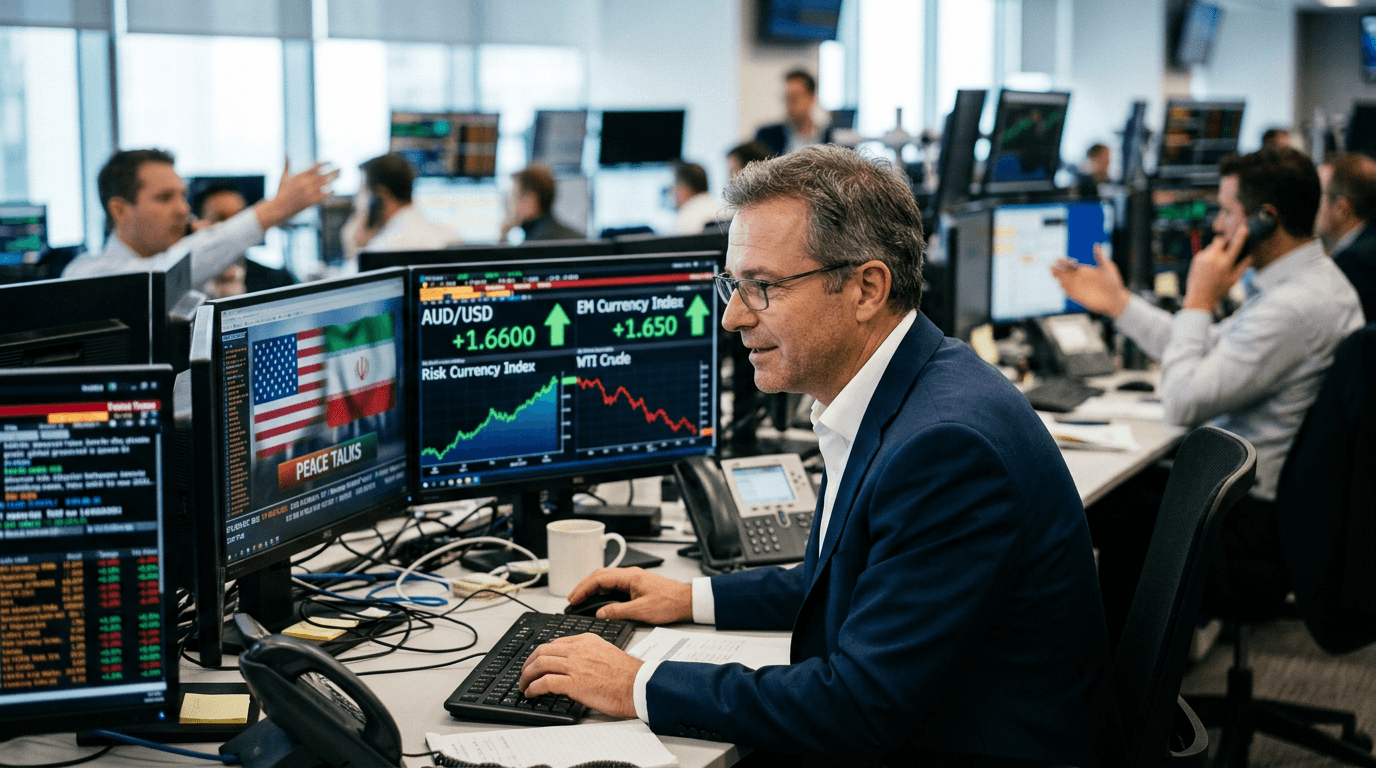
For once, Middle East headlines are taking pressure off markets rather than adding to it. Hints of improving US‑Iran relations have nudged investors into a more “risk‑on” stance, lifting higher‑beta currencies such as the Australian dollar and selected emerging‑market FX while weighing on the traditionally defensive US dollar.[1][3] With oil risk premia being repriced and global growth expectations nudging higher, FX traders are recalibrating how much geopolitical insurance they are willing to pay for in the form of a stronger greenback.[1][3]
WHAT’S DRIVING THE MOVE?
The core story is straightforward: prospects of a US‑Iran understanding reduce the perceived risk of escalation in a key geopolitical hotspot and one of the world’s major energy-producing regions.[3] When the probability of supply disruptions or conflict falls, markets trim the “fear premium” embedded in oil and other risk assets.
Recent coverage has highlighted that even tentative signs of US‑Iran talks have been enough to knock the US dollar off recent highs as investors rotate back into risk-sensitive assets.[1][3] Historically, similar episodes of de‑escalation chatter have triggered a drop in oil prices, improved risk sentiment and, in turn, a weaker dollar as investors feel less need for safe‑haven exposure.[1]
At the same time, the dollar is not collapsing; it is giving back some ground after a period of strength. In Asia trading, for example, the dollar has traded tepid as markets monitor Iran peace prospects, even while remaining up about 1% for the month overall.[3] That mix of modest dollar softness and firmer risk assets is typical when geopolitical risks ease but domestic US data and yields remain relatively firm.
Importantly, markets do not need a signed peace agreement to move. Positioning adjusts on changes in probabilities at the margin. Each new headline, diplomatic signal or leak about potential frameworks for talks can shift the market-implied odds of a deal and, with them, FX and commodity prices.[2][3]
How Geopolitics Flows Into Fx
To understand why US‑Iran peace prospects matter for currencies, it helps to unpack the transmission channels:
1) Oil prices and terms of trade Lower geopolitical risk around Iran tends to reduce the risk premium embedded in oil prices, or at least cap upside spikes.[1] For net oil importers, especially in Asia and Europe, cheaper or more predictable energy costs improve their terms of trade and can support their currencies. For exporters like the US, a decline in oil prices can slightly dampen the outlook for energy revenues, though the effect on the dollar is often overshadowed by its safe‑haven role.
2) Global risk sentiment The US dollar is not just a medium of exchange; it is the world’s primary safe‑haven currency. When geopolitical tensions intensify, global investors often rush into US Treasuries and the dollar, pushing the greenback higher.[1] When those tensions ease, that “flight to safety” unwinds, and capital flows back into higher-yielding, riskier markets, boosting risk currencies and pressuring the dollar.[1][3]
3) Growth expectations and capital flows If investors believe reduced US‑Iran tensions lower the odds of a major supply shock or conflict, they typically revise up global growth expectations at the margin. That can drive capital into cyclical and commodity-linked economies that are more sensitive to global demand—think Australia, parts of Latin America, and some Asian emerging markets—supporting their currencies versus the dollar.
The combination of these channels explains why even incremental progress toward US‑Iran de‑escalation can ripple quickly through FX markets, often ahead of any concrete policy changes.
Winners And Losers In Currency Markets
Against this backdrop, some currencies tend to benefit more than others.
Higher‑beta and commodity‑linked FX Currencies like the Australian dollar (AUD) often outperform in risk‑on phases. Their economies are leveraged to global trade, commodities and Chinese demand, making them more sensitive to shifts in global growth sentiment. As US‑Iran peace prospects improve and oil risk premia ease, investors are more comfortable adding exposure to these higher‑beta currencies, seeking carry and cyclical upside rather than pure safety.[3]
Selected emerging‑market currencies can also benefit. Countries with solid external balances, credible monetary policy and links to the global manufacturing or commodity cycle may see inflows as the perceived tail risk of a Middle East shock recedes. However, EM FX performance is never uniform; idiosyncratic politics, inflation and debt profiles still matter.
Safe havens and the US dollar On the other side, traditional safe‑haven currencies—especially the US dollar—can soften when geopolitical stress fades.[1][3] The dollar’s role is twofold: haven demand in times of stress and a reflection of US rate and growth differentials in calmer periods. Right now, the easing of Iran-related risks is mainly chipping away at the haven component, leaving US data and Fed expectations to do the heavy lifting.
Other safe havens such as the Japanese yen and Swiss franc may also lose some defensive bid when risk appetite improves, although their moves can be muted if domestic policy (like yield-curve control or negative rates) still discourages capital inflows.
It is also worth noting that markets can be “remarkably sanguine” even when political headlines remain noisy.[4] That complacency can persist until either talks meaningfully progress—validating the risk‑on stance—or collapse, in which case the reaction can be sharp as safe‑haven flows roar back.[4]
What Traders Should Watch
For active traders and those honing their edge in a simulated environment, the current backdrop offers a live case study in geopolitics‑to‑markets dynamics. Key things to monitor include:
1) Headline risk and diplomatic signaling Track not just official announcements but also leaks and commentary from US, European and regional officials about the scope and pace of potential talks—nuclear constraints, sanctions relief, monitoring regimes and security guarantees.[2][3] Markets reprice probabilities continuously; the biggest moves often happen before any formal agreement.
2) Oil price behavior Watch whether oil is grinding lower, range‑trading, or spiking on new incidents. A sustained drift lower in the risk premium component is consistent with ongoing support for risk currencies and a softer dollar. Conversely, any surprise supply disruption or breakdown in talks can quickly reverse that pattern.
3) Cross‑asset risk sentiment Equity indices, credit spreads and volatility gauges such as the VIX provide valuable context. A broad risk‑on move across assets typically aligns with stronger high‑beta FX and a weaker dollar, while a reversal in sentiment can warn of a snapback into safe havens.
4) Policy and data counterforces Remember that the FX impact of US‑Iran developments is layered on top of central bank policy and macro data. As noted, the dollar can still post monthly gains even while easing on specific sessions tied to peace hopes.[3] Do not treat geopolitics in isolation; integrate it into your broader macro framework.
In a SimFi setting, these dynamics are ideal for testing scenario-based strategies: long AUD or selected EM FX versus the dollar in de‑escalation scenarios, and hedging or reversing those positions if talks stall and risk premia rebuild.
Final Thoughts
Prospects of a US‑Iran understanding are a reminder that geopolitics can sometimes be a tailwind, not just a source of shocks. By trimming the perceived risk of an oil‑market disruption and major regional conflict, improving peace odds have bolstered risk appetite, supported higher‑beta currencies and gently pressured the US dollar off its recent peaks.[1][3]
For traders, the main takeaway is that FX markets are forward‑looking and probability‑driven. You do not need a signed treaty to see meaningful moves; shifting expectations are enough. The challenge—and opportunity—is to read how those expectations evolve, map them to oil, risk sentiment and policy trends, and position accordingly while managing the ever‑present risk of abrupt reversals if talks falter.[4]
Whether you are trading live or practicing in a simulated environment, treating episodes like this as structured case studies will sharpen your ability to connect the geopolitical dots, quantify risk premia and navigate the constant tug‑of‑war between fear and optimism that drives global currencies.