
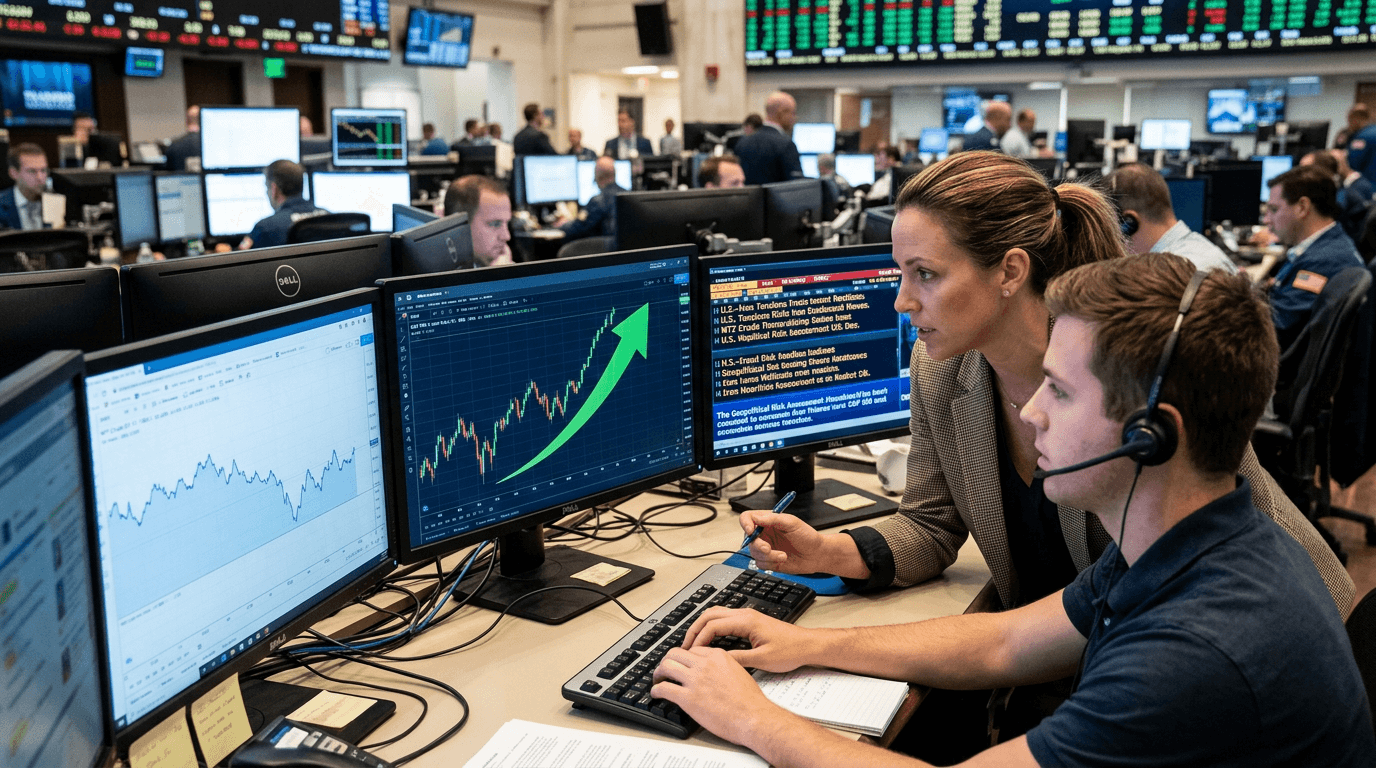
Wall Street equity futures are pointing higher again after a bruising sell‑off, as oil prices stabilize and traders reassess how much the latest U.S.–Iran flare‑up really changes the macro picture[5]. The move suggests that the initial wave of risk aversion is fading, but it also underscores how quickly sentiment can swing when geopolitical headlines collide with already‑fragile markets.
Markets Rebound As Risk Aversion Eases
U.S. stock index futures have edged higher, with S&P 500, Nasdaq 100, and Dow contracts all in the green as global markets and crude oil prices steady following renewed U.S. strikes on Iranian targets[5]. Earlier, the same futures had sold off sharply as traders rushed to price in the risk of a broader Middle East conflict and potential disruptions to energy supply.
Recent pre‑market data showed Nasdaq futures outperforming, rising around 0.7%, with S&P 500 and Dow futures up roughly 0.3–0.4%, while small‑cap Russell 2000 futures also ticked higher[10]. This kind of partial rebound is typical after a shock: systematic strategies recalibrate, short‑term traders cover positions, and investors hunt for bargains in sectors that were indiscriminately sold.
It is important to remember what equity index futures represent. They are leveraged contracts that track major benchmarks such as the S&P 500 and Nasdaq 100, traded nearly 24 hours a day. Because they move before the cash market opens, they provide a real‑time snapshot of how global investors are digesting new information and adjusting risk appetite.
For anyone trading on a simulated finance platform, watching futures is an invaluable way to understand market tone. A steep overnight decline followed by a measured rebound, as seen this week, tells you that the market is still nervous but no longer in outright panic.
Oil Steadies, Conflict Premium Gets Repriced
The initial trigger for the equity sell‑off was a sharp rise in geopolitical anxiety after renewed U.S. strikes on Iran, against the backdrop of an already‑tense Middle East conflict[5]. Oil prices jumped as traders reassessed the risk of supply disruptions, particularly through critical shipping routes such as the Strait of Hormuz, a chokepoint for global crude exports.
As more information emerged and no immediate escalation into a broader regional war materialized, crude prices began to retreat from their highs and then stabilized[5][15]. That stabilization is significant: when oil is trending sharply higher on war fears, markets worry about an inflation shock; when it steadies, investors can start to separate short‑term noise from longer‑term fundamentals.
Earlier episodes show a similar pattern. When renewed U.S. and Iranian attacks raised concerns that the conflict might be prolonged, oil moved higher and equities momentarily stumbled on inflation and growth worries[3]. By contrast, when signs of de‑escalation appeared and oil prices declined, futures and equities recovered as the perceived conflict premium in energy eased[18].
For traders, this dynamic highlights a critical lesson: geopolitical risk is often priced first through commodities, and then ripples into equities and bonds. Monitoring crude futures alongside equity index futures can provide early signals about whether the market sees a shock as transient or transformational.
CROSS‑ASSET RIPPLE EFFECTS: FX, RATES, AND COMMODITIES
While the headline is about equity futures, the real story is cross‑asset. When Middle East tensions spike, investors typically rotate toward perceived safe havens like the U.S. dollar, the Japanese yen, and gold, while shedding higher‑beta assets such as small caps and emerging‑market currencies. At the same time, Treasury markets often see a bid as investors seek protection, pushing yields lower in classic “risk‑off” fashion.
In the latest episode, that risk‑off pattern was partially visible during the initial sell‑off, but the swift rebound in futures illustrates how quickly markets reassess once the immediate shock is absorbed. As oil steadied and chip stocks extended a recovery from a recent pullback, U.S. equity futures turned higher again[16]. That combination—less fear about energy, plus renewed confidence in growth drivers like semiconductors—helps re‑anchor risk sentiment.
For macro‑oriented traders, the takeaway is to think in terms of interconnected markets rather than isolated moves. A spike in oil and a drop in equities may be temporary if bond yields are not confirming the story of sustained inflation risk. Conversely, if higher energy prices coincide with rising inflation expectations and a weaker growth outlook, the shock could be more persistent.
HOW PROFESSIONALS ARE POSITIONING AROUND U.S.–IRAN RISK
Institutional investors are not ignoring the conflict; they are reframing it. Instead of assuming a worst‑case scenario, many are looking at how earnings, inflation expectations, and central bank policy might evolve if the Middle East situation remains tense but contained. That means paying attention to corporate guidance, economic data, and policy communications alongside military headlines.
In several recent rebounds, chip and tech stocks have acted as stabilizers, offsetting geopolitical worries and driving indexes higher even as tensions lingered[3][16]. Semiconductor names and AI‑linked infrastructure plays have been a focal point, with investment banks highlighting fundamental earnings strength and long‑term capital‑expenditure trends in the sector[2]. When these growth engines are intact, equity markets appear more willing to look through short‑term shocks.
Investors are also watching upcoming jobs data and central bank commentary, since a sustained geopolitical premium in oil could complicate the inflation outlook and interest‑rate paths[11]. The market’s message right now is nuanced: the U.S.–Iran situation is clearly a risk, but not yet an overarching macro regime shift.
Practical Takeaways For Simulated And Live Traders
For traders using simulated finance platforms, this environment is a live textbook on how geopolitical events interact with markets. A few practical lessons stand out:
First, distinguish between the initial shock and the “second‑day” narrative. The first move is driven by surprise and positioning; the subsequent moves, like the current futures rebound, are driven by analysis and reassessment. Designing trading scenarios that capture both phases can improve your understanding of volatility and liquidity.
Second, build cross‑asset dashboards. Track equity index futures, oil, major FX pairs, and benchmark bond yields together. When an event like a U.S.–Iran strike hits, see which market reacts first, which reacts most, and which lags. In simulation, you can test strategies that pair equity futures trades with hedges in energy or rates to manage risk more effectively.
Third, respect correlation shifts. In calm periods, sectors and assets often move with well‑behaved correlations. In stress, those correlations can spike or invert. Simulated trading around events like these can help you practice adjusting position sizes, tightening risk limits, and avoiding over‑reliance on historical relationships that may break down under geopolitical pressure.
Finally, avoid headline‑chasing. The partial rebound in futures despite ongoing conflict headlines illustrates that markets try to quantify risk, not simply react to it[5][10]. Use simulations to practice waiting for confirmation—through price action, volume, and cross‑asset signals—before committing to a directional view.
Looking ahead, traders will remain focused on developments in the U.S.–Iran relationship, the trajectory of oil prices, and how these factors feed into inflation expectations and central bank policy. At the same time, earnings from key sectors such as technology and energy will help determine whether the current rebound in equity futures becomes a more durable trend or another short‑lived relief rally[10][16]. In an interconnected market, mastering the link between geopolitics, commodities, and equity futures is not just a macro skill—it is essential risk management.