
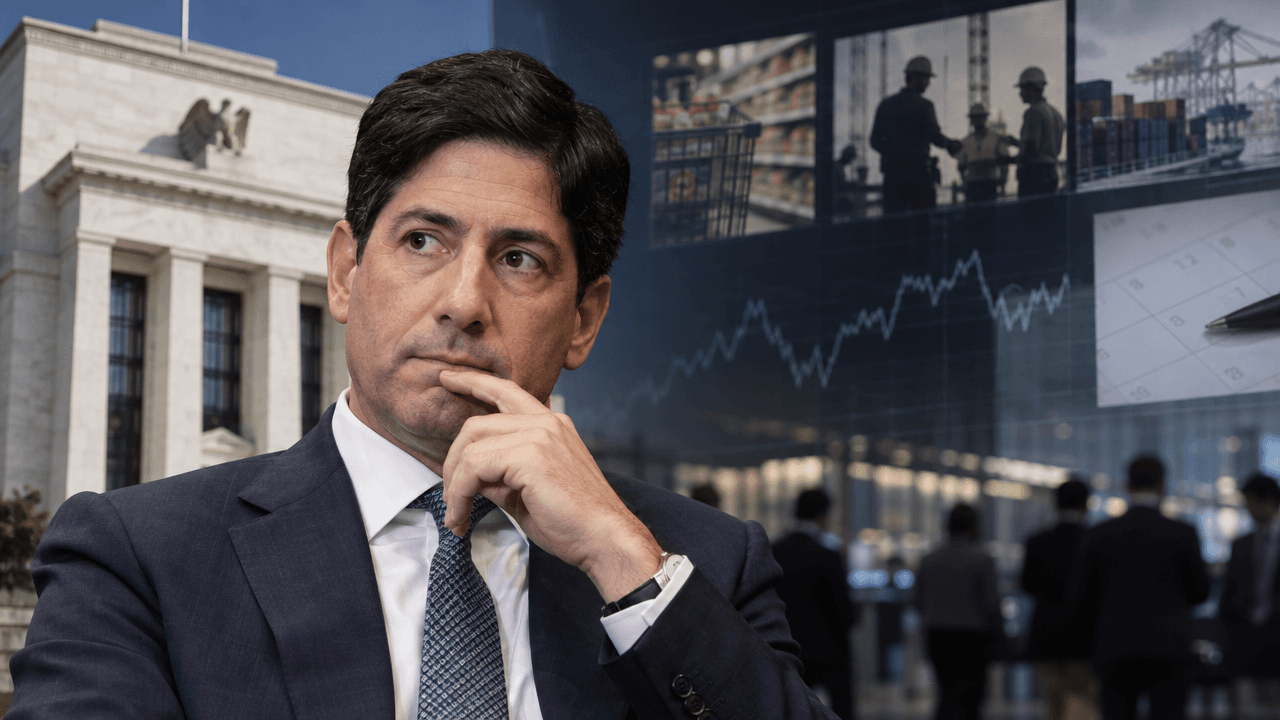
Federal Reserve Chair Kevin Warsh has made one point unmistakably clear: markets should not expect advance signals about the central bank’s next interest-rate decision. Speaking at the International Monetary Fund and World Bank meetings in Bangkok, Warsh declined to say whether policymakers would raise rates, hold them steady, or take another approach at the Federal Open Market Committee’s remaining meetings of 2026. [1]
His refusal to provide guidance leaves investors focused on the data rather than the Fed chair’s words. The October 27–28 meeting and the December 8–9 meeting are now the key decision points for evaluating inflation, employment, and economic growth. [2][11]
A Shift Away From Forward Guidance
Warsh said he does not “prejudge” meetings and does not believe in explaining in advance what he might do at upcoming policy gatherings. The position represents a more limited approach to communication than markets have often received from central banks, where officials use speeches and interviews to prepare investors for likely policy changes.
Forward guidance can reduce uncertainty when economic conditions are relatively stable. If policymakers strongly suggest that rates will remain unchanged, businesses and investors can plan around that expectation. However, guidance can become a constraint when new data changes the outlook. A central bank that has signaled a specific move may face pressure to follow through even when inflation or labor-market conditions evolve unexpectedly.
Warsh’s approach keeps every meeting open. It also places greater emphasis on the Federal Reserve’s official statement, economic projections, press conference, and the incoming data released between meetings.
For traders, the message is simple: do not treat the absence of a warning as evidence that rates will remain unchanged. Silence is not a policy promise.
Why October And December Matter
The October meeting arrives after policymakers raised rates in September and as markets assess whether that move was sufficient to restrain inflation. Recent reporting indicates that Fed officials generally expected another increase before the end of the year, but the meeting minutes did not specify whether October or December was the preferred timing. [12]
That distinction matters because rate decisions work with a delay. Higher borrowing costs can eventually cool consumer demand, business investment, housing activity, and financial conditions, but the effects are not immediate. Policymakers therefore need to balance the risk of doing too little against the risk of tightening too aggressively.
The October meeting gives the Fed an opportunity to review the latest inflation and employment information before deciding whether additional action is necessary. December then becomes a second checkpoint. If price pressures remain persistent and the labor market stays resilient, policymakers could view another increase as appropriate. If growth slows materially or employment weakens, officials may prefer to wait.
Warsh has described the two meetings as moments when policymakers will assess output, employment, and inflation together. [2] That reinforces an important principle: the Fed is not targeting a single economic statistic. It is evaluating the broader balance of risks.
The Market Reaction
The dollar eased modestly after Warsh’s remarks as traders waited for clearer policy signals. [2] Currency markets often respond quickly to changes in interest-rate expectations because higher U.S. rates can attract global capital and support demand for dollar-denominated assets.
When the central bank chair refuses to indicate whether rates are moving higher, traders must reassess the probability of future policy changes using economic data, futures pricing, and comments from other Fed officials. That can produce short-term volatility in the dollar, Treasury yields, equities, and commodities.
The market’s current interpretation appears to lean toward an October pause, although expectations remain sensitive to upcoming inflation data. One recent report placed the probability of an October rate increase at roughly one in four, while investors continued to anticipate a greater chance of action in December. [10]
These probabilities are not guarantees. They reflect the prices traders are willing to pay in interest-rate futures markets at a particular moment. A stronger-than-expected inflation report could quickly push rate-hike expectations higher, while weaker employment or growth data could have the opposite effect.
What Traders Should Watch
The most important information will come from inflation, employment, and growth indicators.
Inflation data will show whether price pressures are easing consistently or remaining stubbornly high. Core inflation deserves particular attention because it excludes volatile food and energy prices and can provide a clearer view of underlying trends.
Employment data will help determine whether the economy can withstand additional tightening. A stable labor market may give the Fed more flexibility to raise rates, while a sharp deterioration in hiring or unemployment could encourage caution.
Growth indicators will provide context. If consumer spending, business activity, and overall output remain strong, policymakers may worry that demand is keeping inflation elevated. If growth loses momentum, the case for waiting becomes stronger.
Traders should also monitor Treasury yields, the dollar index, and market-based inflation expectations. These financial conditions can tighten or loosen even before the Fed changes its benchmark rate.
Practical Takeaways For Simfi Traders
The current environment rewards disciplined scenario planning rather than confident predictions. Simulated traders can prepare by building separate plans for an October hold, an October hike, and a delayed December move.
Before major data releases, define entry levels, stop-loss points, and maximum risk. Avoid increasing position size simply because the market appears certain about the next Fed decision. Expectations can change rapidly when new information contradicts the consensus.
It is also useful to compare reactions across markets. A stronger dollar combined with rising Treasury yields may indicate that traders are pricing a more restrictive Fed. Falling yields and a weaker dollar may suggest expectations of a pause or slower future tightening. Equities and gold can provide additional clues, although neither offers a perfect signal.
The broader lesson is that central-bank uncertainty is itself a market condition. When guidance is limited, volatility can rise as investors respond to every major economic release.
Conclusion
Kevin Warsh’s refusal to signal the Fed’s next move does not mean policy has become unpredictable without limits. It means the decision will be determined closer to each meeting, using the latest evidence on inflation, employment, and growth.
For now, October and December stand as the year’s critical policy checkpoints. Traders should resist the temptation to interpret silence as reassurance and instead prepare for multiple outcomes. In a data-dependent market, flexibility, risk control, and careful analysis may be more valuable than trying to forecast the Fed from a single headline.