
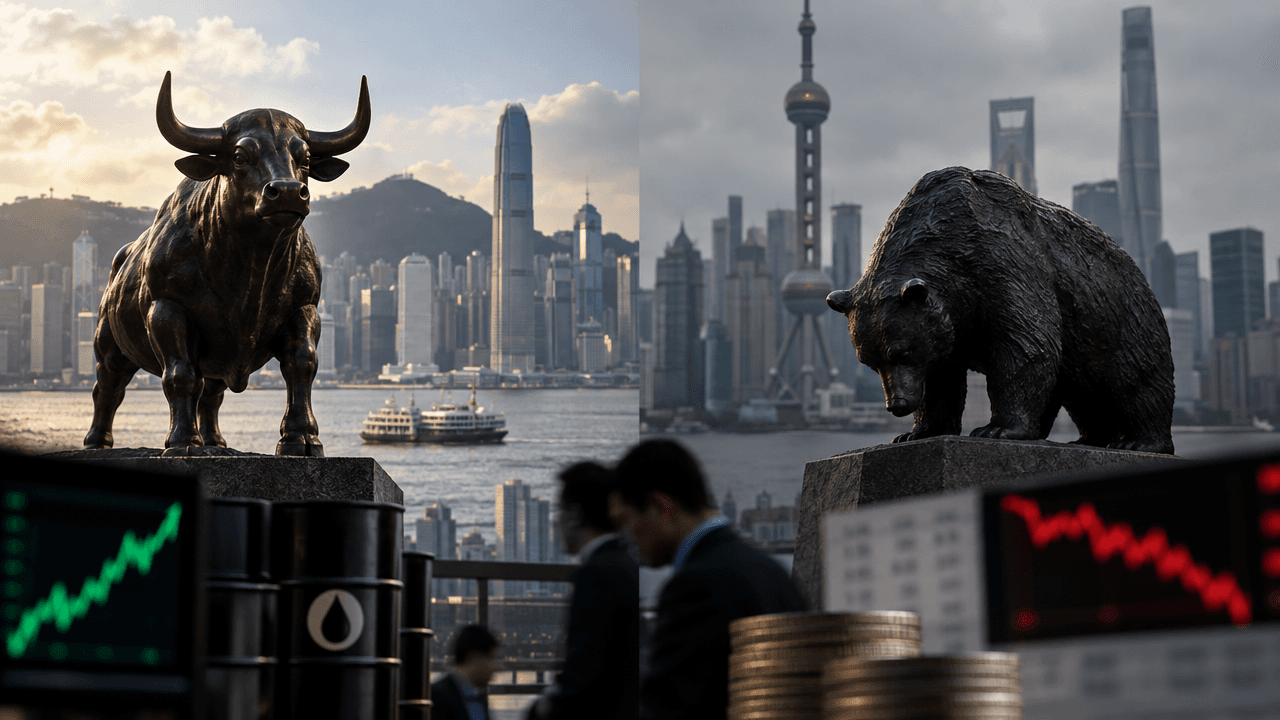
Asian markets sent mixed signals on Friday, October 9, as investors weighed the push and pull of higher energy costs, elevated bond yields and pressure on major technology shares. Hong Kong’s Hang Seng rose 1.1% to 24,046.79, while Shanghai’s Composite fell 1.4% to 3,758.47 in holiday-thinned trading. The contrast is a useful reminder: regional markets can react differently to the same global risks, and one session rarely tells the whole story. [2]
Why The Markets Diverged
The day’s split came against a tense global backdrop. Japan’s Nikkei 225 slipped 0.8%, while Australia’s S&P/ASX 200 gained 0.6%; markets in South Korea and Taiwan were closed for a holiday. With fewer markets trading, price moves can be more sensitive to individual orders and less representative of broad regional sentiment. [2]
Hong Kong’s advance did not erase the concerns weighing on other markets. Investors were still assessing costly energy, high borrowing rates and weakness among influential technology stocks. Shanghai, meanwhile, was trading ahead of China’s expected economic growth figures the following week, giving investors another reason to be selective. The result was not a simple vote of confidence in one market or rejection of another, but a snapshot of competing forces. [2]
Oil: A Cost Shock And An Inflation Risk
Oil prices had climbed sharply during Thursday’s U.S. session: Brent crude rose 4.1% to $104.28 a barrel, amid uncertainty about when conflict-related disruption would ease. By early Friday, however, Brent had pulled back 1% to $103.28, and U.S. benchmark crude was down 0.9% to $90.23. That retreat offered some relief, but prices remained high enough to keep energy costs in focus. [2]
For businesses, expensive oil can raise transport, manufacturing and operating costs. For households, higher fuel and utility bills can squeeze spending elsewhere. If those pressures persist, investors may worry that inflation will stay stubborn and central banks will have less room to lower interest rates. Energy producers may benefit from stronger prices, but oil-importing economies and companies with thin margins can face the opposite effect.
A useful investor question is not simply “Is oil up today?” but “How long might elevated prices last, and who has the ability to pass the cost on?” That distinction matters when comparing companies and sectors.
Yields And The Price Of Risk
Bond yields were another source of unease. The U.S. 10-year Treasury yield reached 5.35% early Thursday before falling to 5.23%. Yields at high levels can make borrowing more expensive for companies and consumers, while also giving investors a more competitive return on bonds compared with riskier assets such as shares. [2]
Higher yields can weigh particularly on businesses whose valuations depend on profits expected far in the future. Those future earnings are worth less in today’s terms when the discount rate rises. The effect can be pronounced in fast-growing technology companies, even when their long-term prospects remain intact.
Yields do not move in a straight line, and Thursday’s retreat showed how quickly sentiment can shift. The bond market reacted after a U.S. Treasury auction, underscoring why investors should watch both the direction of yields and the news driving them—not just a single closing number. [2]
Tech Stocks Face A Higher Bar
Technology weakness in the United States added to the cautious tone. The Nasdaq Composite fell 1.3% on Thursday, while Nvidia lost 2.9%, Broadcom fell 4.3% and Micron Technology dropped 4.8%. Investors have been asking whether the growth expected from artificial-intelligence investment can justify the high prices attached to some AI-related shares. [2]
That does not mean the technology outlook has suddenly disappeared. It means the market may be becoming more selective. Companies with strong cash generation, manageable debt and evidence that new technology is translating into revenue may be viewed differently from firms relying on ambitious growth forecasts. For traders, separating a sector-wide pullback from a change in a company’s fundamentals is essential.
Practical Takeaways For Traders
First, treat a holiday-thinned session with care. Lower participation can magnify price moves, so avoid assuming that a single day establishes a durable trend.
Second, track the links between oil, inflation expectations and yields. A sustained energy shock could influence both corporate costs and the interest-rate outlook, while a temporary pullback may ease pressure without removing the underlying risk.
Third, look beyond headline index performance. Hong Kong rose while Shanghai fell, but the broader picture also included a weaker Nikkei, a stronger Australian market and technology losses in the U.S. Checking sector and regional breadth can help reveal whether a move is broad or concentrated.
Finally, define risk before placing a trade. In a market shaped by geopolitical uncertainty, volatile commodities and shifting yields, position sizing and clear exit levels matter more than confidence in a single forecast.
Conclusion
Friday’s divergence across Asian markets reflected uncertainty rather than a clear regional trend. Hong Kong advanced and Shanghai declined as investors balanced oil risks, high yields, technology valuations and upcoming Chinese economic data. For market participants, the most useful approach is to follow those drivers together, stay alert to thin liquidity and distinguish short-term price swings from changes in underlying fundamentals.