
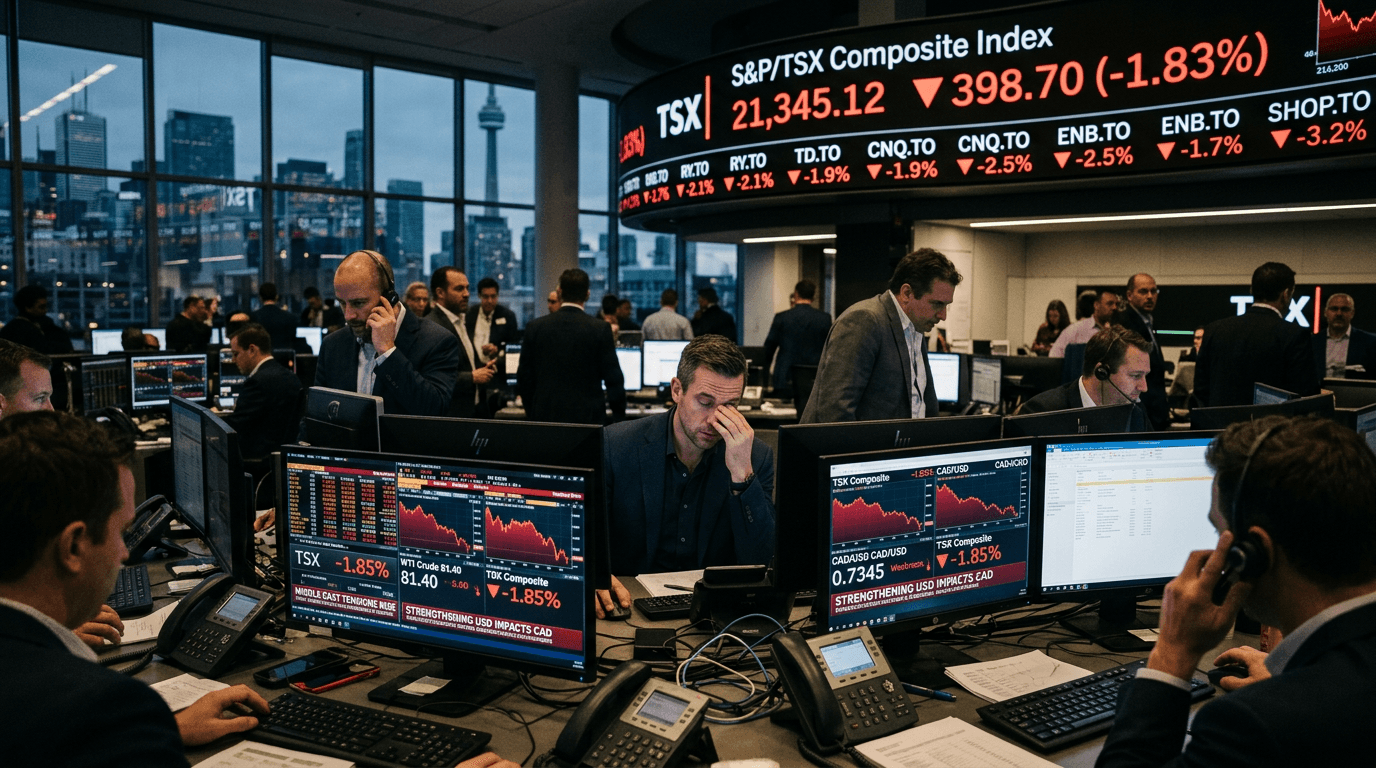
Canadian assets are feeling the strain as a mix of rising Middle East tensions and a stronger U.S. dollar pushes investors toward safety, pressuring both domestic equities and the Canadian dollar. Canadian stocks have been trading lower, with the S&P/TSX Composite edging below key levels as geopolitical headlines inject fresh uncertainty into the outlook for global growth and commodities.[5][3] At the same time, the loonie has softened against the greenback as investors reward perceived safe havens and reassess risk exposure to commodity-linked economies.[1][3]
What Is Pressuring Canadian Assets Now
The latest leg lower in Canadian stocks is part of a broader risk-off move sparked by the escalation of conflict involving Iran and the wider Middle East, a region critical for global energy supply.[3][4] Coordinated military actions and the threat of further disruption have raised the macroeconomic stakes, prompting investors to dial back exposure to equities and cyclical assets worldwide.[3][7]
Canada is getting caught in that global downdraft. The S&P/TSX Composite Index has slipped as investors reassess earnings prospects in a world where energy prices, shipping routes, and corporate confidence could all be affected by geopolitics.[5][3] International equity markets outside the U.S. have seen some of the sharpest pullbacks since the conflict escalated, and Canadian stocks have underperformed U.S. benchmarks in this environment.[1][3]
On the currency front, the Canadian dollar tends to behave as a “risk” and commodity-linked currency. When volatility rises and investors flock to perceived safe havens, the U.S. dollar typically benefits at the expense of currencies like the CAD, particularly when commodity prices are under pressure and global growth fears are in focus.[1][7]
How Middle East Risks Reach Canada
The Middle East is a key hub for global oil flows, so any conflict there immediately raises questions about supply, prices, and shipping routes.[4] Analysts note that disruptions to Iranian output or traffic through strategic chokepoints can meaningfully tighten the oil market, pushing crude prices higher and increasing volatility across energy assets.[4]
For Canada, this is a double-edged sword. On one hand, higher oil prices can be supportive for Canadian producers, and energy makes up roughly 15–16% of the TSX Composite.[2] In theory, sustained strength in crude should bolster earnings for domestic energy names and improve Canada’s terms of trade as a major exporter.[2][4]
On the other hand, when geopolitical stress is high, the “good news” from higher oil prices is often overwhelmed by broader risk aversion. RBC’s market strategists highlight that since the latest phase of the Iran-related conflict began, risk assets globally have suffered, with international equities down 5–7% in some regions, while U.S. equities have held up much better.[3] That pattern—U.S. resilience versus weaker performance elsewhere—is exactly what we are seeing in Canada as well.[1][3]
Global institutions such as the IMF have repeatedly flagged geopolitical escalation as a key downside risk to the world economy, warning that heightened uncertainty can dampen investment, weigh on trade, and tighten financial conditions.[7] Those macro concerns feed directly into equity valuations and into the outlook for currencies tied to global growth and commodities, including the CAD.
WHY A STRONGER U.S. DOLLAR WEIGHS ON CANADIAN STOCKS AND THE LOONIE
The other major headwind is the U.S. dollar itself. During periods of geopolitical tension and financial-market stress, the greenback often strengthens as investors seek liquidity, safety, and U.S. assets—which are seen as relatively defensive.[3][7] In the current episode, the stronger dollar is playing out along familiar lines: U.S. equities have outperformed many global peers, and the USD has firmed against a broad basket of currencies, including the Canadian dollar.[1][3]
A firm U.S. dollar also tends to be negative for commodities that are priced in USD, such as oil and base metals. Morningstar analysts note that the recent strength in the greenback has dragged down commodity prices, which in turn has weighed on Canadian stocks given the market’s heavy exposure to energy and materials.[1] When commodities struggle, the earnings outlook for many TSX constituents comes under pressure, and the currency of a resource-heavy economy like Canada often follows.
This combination—stronger U.S. dollar, softer commodities, and heightened geopolitical risk—helps explain why Canadian stocks have lagged global peers since the Iran-related conflict intensified, even though Canada is, in some respects, fundamentally well positioned as an energy producer.[1][2] Importantly, some analysts see this underperformance as tied largely to war-induced uncertainty rather than a deterioration in Canada’s long-term growth story.[1]
Implications For Traders And Investors
For traders and investors, this environment is defined by cross-currents rather than a simple one-way bet. On the equity side, sector dispersion is likely to widen. Energy stocks may find support from higher oil prices and a tighter supply backdrop, while financials, consumer, and cyclical industrials could be more sensitive to global growth worries and risk sentiment.[2][4][7] Stock selection and sector tilts matter more when the macro tide is no longer lifting all boats.
In FX, CAD behavior is likely to reflect a tug-of-war between oil prices and risk appetite. A spike in crude driven by supply fears might offer only limited support to the loonie if the broader environment is one of intense risk aversion and a runaway U.S. dollar.[4][1] Conversely, any signs of de-escalation in the Middle East that ease safe-haven demand for USD could allow CAD to recover, especially if oil remains firm and global growth expectations stabilize.[3][7]
For SimFi and active traders, the current backdrop highlights the importance of understanding correlations and regimes. Relationships that hold in “normal” times—such as a tight positive link between oil and CAD—can behave differently when geopolitical risk dominates. Scenario testing, stress analysis, and clear rules around position sizing and stop-losses become crucial tools when volatility is driven by headlines rather than data alone.
Scenarios To Watch And Practical Takeaways
Looking ahead, several scenarios could reshape the outlook for Canadian assets:
A rapid de-escalation in the Middle East that keeps key shipping routes open and reduces the perceived risk premium in oil would likely support global risk sentiment, pressure the U.S. dollar lower, and give both Canadian equities and the loonie room to recover.[3][4] In that environment, Canada’s relatively attractive valuations and resource exposure could become a tailwind rather than a drag.[1][2]
A prolonged or intensifying conflict that disrupts supply more seriously would probably mean higher energy prices but also greater uncertainty about global growth and policy responses.[4][7] That combination could keep the U.S. dollar strong and maintain pressure on non-U.S. equities, including Canada, even if domestic energy names outperform within the TSX.[1][3]
For traders, a few practical ideas follow from this:
Focus on relative moves, not just direction. The gap between U.S. and Canadian equity performance, and between USD and CAD, can create opportunities for spread trades and hedged strategies rather than only outright long/short positioning.[1][3]
Pay attention to sector and factor exposures. Portfolios or strategies heavily concentrated in cyclicals and commodities will be more sensitive to swings in both the oil complex and the U.S. dollar. Balancing those exposures with more defensive or less globally sensitive names can help smooth returns in turbulent periods.[1][7]
Integrate geopolitical risk into risk management. Headlines are now a key catalyst for intraday and multi-day moves. Building in wider—but still disciplined—risk limits, and pre-planning responses to sharp volatility spikes, can help prevent emotional decision-making when markets react abruptly to new developments.
In short, the pressure on Canadian stocks and the CAD is a textbook illustration of how geopolitics, commodities, and currency dynamics intersect. For disciplined traders and long-term investors, understanding those linkages—and preparing for multiple outcomes—can turn short-term uncertainty into a more informed and resilient strategy.