
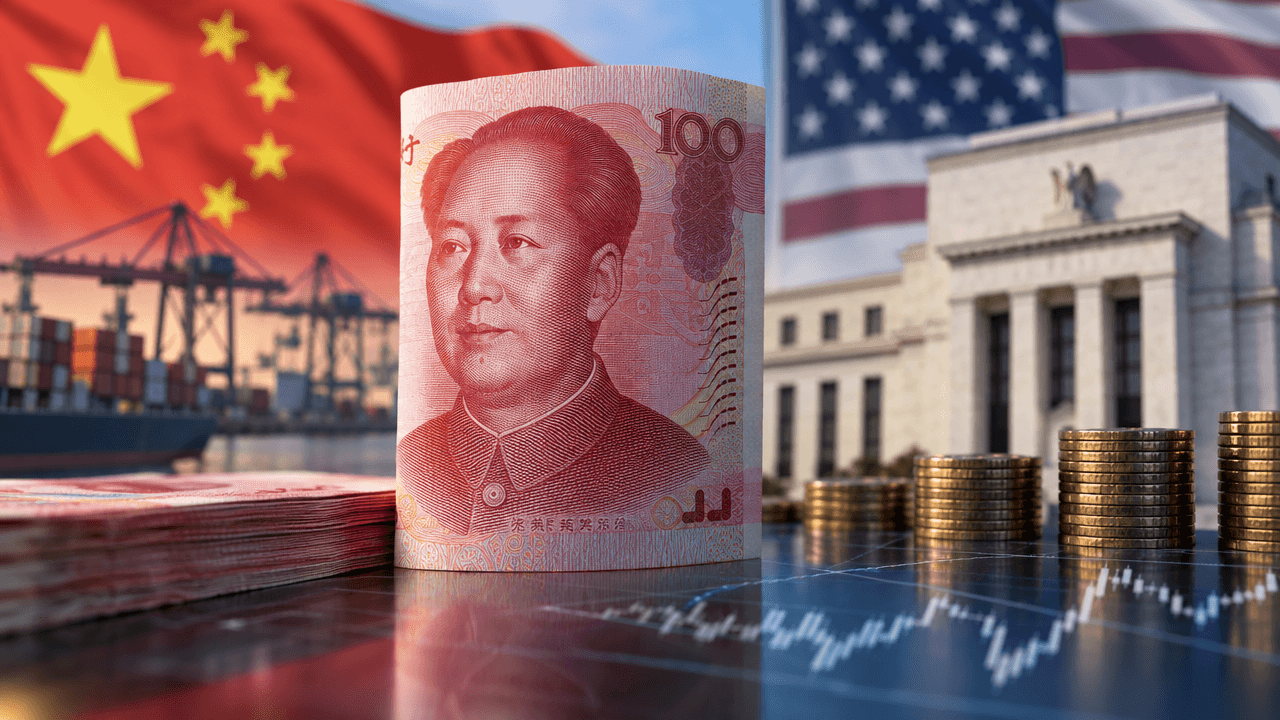
China’s yuan has strengthened to its highest level against the US dollar since January 2023, marking a notable shift in foreign-exchange markets. The onshore yuan briefly reached 6.6897 per dollar on Friday, October 16, while the currency was on track for a third consecutive weekly gain. The move has been supported by resilient Chinese exports, a firmer central-bank reference rate and changing expectations for US monetary policy. [1]
Why The Yuan Is Rising
One of the clearest drivers of the yuan’s recent performance is China’s export strength. When Chinese exporters receive foreign-currency revenue, they may convert some of those dollars into yuan to pay domestic wages, suppliers and taxes. Stronger export receipts can therefore increase demand for the Chinese currency.
That support is particularly important because China’s domestic economy remains uneven. The property sector continues to face pressure, consumer demand has been relatively subdued and investors remain cautious about the pace of the broader recovery. Resilient overseas demand has helped offset some of those concerns and provided the yuan with a more stable foundation.
The People’s Bank of China, or PBOC, has also signaled greater tolerance for a stronger currency. On Friday, the central bank set the yuan’s daily midpoint at 6.7220 per dollar, its strongest fixing since February 2023. The midpoint helps guide onshore trading and defines the currency’s daily trading range, which is generally permitted to move by 2% in either direction. [1][9]
A stronger fixing does not guarantee a one-way currency move. However, repeated firm settings can influence market expectations by showing that policymakers are not aggressively resisting yuan appreciation.
What The Exchange Rate Signals
The dollar-yuan exchange rate is quoted as the number of yuan required to buy one US dollar. When that number declines, the yuan is strengthening. For example, a move from 7.00 to 6.70 means fewer yuan are needed to purchase a dollar.
A stronger yuan can produce several economic effects. It reduces the domestic cost of imported commodities, machinery, technology and consumer products. It can also ease the burden on Chinese companies that have borrowed in dollars or need to make dollar-denominated payments.
For international investors, currency appreciation may improve returns on yuan-denominated assets when those returns are converted back into dollars or another foreign currency. It can also support confidence in China’s financial markets by reducing fears of rapid capital outflows.
There are trade-offs, however. A stronger yuan makes Chinese goods more expensive for overseas buyers when prices are converted into foreign currencies. If appreciation becomes too rapid, exporters may face pressure on profit margins. Policymakers therefore need to balance currency stability, import costs and export competitiveness.
The Gdp Test Ahead
The yuan’s next major test will come from China’s third-quarter economic data. Government figures covering gross domestic product, retail sales, industrial production and investment were scheduled for release on October 19. A Reuters survey of economists indicated that quarterly growth was expected to improve modestly, with annual growth forecast at 4.4%, compared with 4.3% in the second quarter. [4][10]
That forecast points to a complicated economic picture. A slight improvement would suggest that recent policy support is beginning to have an effect, but growth below the lower end of China’s official annual target range would still highlight the economy’s underlying challenges.
Stronger-than-expected data could reinforce demand for the yuan by encouraging investors to believe that China’s recovery is broadening beyond exports. Weak figures could have the opposite effect, particularly if they raise expectations for additional monetary easing or fiscal support.
Traders should look beyond the headline GDP number. Retail sales can offer clues about household spending, while industrial production helps measure manufacturing momentum. Fixed-asset investment and property-related data can show whether domestic demand is improving or whether the recovery remains dependent on external trade.
The Us Dollar And Global Markets
The yuan’s gains are also connected to the outlook for US monetary policy. Interest-rate expectations influence currency markets because they affect the relative attractiveness of assets denominated in dollars and other currencies.
If investors expect US rates to fall, or believe the Federal Reserve will become more accommodative, the dollar may lose some support. That can make it easier for the yuan and other currencies to appreciate. Conversely, higher US yields can attract capital into dollar assets and create headwinds for the yuan.
Rising global bond yields have complicated the picture. Despite those yields and lingering concerns about China’s domestic economy, the yuan has remained firm. That resilience suggests current demand for the currency is being supported by more than a temporary decline in the dollar.
For traders, the key is to avoid treating one exchange-rate level as a complete economic verdict. Currency markets reflect expectations, positioning, central-bank policy and cross-border trade flows simultaneously.
Practical Takeaways For Traders
First, monitor the PBOC’s daily midpoint. A sequence of stronger fixings can indicate that policymakers are comfortable with gradual appreciation, while unexpectedly weak fixings may signal concern about excessive currency strength.
Second, compare the onshore yuan with the offshore yuan. Divergence between the two markets can reveal differences in investor sentiment, liquidity and expectations about future policy.
Third, watch China’s economic data as a group rather than focusing only on GDP. A stronger headline accompanied by weak retail sales or investment could limit the yuan’s upside.
Finally, keep the US dollar in view. Federal Reserve communication, US inflation data, Treasury yields and labor-market reports can quickly alter the interest-rate outlook that drives global currency flows.
The yuan’s move to its strongest level since early 2023 is significant, but it is not yet proof of a complete transformation in China’s economic outlook. For now, export resilience and supportive PBOC signals are outweighing domestic concerns. The next phase will depend on whether economic growth, household demand and policy expectations can provide the same support that exporters have delivered.