
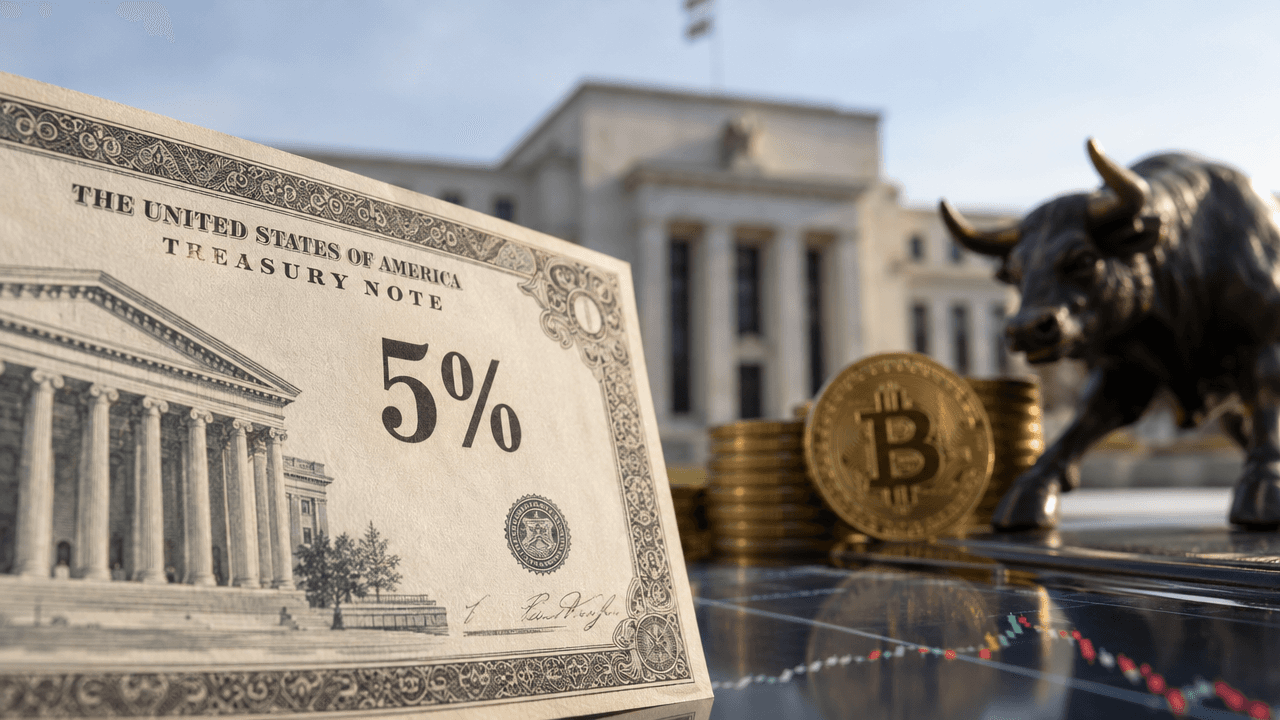
When Treasury yields stay elevated, markets are forced to reassess what risk is worth. The recent climb in the 10-year Treasury yield to roughly 5.10%, after an intraday move toward 5.30%–5.32%, has kept pressure on equity futures, long-duration assets and cryptocurrencies. The message from the bond market is clear: investors can earn a comparatively attractive return from U.S. government debt, so speculative assets must offer stronger growth potential to justify their risk.
This dynamic helps explain why volatility has persisted across stocks and digital assets. Higher yields do not automatically guarantee that equities or crypto will fall, but they raise the financial hurdle for every risk-taking decision.
Why Treasury Yields Matter
The 10-year Treasury yield acts as a reference point for borrowing costs and asset valuations throughout the financial system. It influences mortgages, corporate debt, consumer loans and the discount rates used by investors to value future earnings.
When yields rise, the present value of future cash flows declines. This is especially important for growth companies whose valuations depend on profits expected years in the future. A technology company with strong long-term potential may still be attractive, but its share price becomes more difficult to justify when investors can earn more from a lower-risk Treasury security.
Higher yields also create competition for capital. Investors who previously accepted modest returns from equities, speculative bonds or crypto may become more selective when government debt offers yields above 5%. Recent market analysis has linked elevated Treasury yields with pressure on Bitcoin and other risk assets, particularly because crypto generally does not provide a traditional cash yield. [9][15]
Equities Face A Higher Valuation Bar
The impact is not uniform across the stock market. Companies with stable earnings, strong balance sheets and reliable cash generation may withstand higher yields better than highly valued growth stocks. By contrast, businesses that rely heavily on cheap financing or distant future profits can be more sensitive to changes in interest rates.
Equity futures often react quickly when Treasury yields move sharply because futures markets continuously adjust expectations for discount rates, economic growth and Federal Reserve policy. If yields rise because inflation appears persistent, investors may expect interest rates to remain restrictive for longer. If yields rise because of increased government borrowing or concerns about fiscal sustainability, the market may demand a larger premium to hold long-term debt.
Both scenarios can increase volatility. A company may report solid earnings and still see its share price decline if investors believe the broader rate environment has become less supportive. This is why traders should separate company-specific news from macroeconomic pressure.
Crypto And Long-duration Risk
Cryptocurrency often trades as a high-beta risk asset during periods of tightening financial conditions. Bitcoin, Ethereum and smaller digital assets can be affected by changes in liquidity, leverage and institutional portfolio positioning.
When yields rise, the opportunity cost of holding a non-yielding asset increases. Investors may reduce exposure to crypto, increase cash allocations or rotate toward assets with more predictable income. Higher yields can also strengthen the U.S. dollar, creating another potential headwind for dollar-priced commodities and global risk assets.
The effect can be amplified in crypto markets. Lower liquidity, derivatives leverage and concentrated positioning may turn a modest shift in sentiment into a rapid price move. Recent reporting noted declines across Bitcoin, Ethereum and altcoins as Treasury yields rose, while analysts identified stabilizing long-term yields and renewed spot Bitcoin ETF inflows as important conditions for a sustained recovery. [9][12]
Still, the relationship is not mechanical. Crypto can rally despite high yields when adoption, liquidity or institutional demand is strong. The key issue is whether those positive forces are powerful enough to offset the pressure created by higher discount rates and reduced risk appetite.
How Traders Can Respond
First, monitor the direction and speed of yield changes rather than focusing only on the absolute level. A gradual move may be easier for markets to absorb than a sudden spike. The 10-year yield, real yields, inflation expectations and the shape of the yield curve can provide useful context.
Second, reduce reliance on a single market narrative. Strong earnings may support equities, while a weaker dollar or renewed liquidity may support crypto. Conversely, disappointing economic data can hurt stocks if it raises recession fears, even if it eventually lowers yields. Traders should evaluate which force is dominating at the time.
Third, manage exposure around volatility instead of trying to predict every turning point. Smaller position sizes, predefined exits and lower leverage can help prevent a temporary market move from becoming a major account drawdown. In a SimFi environment, traders can use these conditions to test whether their strategy actually performs under changing rates rather than only during favorable momentum periods.
A useful exercise is to create a rate-sensitivity watchlist. Track growth stocks, banks, defensive companies, Bitcoin, major altcoins and Treasury yields together. Then record how each asset responds to rising and falling yields. This builds a practical understanding of correlation, leadership and regime change.
The Bigger Market Lesson
Elevated Treasury yields are more than a bond-market statistic. They influence valuation, liquidity, portfolio allocation and risk tolerance across nearly every major asset class. With the 10-year yield recently trading near 5.10% after touching approximately 5.30%–5.32%, markets are operating in an environment where capital is more expensive and patience is being tested.
For traders, the objective is not to assume that high yields will permanently suppress stocks or crypto. It is to recognize that the market’s hurdle rate has changed. Strategies that depend on cheap money, constant liquidity or aggressive leverage may need to be adjusted.
The most resilient approach combines macro awareness with disciplined execution. Watch Treasury yields, respect volatility and evaluate each trade according to both its potential reward and the return available elsewhere. When the risk-free rate rises, good opportunities can still exist—but they must be selected with greater precision.