
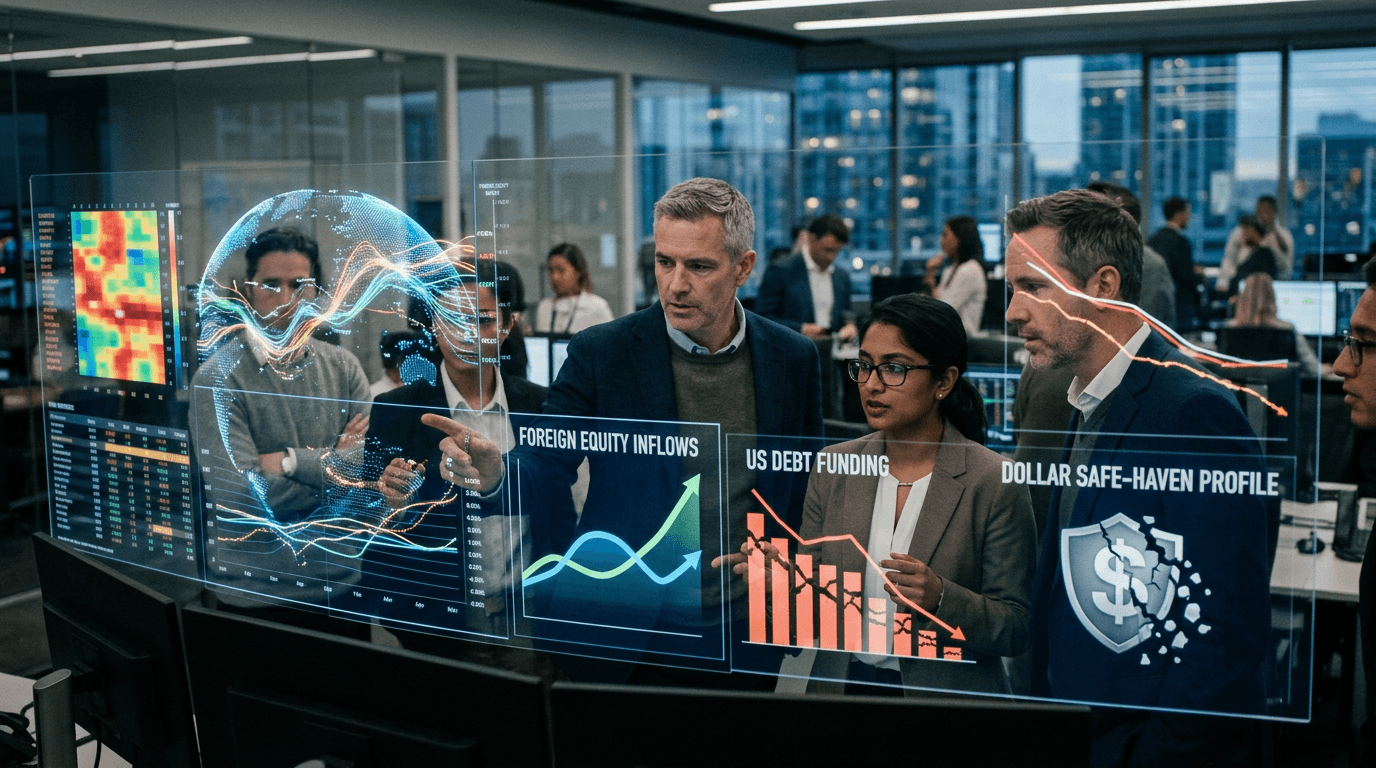
Foreign money has always been a crucial pillar of U.S. financial stability, but the way that capital enters the country is changing. Instead of primarily buying Treasuries and other debt, international investors are increasingly financing the United States by purchasing U.S. equities. This shift sounds benign in a bull market driven by themes like artificial intelligence, but it quietly alters the risk profile of the dollar and how it behaves in the next bout of market stress.[1] For traders and investors, this is not a distant macro curiosity—it is a structural evolution that can reshape correlations, hedging strategies, and portfolio risk.
The New Funding Mix
For decades, the U.S. has run persistent current account deficits, essentially importing more goods, services, and income than it exports. That gap has been financed by capital inflows from abroad, traditionally centered on foreign demand for U.S. government bonds and other debt securities. Debt inflows are typically seen as “safer” and more stable, especially when they come from official institutions such as central banks and sovereign wealth funds.
Recent evidence suggests this composition is changing. Deutsche Bank notes that the United States is now relying more on foreign purchases of U.S. stocks than on foreign purchases of debt to finance its external needs, reflecting both strong performance and global enthusiasm for U.S. equities, especially in technology and AI-related sectors.[1] At the same time, foreign demand for Treasuries has been more hesitant, influenced by geopolitical tensions and concerns about U.S. fiscal trajectories.[1][2]
Another important shift is that inflows are now driven more by private investors seeking yield and capital gains, rather than by foreign central banks accumulating reserves.[9] Private flows are more sensitive to risk appetite, performance trends, and currency expectations, making them inherently more cyclical and harder to rely on in crisis periods.
Why Equity-led Funding Is Riskier For The Dollar
The key concern is not that foreign investors like U.S. stocks—on the surface, that is a vote of confidence—but that the nature of equity flows is very different from that of bond flows. Foreign purchases of Treasuries have historically shown countercyclical behavior: in times of global stress or recession risk, safe-haven demand for U.S. debt tends to rise, supporting both Treasuries and the dollar.[1] This has given the dollar a powerful defensive characteristic.
By contrast, equity flows are more cyclical and “risk-on.” When volatility spikes, global growth expectations deteriorate, or technology valuations correct, investors often pull back from equities and rotate into cash or safer fixed income. Research from the BIS underscores that global equity flows are tightly linked to risk appetite and the strength of the U.S. dollar: a stronger dollar and higher risk aversion tend to dampen equity inflows, while a weaker dollar and calmer markets support them.[3] That means equity-based funding evaporates precisely when it is most needed.
If the U.S. external deficit is increasingly funded by these pro-cyclical equity inflows, the dollar becomes more exposed to the boom–bust cycle of global risk sentiment and the AI-driven growth narrative. Deutsche Bank’s analysts argue that this will make the dollar “more risky and more leveraged to AI,” as its support in downturns is increasingly tied to the same assets that are likely to be sold in a correction.[1][10]
How This Shifts Dollar Behaviour In Stress
Imagine a classic risk-off shock: equities sell off, volatility spikes, and global growth expectations are marked down. In the old regime, such an episode often triggered a rally in the dollar and Treasuries as global investors sought safety. Bond inflows helped to finance the U.S. external deficit even as risk assets fell, cushioning the currency.[1]
In the emerging regime, foreign investors hold more U.S. shares and relatively less U.S. debt. In a sell-off, they may reduce U.S. equity exposure, repatriate capital, or at least stop adding to positions. Evidence from recent episodes suggests that foreign buying of both U.S. stocks and bonds can stall simultaneously, with outright selling of Treasuries in some cases, prompting concerns about a “buyers’ strike” in U.S. assets.[2] That kind of behavior increases the risk that the dollar weakens during global stress instead of strengthening.
Analysts have warned that record net foreign equity inflows into U.S. markets in recent years have not delivered a stronger dollar, and that a slowdown in those flows could lead the dollar to behave more like a risk-on currency, moving in the same direction as U.S. equities rather than opposite to them.[8][10] If that pattern persists, traditional diversification assumptions—“stocks down, dollar up”—could be less reliable.
What Traders Should Watch
For traders and SimFi participants, this structural shift in funding isn’t just a macro talking point; it has practical implications for strategy design, risk management, and scenario testing.
First, monitoring the composition of capital flows matters. Official data on the U.S. balance of payments, Treasury International Capital (TIC) flows, and foreign holdings of U.S. securities can reveal whether equity inflows remain dominant or whether bond demand is recovering. Analysts have highlighted that recent inflows are increasingly private and yield-seeking rather than official and reserve-driven, which amplifies cyclical vulnerability.[9]
Second, watch the correlation between the dollar and U.S. equities. If the dollar increasingly trades as a risk-on asset—weakening when stocks fall and strengthening when they rally—that alters hedging logic for global portfolios.[8][10] For example, international investors who used to leave U.S. currency risk unhedged because the dollar tended to support them in drawdowns may now reconsider hedge ratios.
Third, track signals of foreign investor sentiment toward U.S. assets. Research examining ETF flows shows that foreign buying of U.S.-focused equity and bond ETFs can slow sharply or even reverse when valuations and policy outlooks become less attractive.[2] In a world where those flows help fund U.S. deficits, a sustained slowdown raises the risk of higher funding costs and renewed downward pressure on the dollar.
Implications For Simulated Finance Traders
In a SimFi environment, this evolving funding mix creates a rich set of scenarios to test.
Traders can model stress episodes where: - U.S. equities correct sharply. - Foreign equity inflows dry up or reverse. - Treasuries do not rally as strongly as in past crises. - The dollar weakens alongside risk assets instead of strengthening.
Such scenarios challenge conventional hedging assumptions. For example, a long-dollar position may no longer reliably offset equity risk if the currency trades more pro-cyclically. Simulated strategies could explore combinations like long volatility, selective duration exposure, or cross-currency hedges rather than simply defaulting to a long USD hedge.
Another valuable SimFi exercise is to test sensitivity to changing foreign participation. How does a strategy perform if foreign demand for U.S. assets slows over several quarters, leading to a gradual repricing of the dollar lower? Analysts have linked periods of diminished foreign inflows with simultaneous softness in the dollar, Treasuries, and U.S. equities, signaling a broader reassessment of U.S. assets.[2] Simulating that environment can reveal hidden concentration risks in strategies heavily tied to a strong-dollar regime.
Finally, SimFi traders can practice integrating flow data into their decision-making process. Building rules that react to shifts in equity versus bond inflows, or to changes in the correlation structure between the dollar, rates, and risk assets, can help prepare for a world where the dollar’s behavior is less predictable but more sensitive to capital flow dynamics.
Conclusion
The U.S. reliance on foreign equity inflows over debt inflows represents more than a technical detail in the balance of payments. It changes the way the dollar is funded, how it behaves in stress, and how sensitive it is to global risk sentiment and equity cycles.[1][3][9] As foreign capital into U.S. stocks becomes a key funding source, the dollar’s traditional safe-haven role looks less automatic and more conditional on the health of risk assets themselves.[1][2][10]
For traders and investors, especially those using SimFi platforms, the message is clear: do not assume yesterday’s dollar behavior will hold tomorrow. Incorporating flow composition, foreign investor behavior, and shifting correlations into your playbook is no longer optional—it is central to navigating a world where U.S. funding is increasingly equity-driven and the dollar’s vulnerabilities are moving to the forefront.