
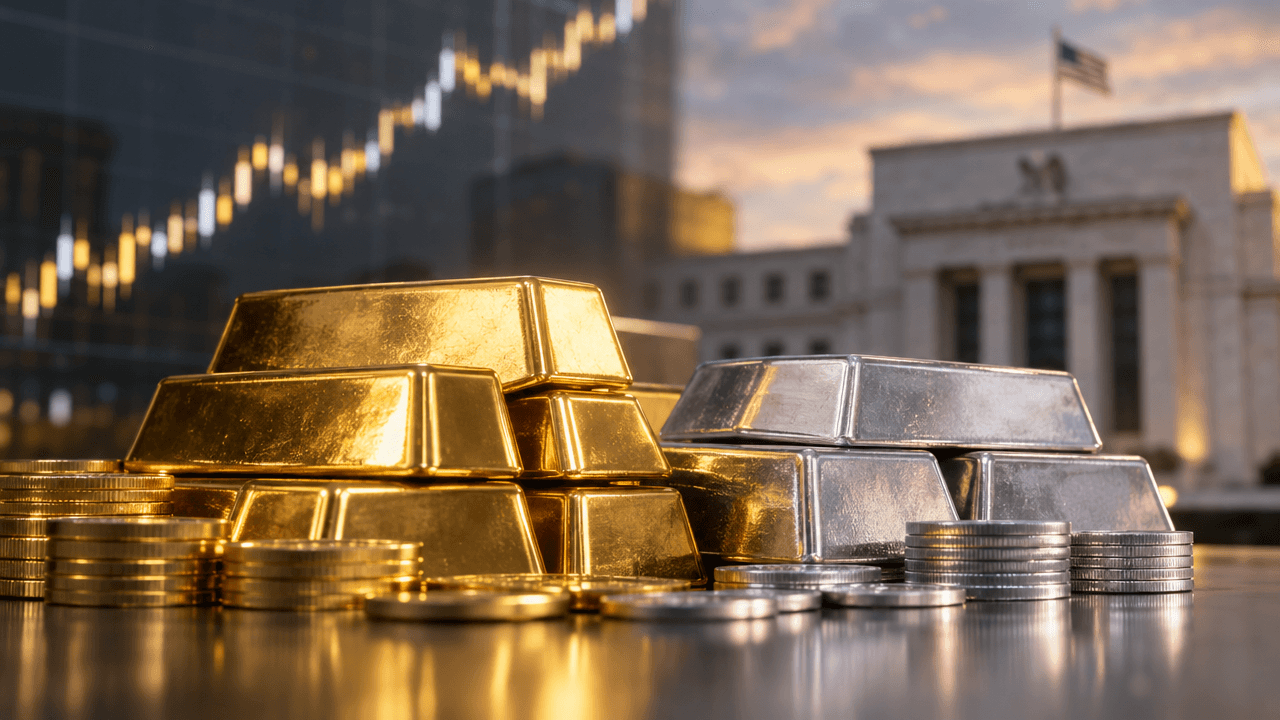
Precious metals are sending a clear message: investors are willing to pay a premium for protection when the outlook for monetary policy, currencies and geopolitics becomes harder to predict. Gold reached approximately $4,549 per ounce, while silver climbed to a record $77.40, extending a powerful rally fueled by safe-haven demand, expectations for Federal Reserve easing and a weaker U.S. dollar.
The move is significant because precious metals are not rising for just one reason. They are benefiting from several forces at once. Investors are seeking assets that can preserve purchasing power, diversify portfolios and provide a measure of protection when confidence in traditional markets becomes fragile.
Why Gold And Silver Are Rising
Gold is often viewed as a defensive asset because it does not depend on the earnings of a company, the solvency of a borrower or the policy decisions of a single government. During periods of political tension or financial uncertainty, demand for gold can increase as investors reduce exposure to riskier assets.
Expectations for lower interest rates have added to that demand. Gold does not pay interest or dividends, so its opportunity cost rises when cash and government bonds offer attractive yields. Conversely, when investors expect the Federal Reserve to ease monetary policy, falling yields can make gold more competitive.
A weaker dollar provides another tailwind. Gold and silver are generally priced in U.S. dollars, which means a decline in the currency can make them less expensive for international buyers. That can stimulate demand across global markets. Recent precious-metals gains have also reflected the relationship between bullion, Treasury yields and the dollar. When yields and the dollar weaken, non-yielding metals typically become more appealing. [6]
Silver has benefited from the same monetary and currency trends, but its market has an additional source of demand. Unlike gold, silver is widely used in industrial applications, including electronics, solar equipment, electric vehicles and other technologies. This gives silver a dual identity: it can act as a defensive asset while also responding to expectations for industrial growth.
The Safe-haven Signal
Record prices do not necessarily mean that investors expect an immediate crisis. They can indicate that market participants are paying more for insurance against a range of possible outcomes.
Those risks may include renewed geopolitical conflict, policy uncertainty, concerns about government debt, currency volatility or a sudden decline in risk appetite. In such conditions, precious metals can attract capital even when investors are not abandoning stocks and bonds entirely.
The current rally therefore reflects more than fear. It reflects a preference for flexibility. Investors may want assets that can retain value if inflation remains stubborn, interest rates fall sharply or confidence in fiat currencies weakens.
Recent market action has also demonstrated how quickly this relationship can change. Hotter inflation data, hawkish Federal Reserve commentary and a stronger dollar have previously pressured gold because higher rates increase the appeal of interest-bearing assets. [3] This sensitivity means that precious metals can remain structurally supported while still experiencing sharp pullbacks.
What The Records Mean For Traders
For traders, a record price is not automatically a buy signal. Momentum can attract new buyers, but crowded positioning can also increase the risk of volatility. A market that has moved rapidly may react aggressively to relatively small changes in interest-rate expectations, employment data, inflation or geopolitical headlines.
Gold traders should monitor real yields, the U.S. dollar index and Federal Reserve communication. If inflation declines and policymakers signal that rate cuts are approaching, gold may receive further support. If inflation stays elevated and the Fed maintains a restrictive stance, yields and the dollar could create headwinds.
Silver traders should watch both monetary indicators and industrial expectations. Silver can move more sharply than gold because its market is smaller and because investment demand interacts with manufacturing demand. That creates greater upside during strong rallies, but it can also produce deeper declines when economic expectations deteriorate.
For SimFi traders, these markets offer a useful exercise in disciplined risk management. A sensible approach may include defining an entry level, setting a maximum loss before opening a position and avoiding excessive leverage after a large move. Traders should also distinguish between a trend-following strategy and a reversal strategy. Buying strength requires confidence that momentum will continue; selling after a rally requires evidence that the underlying drivers are weakening.
Practical Takeaways For Investors
First, separate the fundamental story from the price action. Safe-haven demand, lower-rate expectations and a weaker dollar may support metals, but prices can still retreat when traders take profits.
Second, use multiple indicators rather than relying on a single headline. Watch the dollar, bond yields, inflation expectations, central-bank guidance and geopolitical developments together.
Third, treat silver as a higher-volatility instrument. Its industrial exposure can enhance returns during favorable economic conditions, but it can also make silver more vulnerable to growth concerns than gold.
Finally, size positions according to risk rather than excitement. Record highs often generate emotional decisions. A smaller position with a defined exit can be more durable than an oversized trade based on fear of missing out.
The Broader Market Message
The surge in gold and silver suggests that investors are not fully comfortable with the economic and political outlook. They are seeking assets that can perform across several scenarios, including lower interest rates, currency weakness and renewed uncertainty.
That does not guarantee that precious metals will rise in a straight line. Their next major move will likely depend on whether the Federal Reserve shifts toward easing, whether the dollar continues to weaken and whether geopolitical risks intensify or fade.
For now, the records show that defensive assets remain firmly in demand. The most important lesson for traders is not simply that gold and silver are expensive. It is that market participants are assigning increasing value to resilience, diversification and protection when the future becomes difficult to price.