
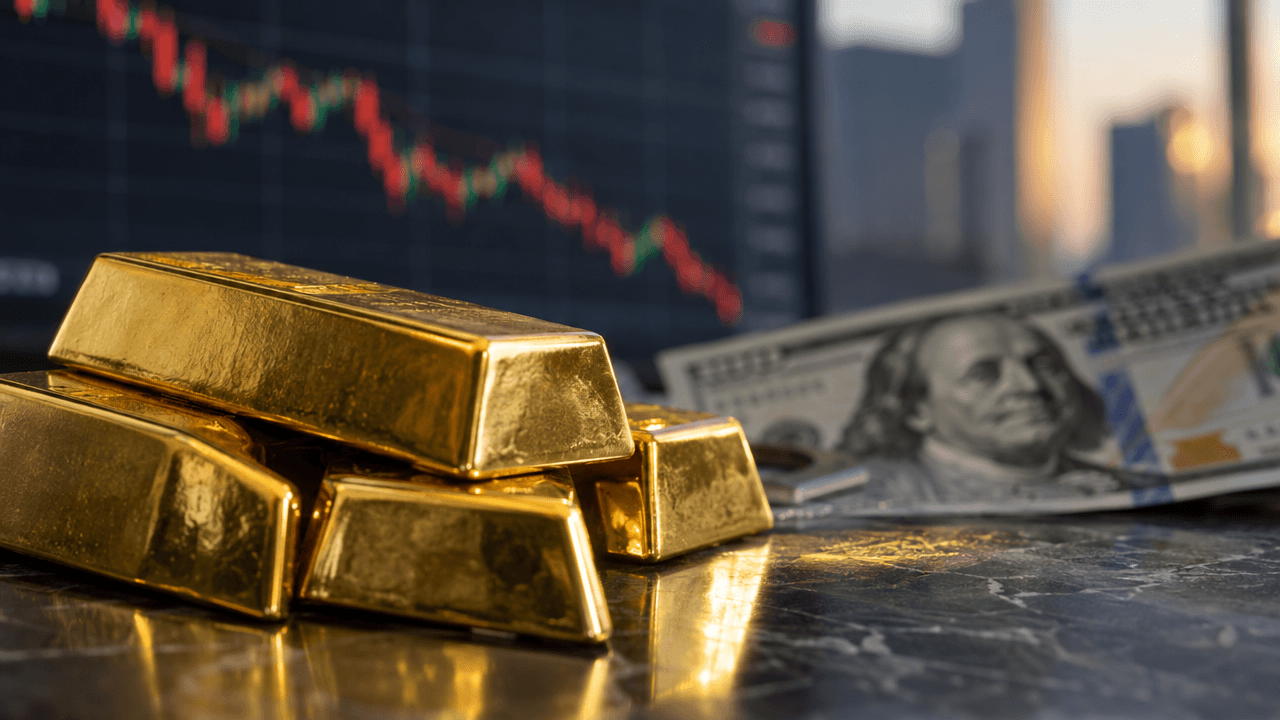
Gold weakened 0.76% to approximately $3,850.97, remaining below the psychologically important $3,900 level as a stronger U.S. dollar reduced international demand for the precious metal. The decline came despite a broader equity-market selloff, highlighting an important lesson for traders: gold does not always rise when stocks fall. Its performance depends on the interaction between safe-haven demand, interest rates, currency movements, and investor positioning.
The latest move reflects a market focused less on immediate fear and more on the opportunity cost of holding an asset that produces no interest or dividend. With traders anticipating a potentially more restrictive Federal Reserve stance, bonds and cash-like instruments have become relatively more attractive. Gold, meanwhile, faces pressure from both currency valuation and changing expectations for interest rates.
Why The Dollar Matters For Gold
Gold is generally priced in U.S. dollars. When the dollar strengthens, the metal becomes more expensive for buyers using euros, yen, pounds, and other currencies. That can reduce international demand and encourage some investors to delay purchases or reduce existing positions.
Recent market reports indicated that the dollar reached a fresh 19-month high, adding to pressure on bullion. Spot gold also remained near a more-than-one-year low as traders evaluated stronger expectations for a Federal Reserve rate increase in December. [1]
The relationship is not mechanical, but it is one of the most important short-term drivers of gold. A rising dollar often signals tighter financial conditions, stronger demand for U.S. assets, or expectations that U.S. interest rates will remain comparatively high. Each of those factors can weigh on dollar-denominated commodities.
For traders, the practical takeaway is to avoid analyzing XAU/USD in isolation. A bullish gold setup becomes less convincing when the dollar index is breaking higher, U.S. yields are rising, and markets are pricing additional monetary tightening.
The Opportunity Cost Of Non-yielding Gold
Gold can serve as a store of value, an inflation hedge, and a portfolio diversifier, but it does not pay interest. That characteristic becomes more significant when government bond yields rise.
If investors can earn a higher return from Treasury securities with relatively low perceived credit risk, holding gold requires a stronger reason. Investors may still buy bullion for protection against inflation, geopolitical instability, or currency debasement, but the hurdle for doing so becomes higher when real and nominal yields are attractive.
Market coverage of the latest decline pointed to elevated Treasury yields and expectations of tighter Federal Reserve policy as major sources of pressure. Higher rates increase the opportunity cost of holding bullion because capital allocated to gold cannot simultaneously earn interest in cash or bonds. [2]
This explains why gold can fall even during a stock-market selloff. If investors are raising cash, covering losses, or moving toward the dollar and short-term government securities, gold may not receive the usual defensive inflows. Safe-haven demand is therefore conditional, not guaranteed.
Equity Volatility Does Not Guarantee A Gold Rally
The broader equity-market decline created a complicated environment for precious metals. A technology-led selloff can initially support gold as investors seek protection, but it can also produce forced selling. Traders facing losses in stocks may liquidate profitable gold positions to raise cash or meet margin requirements.
Recent analysis noted that the technology-stock selloff encouraged some investors to reduce gold exposure to cover losses elsewhere in their portfolios. [9] This dynamic is particularly relevant when market volatility rises quickly and liquidity becomes more important than diversification.
Gold’s response to a risk-off event depends on the source of the shock. A geopolitical crisis that undermines confidence in currencies or governments may be strongly bullish for gold. A repricing of interest rates, however, can be bearish if it boosts the dollar and bond yields. Understanding that distinction helps traders avoid the simplistic assumption that “stocks down equals gold up.”
Key Levels And Market Signals To Watch
With gold trading below $3,900 and near $3,850, traders should monitor whether the market can reclaim former support levels or continues to establish lower lows. A sustained move above $3,900 could indicate that selling pressure is easing, particularly if it occurs alongside a weaker dollar or falling Treasury yields.
On the other hand, continued trading below that area would suggest that sellers remain in control. The previous session saw spot gold fall to about $3,830.74, its lowest level since October 2025, according to Reuters-reported market data. [14] That low is an important reference point for risk management and momentum analysis.
Traders should also follow Federal Reserve communications, inflation data, Treasury yields, and the dollar index. A less hawkish policy outlook could reduce yields and weaken the dollar, creating room for gold to recover. Conversely, stronger economic data or persistent inflation that keeps rate-hike expectations alive could extend the pressure.
For SimFi traders, the lesson is to build scenarios rather than predict a single outcome. A bearish scenario might include a stronger dollar, rising yields, and a decisive break below recent support. A recovery scenario could involve softer economic data, reduced rate expectations, and a dollar reversal. Each scenario should include an entry plan, invalidation level, position size, and maximum acceptable loss.
Practical Takeaways For Traders
First, track the dollar index and Treasury yields alongside gold. These markets often explain gold’s direction more clearly than headlines alone.
Second, distinguish between temporary volatility and a genuine trend change. A single rebound does not invalidate a bearish structure, while one sharp decline does not prove that a long-term bull market has ended.
Third, avoid excessive leverage during major central bank and economic-data events. Gold can move rapidly when interest-rate expectations change.
Finally, treat the $3,900 area as a useful psychological reference, not an automatic buy or sell signal. Price action, momentum, and macroeconomic confirmation should guide decisions.
Conclusion
Gold’s decline to around $3,850.97 demonstrates how a stronger dollar and higher expected returns elsewhere can overpower traditional safe-haven demand. The broader equity selloff did not automatically support bullion because investors were also responding to tighter monetary-policy expectations, elevated yields, and the need for liquidity.
For traders, the central message is clear: gold is influenced by fear, but it is also governed by opportunity cost. Monitoring the dollar, interest rates, Federal Reserve expectations, and price structure can provide a more complete view of the market. In a SimFi environment, applying that framework with disciplined risk limits allows traders to study both bearish continuation and potential recovery without relying on headlines alone.