
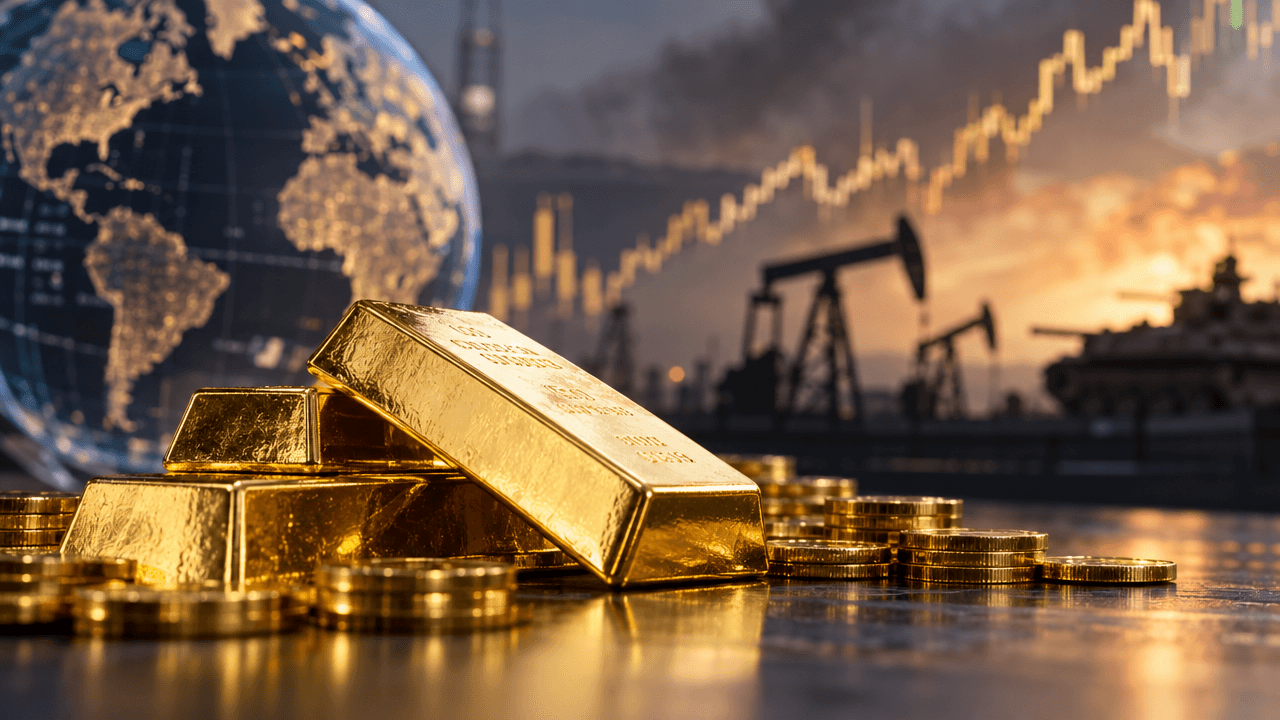
Gold rose about 1.23% to approximately $4,196 an ounce, showing that demand for defensive assets remains strong even as the US dollar strengthens. The move is notable because a firmer dollar usually makes gold more expensive for international buyers and can weigh on prices. Instead, investors appear willing to pay for protection against an uncertain mix of geopolitical risk, elevated oil prices, restrictive monetary policy and volatile borrowing costs.
The latest advance reflects a market balancing two competing forces. On one side, high real yields and a strong dollar raise the opportunity cost of holding bullion, which does not generate interest or dividends. On the other, gold offers a form of portfolio insurance when investors are concerned about war, inflation, government debt or a sudden deterioration in economic conditions. Recent market commentary has highlighted the pressure created by Treasury yields near multi-year highs and real yields around 3%, making gold’s resilience particularly significant. [3][8]
Safe-haven Demand Remains A Key Driver
Gold has traditionally attracted buyers during periods of political and financial uncertainty. Unlike a company share or a government bond, bullion does not depend on a single issuer’s ability to generate profits or repay debt. That characteristic makes it useful as a diversification tool when confidence in markets weakens.
Current geopolitical tensions have added to that demand. Concerns surrounding conflict, commercial shipping routes and energy supplies have helped keep investors focused on the risk of further disruption. A rise in oil prices can also revive inflation fears, creating an uncomfortable environment for households, businesses and central banks.
This relationship is not always straightforward. Higher oil prices can increase demand for gold as an inflation hedge, but they can also make central banks more cautious about cutting interest rates. If policymakers maintain restrictive rates for longer, gold may face renewed pressure from higher bond yields. Market reports have identified this tension as one reason gold’s recent price action has been volatile rather than steadily bullish. [7]
Why Gold Can Rise Alongside The Dollar
The dollar and gold often move in opposite directions, but the relationship is not absolute. Currency movements are only one part of the pricing equation. When investors are especially concerned about geopolitical shocks or financial instability, they may buy both US dollars and gold because each serves a different defensive purpose.
The dollar provides liquidity and is central to global trade and financial markets. Gold, meanwhile, provides diversification and protection from risks tied to currencies, debt markets and central-bank policy. As a result, strong demand for both assets can occur when investors are reducing exposure to riskier positions.
Gold’s latest gain suggests that safe-haven buying has been strong enough to offset the normal headwind from a firmer dollar. It also indicates that traders may be looking beyond the next few days of interest-rate expectations and considering longer-term risks, including persistent inflation, rising public debt and the possibility of further geopolitical escalation.
Real Rates And Central-bank Policy Still Matter
Interest rates remain one of the most important variables for gold. When inflation-adjusted yields rise, investors can earn a larger real return from bonds and other interest-bearing assets. That increases the opportunity cost of holding bullion. Conversely, falling real yields generally make non-yielding gold more attractive.
Recent reports describe elevated real borrowing costs as a significant obstacle for gold, with high Treasury yields giving investors an alternative defensive asset that also provides income. [3] This means gold’s rally will need to withstand continued scrutiny of Federal Reserve policy, inflation data, employment figures and bond-market conditions.
A shift toward lower rates could provide a powerful tailwind. If economic data weakens or inflation shows sustained signs of cooling, expectations for future rate cuts could push yields lower and encourage additional gold purchases. However, stronger-than-expected inflation or renewed oil shocks could produce the opposite result by keeping monetary policy restrictive.
What Traders Should Watch Next
Traders should monitor several connected indicators rather than treating the gold price in isolation. The US dollar index can reveal whether currency strength is becoming a larger obstacle. Treasury yields, particularly inflation-adjusted yields, can show whether the opportunity cost of holding bullion is increasing or declining.
Oil prices also deserve close attention. A sustained rise in crude could reinforce inflation concerns and delay rate cuts, while a decline could ease pressure on consumers, central banks and bond markets. At the same time, geopolitical headlines may trigger rapid price swings even when the underlying economic data has not changed.
From a trading perspective, the recent move toward $4,196 should be viewed as evidence of strong demand, not as a guarantee of a one-way rally. Traders can use support and resistance levels, position sizing and predefined risk limits to manage volatility. Chasing a sharp move without a clear exit plan can be especially dangerous in markets influenced by breaking news.
The Bigger Picture
Gold’s advance shows why defensive assets can remain relevant even in an environment that appears unfavorable for bullion. High real yields and a stronger dollar are creating headwinds, yet geopolitical uncertainty and concerns about inflation continue to attract buyers.
The central question is whether safe-haven demand will persist strongly enough to overcome pressure from interest rates. For now, the answer appears to be yes. Investors are using gold not only as a reaction to immediate headlines, but also as a hedge against a wider range of uncertain outcomes.
For market participants, the practical lesson is to track the interaction between rates, currencies, energy prices and geopolitical risk. Gold’s next major move will likely depend less on any single headline than on which of these forces becomes dominant.