
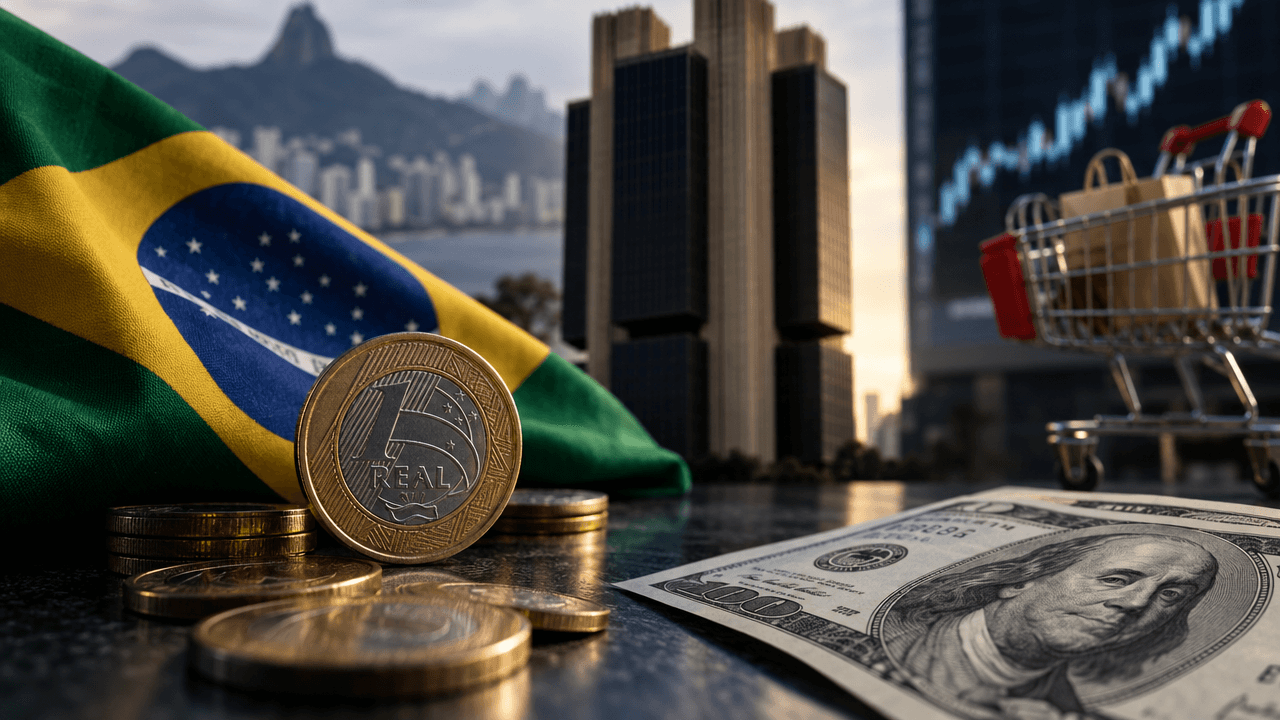
The Brazilian real is facing a familiar emerging-market dilemma: domestic interest rates remain extremely high, yet global capital is being pulled toward the United States. Brazil’s central bank has kept the Selic rate at 13.75%, a level that would normally provide significant support for the currency. However, US Treasury yields above 5% and a stronger dollar are reducing the appeal of Brazilian assets and limiting the real’s ability to recover.
The pressure highlights an important lesson for traders: a currency does not respond only to its own central-bank rate. Relative returns, perceived risk, economic momentum, and global liquidity all matter. Even with one of the highest policy rates among major economies, Brazil may struggle to attract capital when US assets offer higher yields with less perceived risk.
The Global Yield Challenge
The US 10-year Treasury yield recently reached approximately 5.145%, rising sharply over a five-session period. At the same time, the dollar advanced to a 12-month high against the real, trading near R$5.64. These moves have created a difficult environment for emerging-market currencies. [3]
When US yields rise, investors can earn more from dollar-denominated government securities. Those assets are generally viewed as highly liquid and relatively safe, particularly during periods of uncertainty. As a result, some investors reduce exposure to currencies such as the real and move funds into US dollars and Treasuries.
This capital shift can occur even when Brazil offers a much higher nominal interest rate. Investors must consider not only the yield they receive, but also the potential currency loss. If the real weakens by more than the additional interest earned in Brazil, the trade may no longer be attractive.
The stronger dollar can also increase Brazil’s imported inflation. Energy, machinery, technology, and other products priced in dollars become more expensive in local-currency terms. That creates an additional challenge for policymakers because a weaker real may make it harder to reduce interest rates without reigniting price pressures.
Why The Selic Is Not Enough
Brazil’s central bank held the Selic at 13.75% on November 4, ending five consecutive rate cuts. The decision preserved a wide interest-rate differential with the United States and offered some support to the real. However, that support is being offset by the strength of the dollar and the rise in US yields. [9]
A high Selic rate affects the currency through the carry trade. In a basic carry strategy, an investor borrows or holds funds in a lower-yielding currency and invests in a higher-yielding one. Brazil’s elevated rates can attract this capital, but the strategy becomes less appealing when currency volatility increases.
For example, an investor may earn attractive interest in Brazilian assets but suffer a significant loss if the real declines against the dollar. The larger the expected currency move, the higher the Brazilian yield must be to compensate investors for taking that risk.
The central bank therefore faces a delicate balancing act. Cutting rates could support economic activity but reduce the real’s yield advantage. Keeping rates high could help contain inflation and defend the currency, but it may weaken borrowing, investment, and household spending.
Domestic Data Complicates The Outlook
Brazil’s recent retail-sales figures make the policy decision more difficult. Retail sales increased 1.7% year over year in September, compared with expectations for a 1.0% rise. On a monthly basis, sales gained 0.2%, while economists had anticipated a 0.2% decline. [1]
The data suggests that Brazilian consumers remain more resilient than expected despite restrictive monetary policy. Stronger consumption can support economic growth, corporate revenues, and tax receipts. It may also reduce the urgency for immediate rate cuts.
However, stronger retail activity can have two different implications. If consumer demand is expanding without creating excessive inflation, it may point to a healthier economy. If demand is running ahead of supply, it could contribute to persistent price pressures and encourage the central bank to keep rates elevated for longer.
Markets are likely to interpret the data alongside inflation, fiscal developments, employment figures, and exchange-rate movements. A single retail-sales report will not determine the entire rate path, but it reinforces the argument for caution.
What Traders Should Watch
The most important indicator for the real may remain the US-Brazil interest-rate relationship rather than Brazil’s Selic rate in isolation. Traders should monitor the US 10-year yield, Federal Reserve expectations, and the dollar index. Stronger-than-expected US inflation or employment data could push US yields even higher and intensify pressure on the real. Higher US yields generally draw capital toward dollar assets and put pressure on emerging-market currencies. [4]
Brazil-specific risks also deserve close attention. Fiscal concerns, political uncertainty, inflation expectations, and commodity prices can all influence foreign investment flows. Oil and agricultural prices are particularly relevant because Brazil is a major commodity exporter, while imported energy costs can affect domestic inflation.
For SimFi traders, the real provides a useful case study in macroeconomic correlation. A bullish view on Brazilian interest rates does not automatically translate into a bullish view on USD/BRL. The currency pair must be analyzed through both sides of the market: Brazilian monetary policy and the global dollar environment.
Risk management is essential. Traders can define invalidation levels before entering a position, reduce exposure around US data releases, and avoid assuming that a high carry will protect against a rapid currency move.
Conclusion
The Brazilian real is under pressure because Brazil’s high interest rates are competing with an increasingly attractive US yield environment. The Selic at 13.75% remains a powerful source of support, but it cannot fully offset a stronger dollar, Treasury yields above 5%, and elevated global risk aversion.
Stronger retail sales add another layer of complexity by suggesting that domestic demand remains resilient. That may delay rate cuts, but it does not eliminate the external forces weighing on the currency.
For traders, the key takeaway is clear: currency strength depends on relative returns and confidence, not simply on the highest available interest rate. Until US yields stabilize or decline, the real may remain vulnerable even while Brazil maintains a highly restrictive monetary policy.