
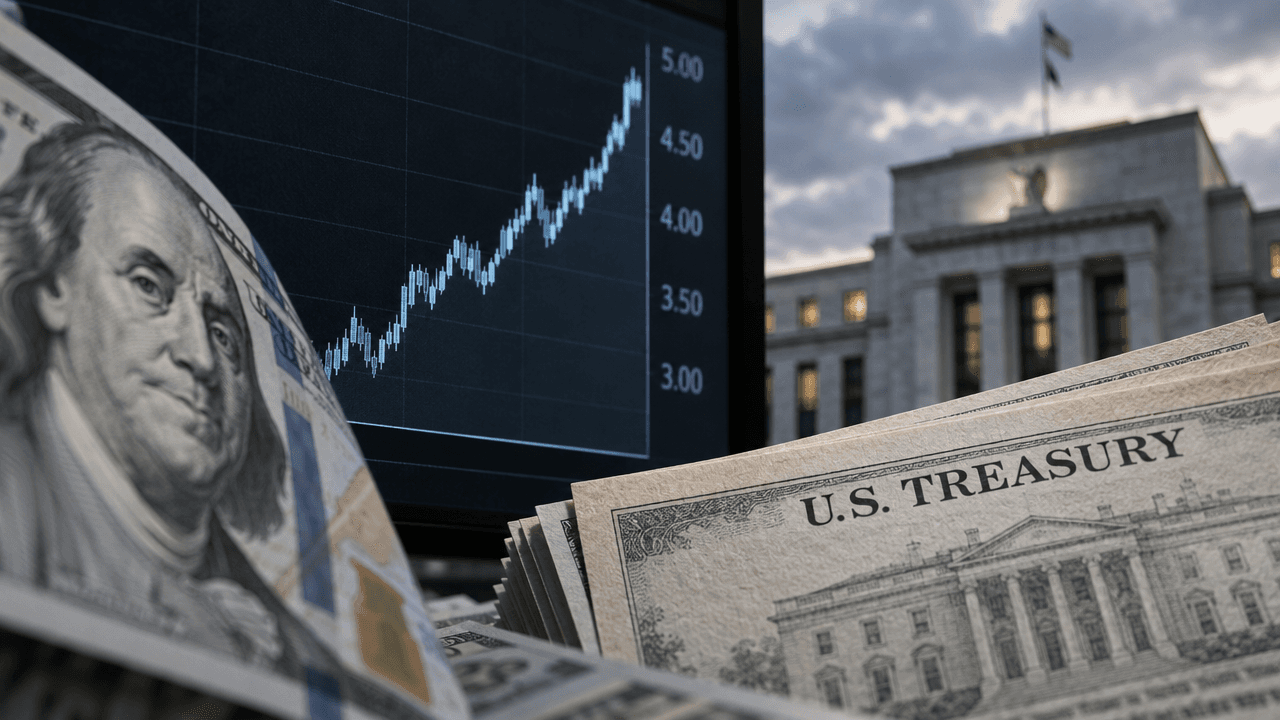
Rising Treasury yields are becoming a significant headwind for U.S. futures as investors reassess the path of interest rates, inflation, and economic growth. The 10-year Treasury yield recently climbed above 5%, reaching its highest level since January 2025, while the 30-year yield moved to levels not seen since 2007. [11][2]
The move is reshaping expectations across financial markets. Traders are increasingly pricing a Federal Reserve rate hike later in 2026, with markets assigning a near-certainty to a December increase and an elevated probability of a 25-basis-point move. [2] That combination of higher borrowing costs and tighter monetary-policy expectations is pressuring equity-index futures while providing support for the U.S. dollar.
Why Higher Yields Pressure Equities
Treasury yields influence the value investors place on future corporate earnings. When the risk-free rate rises, future profits are discounted at a higher rate, reducing their present value. This relationship is particularly important for growth and technology companies, whose valuations often depend on earnings expected several years in the future.
For example, a technology company valued on the assumption of strong earnings growth may appear attractive when Treasury yields are low. As yields rise, however, investors may demand a lower price for the same expected cash flows. This can create heavier selling pressure in growth-oriented indexes such as the Nasdaq 100.
Higher yields can also make government bonds more competitive with stocks. If investors can earn a higher return from relatively low-risk Treasury securities, they may require greater potential returns before committing capital to equities. That shift can reduce demand for stock-index futures and increase volatility during overnight and premarket trading.
The Federal Reserve Expectation Shift
The latest market reaction is not driven only by the level of Treasury yields. It also reflects a change in expectations about what the Federal Reserve may do next.
Markets are now pricing a possible policy-rate increase later in 2026. Recent reporting indicated that traders saw a 100% probability of a December hike, with most of that probability assigned to a quarter-point move and a smaller portion assigned to a half-point increase. [4][10]
Rate-hike expectations can rise when investors believe inflation will remain persistent, economic activity will stay stronger than expected, or energy prices will keep costs elevated. The October producer-price data was slightly softer than forecasts, but it did not prevent yields from moving higher. [2]
For futures traders, this creates a difficult environment. A stronger economy can support corporate revenues, but persistent inflation may force the Fed to keep policy restrictive. The market must therefore balance positive growth expectations against the possibility of higher rates for longer.
Why The 30-year Yield Matters
The 10-year Treasury yield is widely watched because it serves as a benchmark for mortgages, auto loans, corporate borrowing, and many asset-pricing models. [2] The 30-year yield provides an additional warning signal because it reflects longer-term expectations for inflation, government borrowing, economic growth, and bond-market risk.
A rising long-term yield can indicate that investors want greater compensation for holding debt over extended periods. It may also reflect concerns about the supply of Treasury securities and the government’s future financing needs. Recent Treasury market commentary pointed to stronger economic activity and increased financing requirements as factors behind a higher expected interest-rate path. [1]
When the 30-year yield reaches its highest level in nearly two decades, the effect extends beyond daily stock-market sentiment. Higher long-term rates can raise housing costs, increase corporate financing expenses, and reduce the amount of capital available for riskier investments.
The Dollar And Market Rotation
Higher U.S. yields can support the dollar by making dollar-denominated assets more attractive to global investors. If U.S. interest rates are expected to rise relative to rates in other major economies, demand for the dollar may increase.
A stronger dollar can produce mixed results for U.S. companies. Importers may benefit from lower costs for foreign goods and materials, but multinational corporations may face pressure when overseas revenue is converted back into dollars. Exporters can also become less competitive when their products become more expensive for international buyers.
This creates another potential headwind for U.S. equity futures. Companies with substantial international exposure may see earnings estimates revised lower if currency strength persists. At the same time, sectors such as financials may respond differently, depending on how higher yields affect lending margins, credit demand, and bond portfolios.
Practical Takeaways For Simfi Traders
Simulated-finance traders should treat rising yields as a cross-market signal rather than focusing only on the S&P 500 or Nasdaq futures. Monitor the 10-year Treasury yield, the 30-year yield, the dollar index, and Fed-funds futures together.
A practical approach is to identify whether yields are rising because of stronger growth or renewed inflation concerns. Growth-driven increases may support cyclical stocks, while inflation-driven increases can place broader pressure on equity valuations. The reaction in technology, small-cap, financial, and defensive sectors may differ significantly.
Risk management is especially important when bond yields are moving rapidly. Reduce position size when volatility expands, avoid assuming that an early futures move will persist through the cash session, and define exit levels before entering a trade. Economic data, Federal Reserve commentary, and Treasury auctions can all produce sudden reversals.
Conclusion
Rising Treasury yields are creating a challenging backdrop for U.S. futures by increasing discount rates, strengthening the dollar, and reviving expectations for additional Federal Reserve tightening. The immediate market bias may remain cautious, but the broader signal is more nuanced: yields are also reflecting expectations for economic activity, inflation, and government financing.
For traders, the key is to follow the relationship between bonds, equities, and the dollar. Understanding why yields are moving can provide a more reliable framework than reacting to index-price changes alone. In an environment where interest-rate expectations can shift quickly, disciplined risk management and cross-market analysis remain essential.