
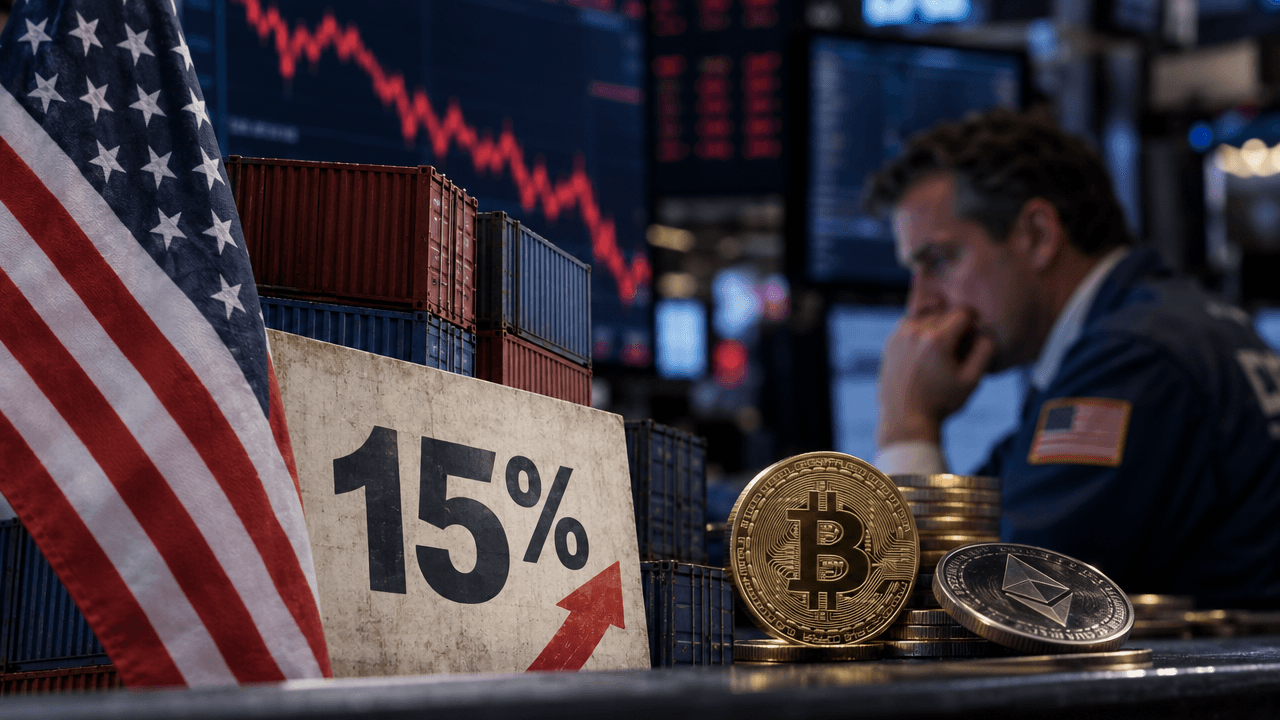
U.S. stock futures are entering the trading session on unstable footing as tariff uncertainty once again challenges investor confidence. S&P 500, Dow Jones, and Nasdaq futures came under pressure after the White House announced a proposed 15% duty, reviving questions about the durability of global trade and the potential cost to American companies and consumers. [1]
The immediate market reaction reflects more than concern about one policy rate. Investors are attempting to assess whether the new tariff is temporary, negotiable, or the beginning of a broader escalation. That uncertainty makes it difficult to price stocks, bonds, currencies, and commodities with confidence. For traders, the central issue is not simply whether tariffs are imposed, but how quickly businesses and markets can adapt.
Why Tariff Uncertainty Matters
Tariffs function like a tax on imported goods. Companies that rely on foreign components may face higher production costs, while retailers can encounter more expensive inventory. Businesses then have several choices: absorb the cost, reduce margins, raise prices, or shift supply chains.
Each option can affect stock valuations. Lower profit margins may hurt earnings forecasts. Higher prices can weaken consumer demand and complicate the Federal Reserve’s efforts to control inflation. Supply-chain changes may require significant capital spending and take months or years to complete.
The latest uncertainty is particularly disruptive because the proposed 15% duty followed a Supreme Court ruling that struck down broad tariffs imposed under an emergency law. The administration then moved toward a temporary global levy under a different legal authority, creating uncertainty about implementation, duration, and possible future challenges. [3]
Markets generally respond better to a known cost than an unknown one. A company may be able to model the effect of a confirmed tariff and adjust its guidance. It is much harder to plan when the rate, effective date, exemptions, and potential retaliation remain unclear.
Sector Pressure May Not Be Evenly Distributed
A tariff announcement does not affect every stock in the same way. Import-heavy industries such as consumer goods, automobiles, retailers, and manufacturers may be especially sensitive to higher input costs. Companies with diversified suppliers, strong pricing power, or large domestic production bases may be better positioned.
Technology stocks can also be vulnerable, even when their products are not directly targeted. Many technology companies depend on international manufacturing networks, specialized components, and cross-border sales. In addition, high-growth shares are often valued on expectations of future earnings. When policy uncertainty pushes investors toward caution, those long-duration assets can experience outsized swings.
Small-cap companies may face a different challenge. They often have less negotiating power with suppliers and fewer financial resources to absorb sudden cost increases. At the same time, domestically focused businesses could eventually benefit if tariffs encourage production within the United States, although that transition would likely be gradual rather than immediate.
Investors should therefore avoid treating the market as a single trade. Tariff exposure varies by company, and a broad index decline can conceal meaningful differences among industries and individual businesses.
Crypto-linked Stocks Add Another Risk Signal
Crypto-linked equities weakened as Bitcoin fell roughly 2% in the cited session. Coinbase and Strategy, two prominent publicly traded companies associated with the digital-asset market, also declined more than 1%. [1]
The move illustrates how tariff headlines can spread beyond traditional equity sectors. Bitcoin and crypto-related stocks are often treated as risk-sensitive assets. When investors reduce exposure to equities, growth shares, and other volatile positions, digital assets can face simultaneous selling pressure.
Crypto-linked companies may also experience greater volatility than Bitcoin itself. Their prices can reflect cryptocurrency movements, trading activity, financing conditions, balance-sheet decisions, and investor sentiment. A modest move in Bitcoin can therefore produce a larger move in an associated stock.
For traders, this relationship is useful as a sentiment indicator, but it should not be interpreted as a guaranteed signal. Bitcoin can respond to liquidity, regulation, institutional flows, and technical factors that are unrelated to tariffs. The key takeaway is that risk aversion may be affecting multiple markets at the same time.
What Traders Should Watch Next
The most important developments will be the tariff’s effective date, its final rate, country-specific exemptions, and the legal basis supporting it. Investors should also monitor responses from major trading partners. Retaliatory measures could broaden the economic impact and place additional pressure on multinational companies.
Corporate guidance will provide another important test. Earnings reports and management commentary may reveal whether businesses are absorbing higher costs, passing them to customers, or delaying investment. Analysts may revise profit forecasts if the policy appears likely to persist.
Economic data will matter as well. If tariffs contribute to higher inflation while slowing growth, markets could face a difficult combination sometimes described as stagflationary pressure. That scenario may complicate expectations for interest-rate cuts and increase volatility across stocks and bonds.
From a trading perspective, position sizing and risk management become especially important. Futures prices can move sharply before the opening bell, but overnight reactions are not always reliable indicators of the full session. Traders may consider waiting for confirmation from cash-market volume, sector breadth, and price action after the open rather than reacting to the first headline.
Practical Takeaways
First, separate confirmed policy from political proposals. A proposed tariff can influence markets immediately, but its final economic effect depends on implementation.
Second, review company-level exposure. Examine supply chains, geographic revenue, pricing power, and management commentary instead of assuming every stock will react alike.
Third, prepare for volatility across asset classes. Stocks, crypto, currencies, and bonds can respond together when investors rapidly reduce risk.
Finally, avoid making oversized decisions based on a single futures move. Tariff uncertainty can generate fast reversals as new exemptions, negotiations, or legal developments emerge.
Conclusion
U.S. stock futures are vulnerable because tariffs affect both economic fundamentals and investor psychology. The proposed 15% duty has revived concerns about costs, inflation, corporate earnings, and retaliation, while Bitcoin’s decline shows that risk aversion is reaching crypto-linked assets as well. [1]
The market’s next direction will depend less on the headline alone than on what follows: whether the tariff is temporary, how trading partners respond, and whether companies can protect profits. For SimFi traders and market participants, the best response is disciplined preparation—track the policy details, understand sector exposure, manage leverage, and let confirmed information guide decisions.