
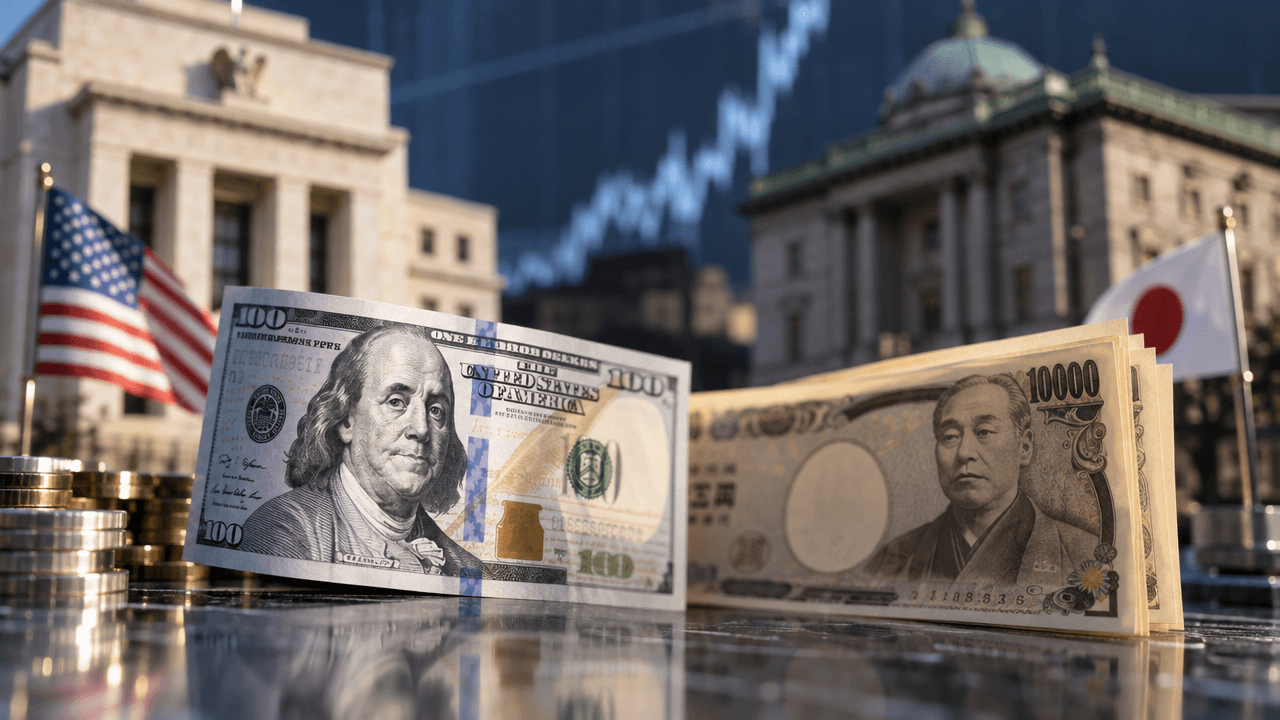
The dollar’s rise to around ¥158.01 highlights how interest-rate expectations can outweigh the usual day-to-day forces in foreign exchange. With the euro near $1.1225, investors are watching the gap between U.S. and Japanese monetary policy, as well as elevated U.S. Treasury yields, for clues about where the yen-dollar exchange rate may go next.
A move in USD/JPY is more than a currency-market headline. It affects the cost of imported goods in Japan, the value of overseas earnings for Japanese companies, and the returns traders may see when positions move with or against the exchange rate. Understanding the drivers—and the risks—can help traders interpret the price action without treating one level as a forecast.
Why Treasury Yields Matter
Treasury yields reflect the return investors demand for holding U.S. government debt. When those yields remain high relative to yields in Japan, dollar-denominated assets may look more attractive to investors seeking income. That can increase demand for dollars and put pressure on the yen.
The relationship is not mechanical. A higher yield does not guarantee a stronger dollar: investors also weigh inflation, economic growth, fiscal risks and expected changes in central-bank policy. But when yield differentials widen, the exchange rate can respond as capital flows and expectations adjust.
Recent reporting has linked firm U.S. yields to dollar support, while also noting that movements in longer-term yields can differ from those in shorter-term yields. That distinction matters. Traders who focus only on the headline ten-year yield may miss shifts in expectations for near-term Federal Reserve decisions. [12][14]
The Policy Gap Behind The Move
Currency markets look ahead. The dollar-yen pair can move not only when the Federal Reserve or Bank of Japan changes rates, but also when traders revise their expectations about what either central bank will do next.
If investors expect U.S. rates to stay higher for longer while Japanese rates rise only gradually, the yield advantage may continue to favor the dollar. If expectations shift toward easier U.S. policy or a faster pace of Bank of Japan tightening, that advantage could narrow. Either change may move USD/JPY before a central bank actually adjusts its policy rate.
Recent market coverage has described uncertainty around the next steps for both central banks. The BOJ’s September rate increase and subsequent policy signals have been part of the yen’s outlook, while U.S. inflation and yield developments have shaped views of Federal Reserve policy. [1][10]
For traders, the practical lesson is to distinguish between a policy decision and a change in expectations. A rate announcement may be widely anticipated and have little effect if it matches market pricing. A subtle shift in policymakers’ language, by contrast, can change expectations and move currencies quickly.
WHY ¥158 IS A RISK ZONE, NOT A GUARANTEE
The yen’s weakness has renewed attention to the possibility of official intervention. Japan and the United States recently conducted a coordinated yen-buying operation, and reporting has described Japanese authorities’ concern about the currency’s valuation. [1][2] That history makes the approach toward ¥158 notable, but it does not mean intervention will happen at any particular exchange rate.
Authorities may be more sensitive to the speed and disorderliness of a move than to a single quoted level. Intervention risk can influence traders even when no action occurs: some may reduce long-dollar positions, while others may demand more room for potential volatility.
This creates two-sided risk. A gradual rise in USD/JPY may continue if yield and policy expectations support the dollar. But a sharp reversal is also possible if officials act, central-bank expectations change, or investors unwind crowded positions. A price level should therefore be treated as a point for monitoring—not as a reliable ceiling or floor.
What Traders Can Watch
First, track Treasury yields across maturities rather than relying on one number. The short end can reflect expectations for near-term Fed policy, while longer maturities also respond to inflation, government borrowing and the compensation investors require for holding long-term debt.
Second, compare market expectations with central-bank communications and incoming data. Inflation and employment releases can reshape the expected path of interest rates. The key question is not simply whether a report is “strong” or “weak,” but whether it changes what investors think policymakers will do.
Third, keep an eye on official comments and the pace of the exchange-rate move. A rapid yen decline may attract more attention than a similar-sized change spread over a longer period. For traders using leverage, that uncertainty makes position sizing, stop placement and awareness of event risk essential.
Finally, treat related currency moves as context, not confirmation. The euro near $1.1225 offers another reference point for broad dollar sentiment, but EUR/USD and USD/JPY have different economic and policy drivers. A dollar move against one currency does not necessarily predict its move against another.
A Disciplined Takeaway
The dollar’s advance toward ¥158 reflects a market balancing elevated U.S. yields and diverging policy expectations against the possibility of a stronger yen or official action. The direction can change as those forces change; the quoted exchange rate is a snapshot, not a promise of what comes next.
For readers and traders, the most useful approach is to follow yields, policy expectations and intervention signals together. Build a plan for more than one outcome, avoid treating round-number levels as certainty, and manage risk so that a sudden reversal does not dictate the entire trade. In a market shaped by shifting expectations, disciplined preparation is more valuable than trying to predict every move.