
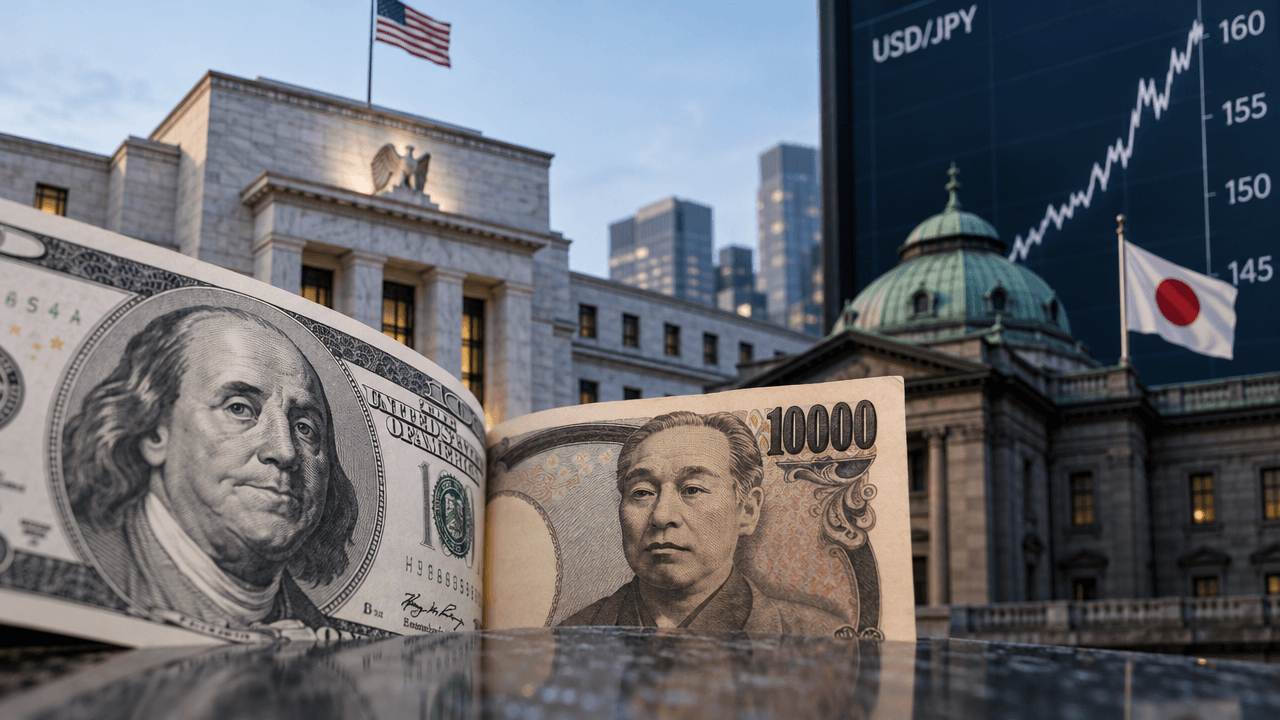
The U.S. dollar is holding near a 19-month high as stronger economic data and increasingly hawkish Federal Reserve commentary reinforce expectations for another interest-rate increase in December. The move has pushed the dollar ahead of most major currencies and kept USD/JPY close to 159.3, a level that is attracting renewed attention from traders and Japanese officials. [1]
The latest price action reflects a familiar market dynamic: currencies tend to strengthen when investors expect interest rates to rise. Higher rates can increase the appeal of assets denominated in that currency, particularly when economic growth appears resilient and inflation remains above policymakers’ comfort zone.
For traders, however, the dollar’s strength is no longer based on a single data release. It is the result of several signals pointing in the same direction.
U.S. DATA REINFORCES THE CASE FOR HIGHER RATES
Recent U.S. figures have made it more difficult for markets to assume that the Federal Reserve will quickly shift toward easier policy. Stronger-than-expected inflation data raised concerns that price pressures remain persistent, while October retail sales increased moderately, suggesting that consumer demand has not weakened enough to eliminate inflation risks. [1]
That combination matters because the Federal Reserve must balance two objectives: supporting employment and maintaining price stability. If consumers continue spending and businesses remain capable of passing on higher costs, inflation could remain elevated for longer than expected.
Interest-rate markets have responded accordingly. Traders are fully pricing a 25-basis-point rate increase at the Federal Reserve’s December meeting, while also assigning a smaller probability to a larger 50-basis-point move. [1] Even if the larger increase does not occur, the fact that markets are considering it highlights how significantly expectations have changed.
The dollar’s rally therefore represents more than optimism about the U.S. economy. It also reflects a repricing of the Federal Reserve’s future path. Investors who previously anticipated a pause or eventual easing are now allowing for a longer period of restrictive policy.
Federal Reserve Signals Keep Expectations Hawkish
Economic data often moves markets temporarily, but central-bank communication can influence expectations for weeks or months. Comments from Federal Reserve officials, including Governor Christopher Waller, have strengthened the view that policymakers remain prepared to respond forcefully if inflation does not cool. [2]
For foreign-exchange traders, the key question is not simply whether the Fed raises rates in December. It is what officials signal afterward. A quarter-point increase may already be reflected in currency prices, meaning the dollar could react more strongly to guidance about future meetings than to the decision itself.
A continued emphasis on inflation risks could support Treasury yields and maintain demand for the dollar. Conversely, if policymakers indicate that December may be the final increase for an extended period, traders could begin reducing long-dollar positions.
This creates a potentially important distinction between an expected rate hike and a surprise shift in the policy outlook. Markets generally respond most sharply when central-bank guidance differs from what investors have already priced in.
USD/JPY APPROACHES A HIGH-RISK ZONE
The Japanese yen remains under pressure, with the dollar trading near 159.3 yen. That level is important because it is close to the area where Japanese authorities previously intervened to support the currency. [1]
The pair is being driven by a wide interest-rate differential. Even with the Bank of Japan gradually moving away from its ultra-loose policy, U.S. rates remain sufficiently attractive to keep demand for dollars elevated.
Bank of Japan Governor Kazuo Ueda has reiterated that further tightening may be necessary and said the central bank will adjust its policy according to economic, price and financial developments. [14] Those comments have helped limit the yen’s losses, but they have not yet reversed the broader trend.
The challenge for yen buyers is that future tightening from the Bank of Japan remains conditional. By contrast, markets view a December Fed increase as highly likely. Until expectations for the two central banks become more balanced, USD/JPY may remain vulnerable to upward pressure.
What Traders Should Watch Next
The dollar’s momentum could continue if upcoming U.S. data confirms that growth and inflation remain firm. Traders should focus on inflation readings, employment indicators, consumer spending and any revisions to earlier economic figures. Strong results could increase expectations for additional Fed action, while weaker figures may encourage profit-taking in the dollar.
Federal Reserve speeches will also deserve close attention. Statements about inflation persistence, labor-market resilience and the timing of future rate changes could move bond yields and currency markets quickly.
In USD/JPY, the 160 area represents both a psychological threshold and a potential intervention risk. A move toward that level may increase volatility even if the underlying interest-rate trend remains favorable to the dollar. Traders should account for the possibility of rapid reversals rather than treating the pair as a one-way market.
Practical risk management is especially important in this environment. Position sizes should reflect the possibility of central-bank headlines, and stop-loss levels should be placed where the original trade thesis is invalidated—not at arbitrary distances. Traders may also consider waiting for confirmation after major data releases instead of entering during the initial price spike.
The dollar’s climb toward a 19-month high shows how quickly markets can reprice monetary-policy expectations. Strong U.S. data and hawkish Fed signals are currently supporting the currency, while the yen faces pressure despite the Bank of Japan’s stated willingness to tighten further. For investors and SimFi traders, the central lesson is clear: follow the gap between expected policy paths, but remain alert to the point at which expectations are already fully reflected in prices.