
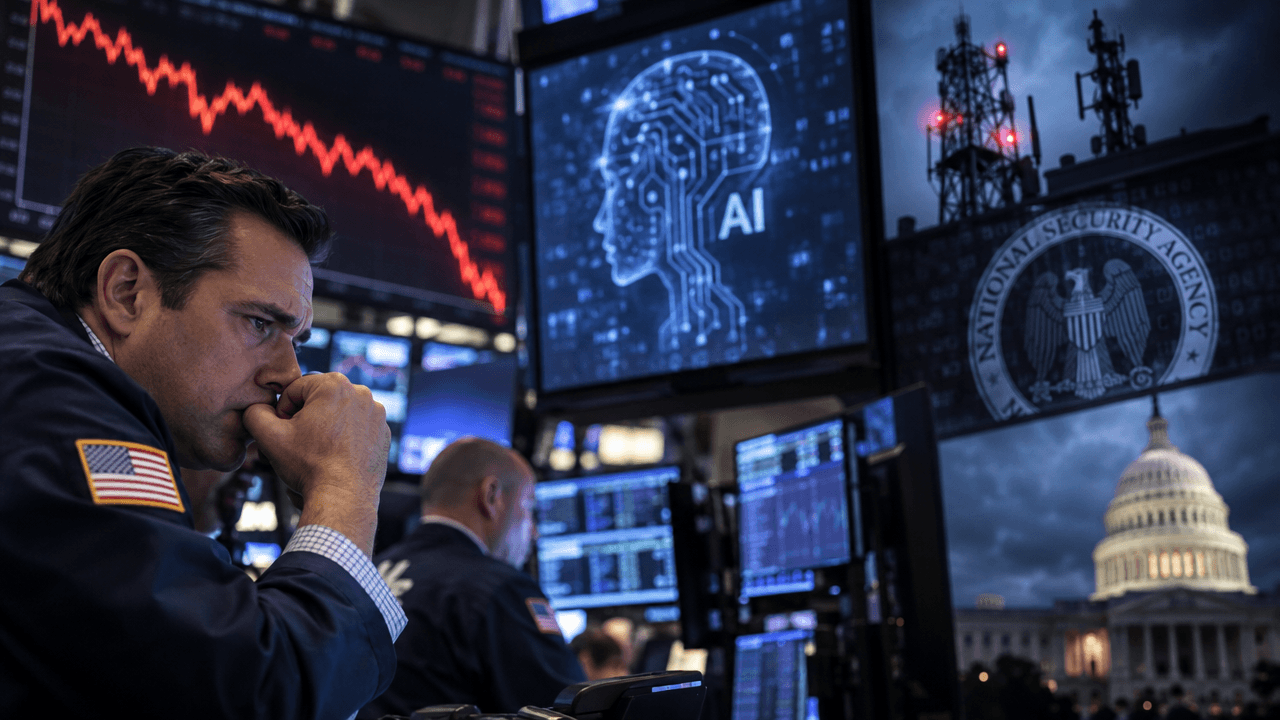
U.S. stock-index futures fell sharply as investors moved into risk-off mode, extending a selloff that has pressured technology shares and raised fresh questions about the durability of the market’s AI-driven advance. Dow futures dropped roughly 840 points, while Nasdaq 100 and S&P 500 futures also moved lower, signaling that traders were preparing for another volatile session.
The decline reflected several overlapping concerns rather than one isolated catalyst. Weaker investor sentiment, mixed economic signals, reports of an NSA communications outage, and growing skepticism about high AI valuations combined to create a market environment where investors were more willing to reduce exposure than chase recent gains.
For traders, the episode is a useful reminder that futures markets can react quickly when uncertainty rises. Futures do not guarantee where the cash market will open, but they provide an early indication of positioning, expected volatility, and the strength of overnight risk aversion.
What Drove The Risk-off Move
The most visible pressure came from technology stocks. The Nasdaq has been particularly sensitive to changing expectations around artificial intelligence, data-center spending, interest rates, and corporate earnings. After a powerful rally, investors increasingly need evidence that AI-related revenue and profits can justify elevated share prices.
That creates a fragile setup. When a highly valued sector begins to weaken, investors may not wait for a fundamental deterioration in earnings. They may simply lock in profits, reduce leverage, or rotate toward less expensive and more defensive areas of the market.
The recent weakness has already affected the major averages. The Dow Jones Industrial Average fell 848.75 points, or 1.64%, in one session and traded more than 1,000 points below its prior close at the low. The S&P 500 also recorded its lowest close since July, while reports linked the selling pressure to broader concerns about technology infrastructure stability. [1]
The Nsa Outage And Market Psychology
Reports of a communications outage involving the National Security Agency added another layer of uncertainty. In a market already worried about outages affecting technology systems and financial infrastructure, news involving a critical government network intensified concerns about operational resilience.
The NSA later said it experienced temporary degradation during scheduled routine maintenance and that mission-critical capabilities remained fully operational. [1] Even so, the initial report demonstrated how quickly an unexpected infrastructure headline can influence markets when confidence is already weakening.
This is less about the direct economic cost of a temporary outage and more about market psychology. Investors often react first to uncertainty and seek details later. During risk-off trading, headlines that might normally have a limited impact can trigger larger moves because traders are already reducing positions and widening their estimates of potential risk.
For SimFi traders, this is an important lesson in distinguishing information from reaction. A headline can produce a rapid price move without changing the long-term value of an asset. Acting impulsively after an alarming report can expose a trader to poor entries, excessive slippage, or unnecessary losses.
Mixed Data Raises The Stakes
Mixed economic data also contributed to the cautious mood. When economic indicators send conflicting signals, traders face greater difficulty assessing the outlook for growth, inflation, and monetary policy.
Strong data can support corporate earnings but also keep interest rates higher for longer. Weak data can increase expectations for easier policy but raise concerns about consumer demand and business profitability. This tension often produces uneven trading rather than a clear directional trend.
In that environment, investors tend to focus closely on upcoming employment figures, inflation readings, consumer spending data, and corporate guidance. The market response may depend less on whether a report is objectively strong or weak and more on how it changes expectations for interest rates and future earnings.
Futures declines should therefore be viewed as a warning about uncertainty, not as a complete forecast. Traders should monitor whether selling continues after the opening bell, whether market breadth improves, and whether defensive sectors outperform growth stocks.
What The Ai Rally Question Means
The central question facing investors is whether the AI rally is supported by sustainable cash flows or by expectations that have moved too far ahead of fundamentals.
AI-related companies may continue to benefit from strong demand, but investors are increasingly examining the cost of building data centers, the pace of monetization, competition among leading firms, and the return on massive capital expenditures. If projected growth slows, even temporarily, high-multiple stocks can experience sharp repricing.
That does not mean the AI theme has ended. It means the market may be moving from broad enthusiasm to a more selective phase. Companies with proven revenue growth, strong balance sheets, and measurable productivity benefits may be treated differently from firms whose valuations depend primarily on distant expectations.
This distinction matters for portfolio construction. Instead of treating all AI-linked companies as one trade, investors can compare valuation, earnings quality, debt levels, free cash flow, and customer concentration.
Practical Takeaways For Traders
First, reduce position size when volatility expands. A trade that appears reasonable under normal conditions can become unmanageable when daily ranges widen.
Second, define risk before entering. Stop levels should reflect the market’s volatility and the trade’s structure rather than an arbitrary percentage.
Third, avoid chasing the first move. Sharp futures declines can reverse if a headline is clarified, economic data surprises positively, or buyers step in near important technical levels.
Fourth, watch confirmation across markets. Falling equities accompanied by rising volatility, weaker cyclical stocks, and strength in defensive assets generally signals broader risk aversion than a decline limited to one technology group.
Finally, separate the short-term catalyst from the long-term thesis. An infrastructure outage may affect sentiment for hours or days, while valuation and earnings determine whether a sustained trend can continue.
Conclusion
The sharp decline in U.S. stock-index futures reflects a market becoming less tolerant of uncertainty. Concerns about AI valuations, mixed economic signals, and infrastructure disruptions have combined to challenge the confidence that powered the recent rally.
For traders, the priority is not predicting every headline. It is managing exposure, testing assumptions, and responding to confirmed price action instead of reacting emotionally to the first burst of news. Risk-off sessions can create opportunity, but only for participants prepared to protect capital while the market searches for stability.