
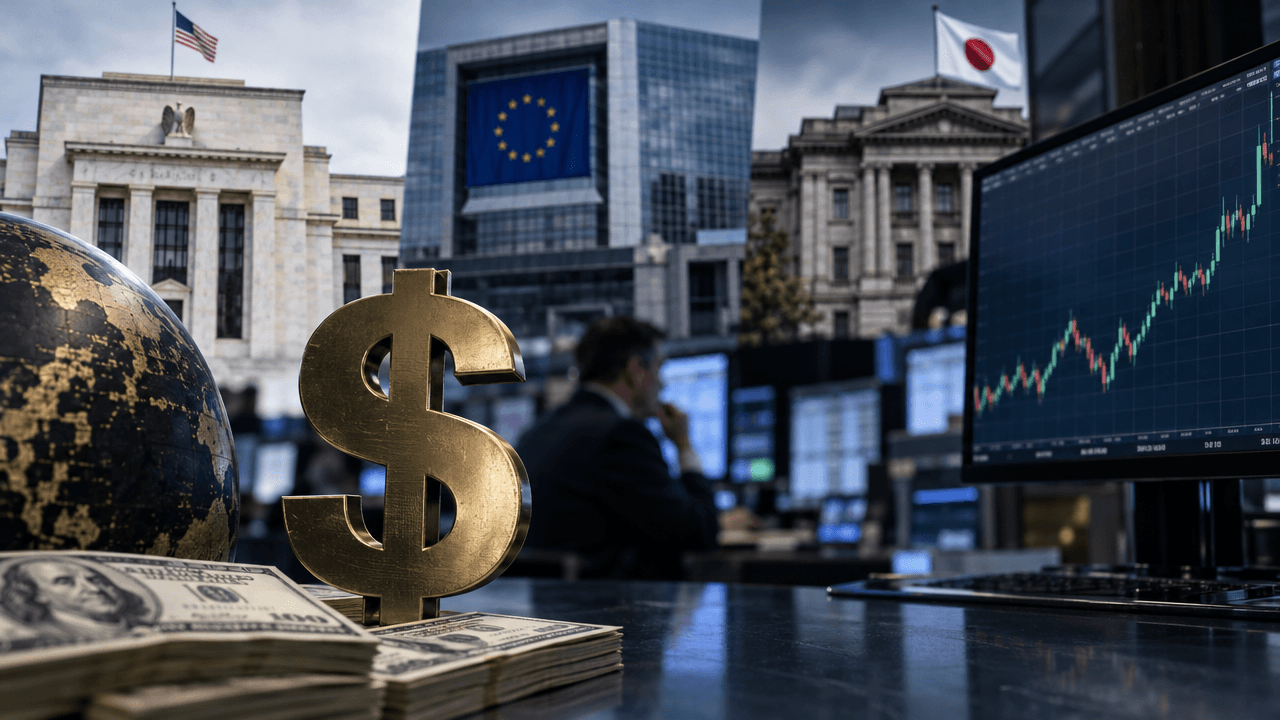
The dollar index edged higher to around 103.740, gaining approximately 0.35% during the cited futures session, as investors assessed a global interest-rate landscape that remains tilted toward tighter monetary policy. Although the Federal Reserve continues to dominate foreign-exchange pricing, signals from the Bank of Japan and European Central Bank suggest that major central banks are not yet ready to declare victory over inflation.
The move is notable because synchronized tightening usually reduces the dollar’s advantage. When several central banks raise rates at the same time, interest-rate differentials can narrow, potentially supporting currencies such as the euro and yen. Yet the dollar has remained firm as markets focus on the strength of the US economy, persistent inflation risks, and expectations that American rates may remain elevated for longer.
What Is Driving The Dollar Higher
The Dollar Index, commonly known as DXY, measures the US currency against a basket of major currencies, with the euro carrying the largest weighting. A rise in the index indicates broad-based dollar strength, although the size of the move can be influenced by changes in any of the major components.
The latest advance reflects a combination of policy expectations and market positioning. The dollar had already reached a 19-month high near 103.858 in recent trading, supported by expectations of further US rate increases and firm economic data. The index later traded around 103.748 after rising approximately 0.3% in one session. [1]
Higher interest rates can support a currency because they increase the potential return on assets denominated in that currency. However, traders do not respond only to current rates. They also price the expected path of monetary policy. If investors believe the Federal Reserve will keep rates higher for longer than other central banks, demand for dollars can increase even when overseas policymakers also sound hawkish.
THE BANK OF JAPAN’S HAWKISH HOLD
The Bank of Japan’s decision to leave interest rates unchanged was not necessarily a dovish event. Markets interpreted the hold alongside signals that another increase could come as early as December. Expectations for a December Bank of Japan hike have remained elevated, with market-implied odds recently placed between roughly 75.6% and 85%. [2]
This distinction between a rate hold and a dovish pause is important. A central bank can keep rates unchanged while preparing investors for a future increase. In Japan’s case, persistent inflation, rising wholesale prices, and pressure from a weak yen are keeping policy normalization on the agenda.
A higher Japanese interest rate could support the yen by narrowing the gap between Japanese and US yields. It could also encourage investors to reduce yen-funded carry trades, in which traders borrow cheaply in yen to purchase higher-yielding assets elsewhere. For now, however, the US rate advantage remains substantial, limiting the yen’s ability to strengthen decisively.
The Ecb Keeps A December Hike In Play
The European Central Bank has also contributed to the hawkish tone. After leaving rates unchanged, ECB officials kept the possibility of a December increase open, citing continued inflation risks. ECB Chief Economist Philip Lane said another December hike could be prudent if economic conditions remain unchanged, while markets have priced a high probability of a quarter-point increase at the next meeting. [9][11]
A European rate hike would normally provide support for the euro. Yet the relationship is not automatic. Currency markets also consider economic growth, fiscal conditions, energy costs, and the credibility of future policy. If traders believe the ECB is raising rates to contain inflation while growth is deteriorating, the euro may fail to benefit significantly.
The same logic applies to the dollar. A hawkish central bank can support its currency, but an unexpectedly weak economy or a rapid shift toward rate cuts can reverse that support. This is why traders are watching incoming inflation, employment, and growth data rather than relying solely on central-bank headlines.
What Traders Should Watch Next
The most important question is whether the tightening bias becomes actual policy action. Investors will monitor US inflation readings, employment data, and Federal Reserve communication for evidence that another increase is likely. Recent market pricing has shown strong expectations for a December Federal Reserve hike, helping reinforce the dollar’s momentum. [6]
Traders should also follow the tone of official guidance. A clear commitment to further tightening could lift bond yields and extend dollar gains. Conversely, language emphasizing economic risks or data dependence could trigger profit-taking.
Technical levels matter as well. A sustained move above the recent 103.858 high could signal that buyers are maintaining control. Failure to hold the 103.70 area, however, would suggest that the rally is losing momentum. Technical signals should be combined with fundamental analysis because central-bank communication can quickly invalidate chart patterns.
For SimFi traders, this environment offers a useful exercise in scenario planning. Rather than entering a position based on a single headline, define separate plans for a hawkish outcome, a neutral outcome, and a dovish surprise. Set risk limits before the trade, monitor correlated markets such as Treasury yields and EUR/USD, and avoid assuming that every central-bank hike automatically benefits the local currency.
The Bigger Market Picture
The dollar’s latest advance shows that a hawkish global policy backdrop does not produce uniform currency performance. The US currency can still rise when the Fed is perceived as more capable of sustaining higher rates, when US growth appears comparatively resilient, or when investors seek liquidity during periods of uncertainty.
At the same time, the rally faces an important test. If the ECB and Bank of Japan deliver the hikes markets anticipate, policy divergence may narrow and limit further dollar appreciation. The dollar’s next leg higher will likely require either stronger US data, more aggressive Federal Reserve guidance, or a renewed increase in demand for safe-haven assets.
The key takeaway is that traders should focus on relative policy expectations rather than isolated rate decisions. A central bank hold can be hawkish, a rate hike can be fully priced in, and a strong currency move can reverse when expectations change. In the current environment, disciplined risk management and careful attention to forward guidance are more valuable than simply reacting to the latest DXY move.