
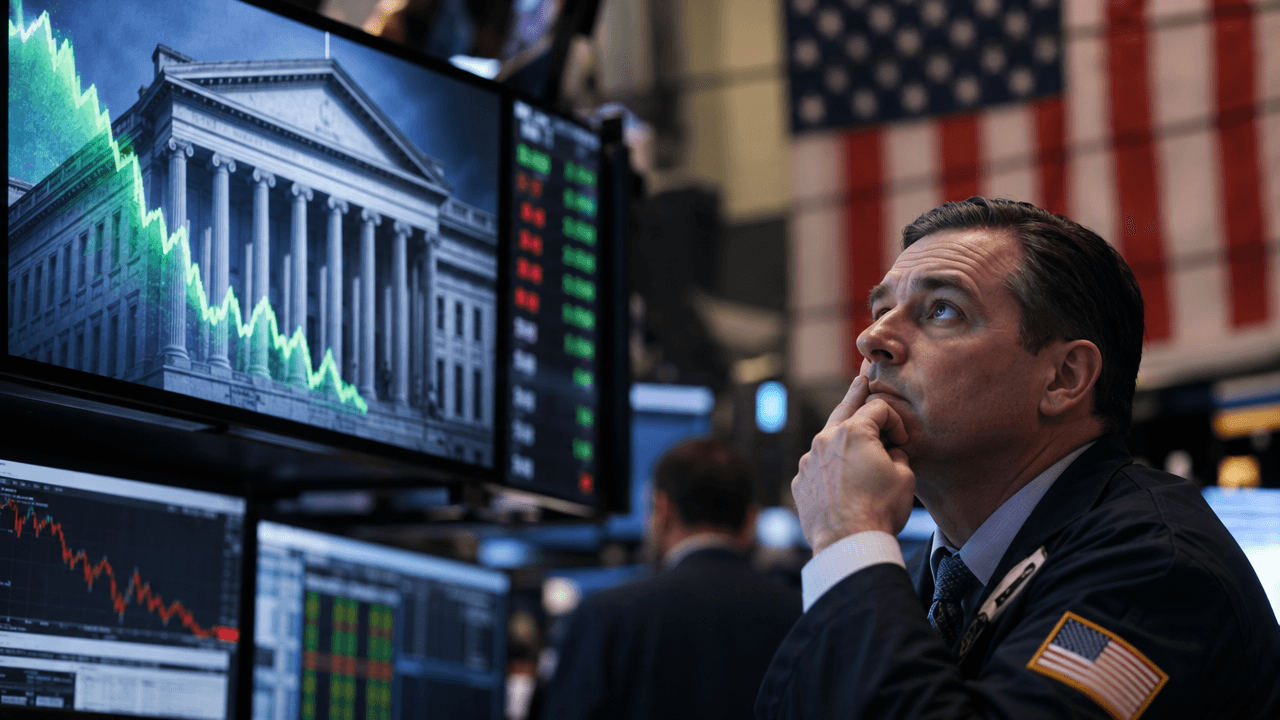
Treasury futures rallied sharply during the latest trading week as investors reduced exposure to riskier assets and moved capital toward U.S. government bonds. The shift pushed yields lower across the curve, with declines of roughly 15 to 20 basis points in several key maturities. Futures gains reflected the traditional inverse relationship between bond prices and yields: when demand for Treasuries rises, prices increase and yields fall. [1]
The move was especially notable because it occurred alongside indications that the Federal Reserve could keep interest rates higher for longer. Normally, expectations for additional rate hikes would pressure Treasury prices. However, the intensity of the equity selloff made safety and liquidity more important than the possibility of higher future policy rates.
What Drove The Treasury Rally
The primary catalyst was a broad decline in equities, particularly technology and artificial intelligence-related stocks. Investors had become increasingly concerned that elevated valuations and aggressive AI investment expectations were difficult to sustain in a high-interest-rate environment. As stocks weakened, some market participants took profits and redirected funds into Treasury securities.
The benchmark 10-year yield fell below 5% during the week, while the two-year yield also recorded a substantial decline. The 10-year yield reached approximately 4.95%, extending its weekly decrease to nearly 15 basis points, while the two-year yield fell about 12 basis points to roughly 4.71% in one market measure. [2]
This is a classic risk-off pattern. Equities represent ownership in companies and therefore carry earnings, valuation, and sentiment risk. Treasury securities, by contrast, are backed by the U.S. government and trade in one of the world’s deepest markets. During periods of uncertainty, investors often accept lower yields in exchange for greater perceived stability and liquidity.
Understanding The Futures Performance
The reported performance varied significantly by maturity. Two-year futures gained approximately 0.42%, while 30-year futures advanced about 2.05%. Ten-year note futures rose around 1.43% during the same period. [1]
The difference is largely explained by duration. Duration measures a bond or futures contract’s sensitivity to changes in interest rates. Longer-duration instruments react more strongly when yields move. A decline of 15 basis points can therefore produce a relatively modest price gain in short-term futures but a much larger gain in long-term contracts.
For traders, this relationship creates both opportunity and risk. A long position in a 30-year Treasury futures contract can benefit considerably from falling yields, but the same position can lose value quickly if inflation data, Federal Reserve communication, or stronger economic growth sends long-term yields higher.
The rally also demonstrates why futures prices should not be viewed in isolation. A percentage gain in a futures contract reflects more than a simple directional call on interest rates. It incorporates contract specifications, duration exposure, leverage, and the market’s expectations about the future path of monetary policy.
The Federal Reserve Factor
The Treasury rally was not driven exclusively by expectations of easier monetary policy. Recent Federal Reserve minutes and policymaker comments remained hawkish, with markets continuing to consider the possibility of additional rate increases. Some expectations pointed toward a potential hike in the near term, followed by another increase later in the policy cycle. [2]
That tension is important. Short-term Treasury yields are heavily influenced by expectations for the federal funds rate, so the two-year sector can remain under pressure when traders anticipate tighter policy. Longer-term yields are influenced by a wider range of factors, including inflation, economic growth, government borrowing, and demand for safe-haven assets.
In the latest week, risk aversion overwhelmed the hawkish policy signal. The equity selloff increased demand for Treasuries even though investors had not fully abandoned the view that interest rates might remain elevated. This tells traders that bond markets can rally for defensive reasons without necessarily signaling that the Federal Reserve is preparing to cut rates.
Practical Lessons For Simfi Traders
Treasury futures offer a useful way to study market positioning, macroeconomic expectations, and risk management in a simulated finance environment. Traders should begin by watching the relationship between yields and futures prices. When yields fall, Treasury futures generally rise; when yields rise, futures generally decline.
The next step is comparing maturities. Two-year futures provide greater sensitivity to Federal Reserve expectations, while 10-year and 30-year contracts are more exposed to inflation, fiscal policy, economic growth, and duration risk. A steep rally in long-term futures may indicate strong defensive demand, falling inflation expectations, or changing views about long-run growth.
Risk controls are essential because futures use leverage. A trader can be correct about the direction of yields and still suffer excessive losses if the position is too large or if volatility creates a temporary move against the trade. Position sizing, stop levels, and scenario analysis should be established before entering a simulated position.
It is also useful to monitor equities, the U.S. dollar, inflation data, labor-market reports, and Federal Reserve communications together. Treasury markets rarely move for just one reason. The strongest signals often appear when several markets confirm the same theme.
What Comes Next
The Treasury rally shows how quickly capital can rotate when investors become concerned about risk. If equity weakness continues, demand for government bonds could remain strong and yields may test lower levels. However, a rebound in stocks, renewed inflation concerns, or more hawkish Federal Reserve guidance could reverse the move quickly.
The central lesson is that Treasury futures are not simply interest-rate instruments. They are also tools for expressing views on growth, inflation, monetary policy, and market sentiment. The latest rally was powered by risk aversion, but its continuation will depend on whether defensive demand remains stronger than the forces keeping interest rates elevated.
For SimFi traders, the best approach is to treat the move as a case study in cross-asset analysis. Track the catalyst, understand duration, respect leverage, and avoid assuming that one week of falling yields automatically confirms a lasting change in monetary policy.