
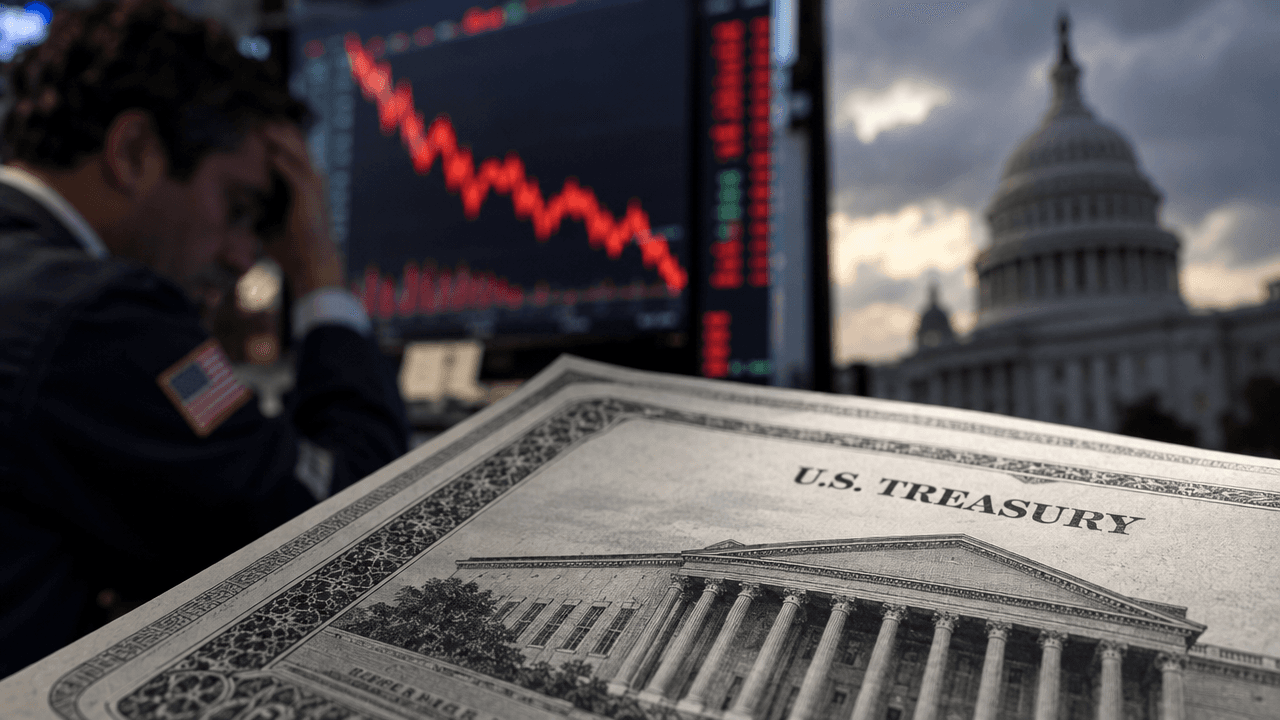
U.S. Treasury yields moved lower as investors sought protection from a sharp equity selloff, highlighting how quickly market priorities can shift from growth and inflation to safety and liquidity. The two-year Treasury yield declined to approximately 4.647%, while the 10-year yield fell to around 4.944%, according to recent market reporting. [13]
The move reflects more than a routine change in bond prices. It shows investors reassessing the outlook for economic growth, Federal Reserve policy, and riskier assets, particularly technology and artificial-intelligence stocks. When uncertainty rises, Treasuries often attract demand because they are highly liquid and backed by the U.S. government. Increased demand pushes bond prices higher and yields lower.
Why Treasury Yields Are Falling
Bond yields and prices move in opposite directions. If investors buy more Treasury notes, their prices rise, and the effective yield available to new buyers declines. That is what happened as market participants reduced exposure to equities and moved money toward government debt.
The recent selling pressure in stocks has been linked in part to concerns about elevated technology valuations and the sustainability of the artificial-intelligence investment boom. Reports indicated that risk aversion spread beyond equities, with investors also responding to weakness in other risk-sensitive assets. The benchmark 10-year yield ended the week near 4.95%, while the two-year yield recorded one of its sharpest weekly declines in more than a year. [7]
This type of price action is commonly called a flight to safety. It does not necessarily mean investors expect an immediate recession. Instead, it suggests that preserving capital and maintaining liquidity have become more important than seeking maximum returns.
What The Two-year And 10-year Yields Signal
The two-year Treasury yield is especially sensitive to expectations for Federal Reserve interest-rate decisions. When it falls, markets are often reducing expectations for future short-term rates or anticipating weaker economic conditions. The decline toward 4.647% therefore indicates that traders became less confident in aggressive additional tightening.
The 10-year yield provides a broader signal. It reflects expectations for future inflation, economic growth, government borrowing, and long-term interest rates. Its move below 5% suggests that demand for longer-term protection strengthened even while inflation concerns remained relevant.
The yield curve also deserves attention. If short-term yields fall faster than long-term yields, the curve can become less inverted or even steepen. That may indicate that traders expect near-term policy pressure to ease while believing inflation and government financing needs will keep longer-term yields relatively elevated.
Recent market data showed that investors still expected a Federal Reserve rate increase in December, but largely ruled out a more aggressive 50-basis-point move. Markets were also awaiting additional inflation information, including the personal consumption expenditures report, the Fed’s preferred inflation measure. [11]
Why This Matters For Traders And Investors
Treasury yields influence a wide range of financial markets. The 10-year yield is a key reference point for mortgage rates, corporate borrowing costs, student loans, and many asset-valuation models. When it declines, financing conditions may improve at the margin, although lenders do not always pass the entire move through to consumers immediately. [1]
Lower yields can also support high-growth companies because future earnings become less heavily discounted. However, that benefit may be overwhelmed when yields are falling because investors are worried about economic or market stress. A bond rally caused by fear is very different from a bond rally caused by orderly disinflation.
For traders, the distinction matters. A declining 10-year yield alongside falling stocks can signal risk aversion. A declining yield alongside rising stocks may instead indicate optimism about lower inflation or easier monetary policy. Price direction alone is not enough; traders should examine the catalyst and the behavior of credit markets, volatility indexes, the U.S. dollar, and commodities.
Practical Takeaways For Market Participants
First, monitor the reason behind yield movements rather than treating every decline as bullish. Safe-haven demand can temporarily lift Treasuries while signaling broader weakness in risk assets.
Second, watch the two-year yield for changes in Federal Reserve expectations. Its rapid decline can reveal that traders are scaling back rate-hike bets, even when central bank officials continue to use hawkish language.
Third, track the 10-year yield for longer-term economic signals. A sustained move below 5% could influence mortgage rates, equity valuations, and corporate financing decisions, but a short-lived drop may simply reflect temporary hedging and portfolio repositioning.
Finally, manage leverage carefully. Bond futures, interest-rate products, and equity positions can all react sharply when expectations change. Traders should define risk before entering a position, account for volatility around economic releases, and avoid assuming that a safe-haven trend will continue indefinitely.
The Bigger Market Message
The Treasury rally demonstrates that markets can respond more strongly to risk sentiment than to official policy guidance. Even with expectations for elevated interest rates still in place, the intensity of the equity selloff encouraged investors to prioritize safety. Treasury futures also rallied as traders questioned how far the Federal Reserve might tighten if financial conditions weakened. [3]
The key question now is whether the decline in yields represents a temporary flight to safety or the beginning of a broader reassessment of economic growth and monetary policy. Future inflation data, labor-market readings, corporate earnings, and the Federal Reserve’s communication will help determine the answer.
For now, the message is clear: when confidence in risk assets deteriorates, Treasuries remain one of the first destinations for capital. Falling yields are therefore not merely a bond-market statistic. They are a real-time measure of investor caution, policy expectations, and the changing balance between return and protection.