
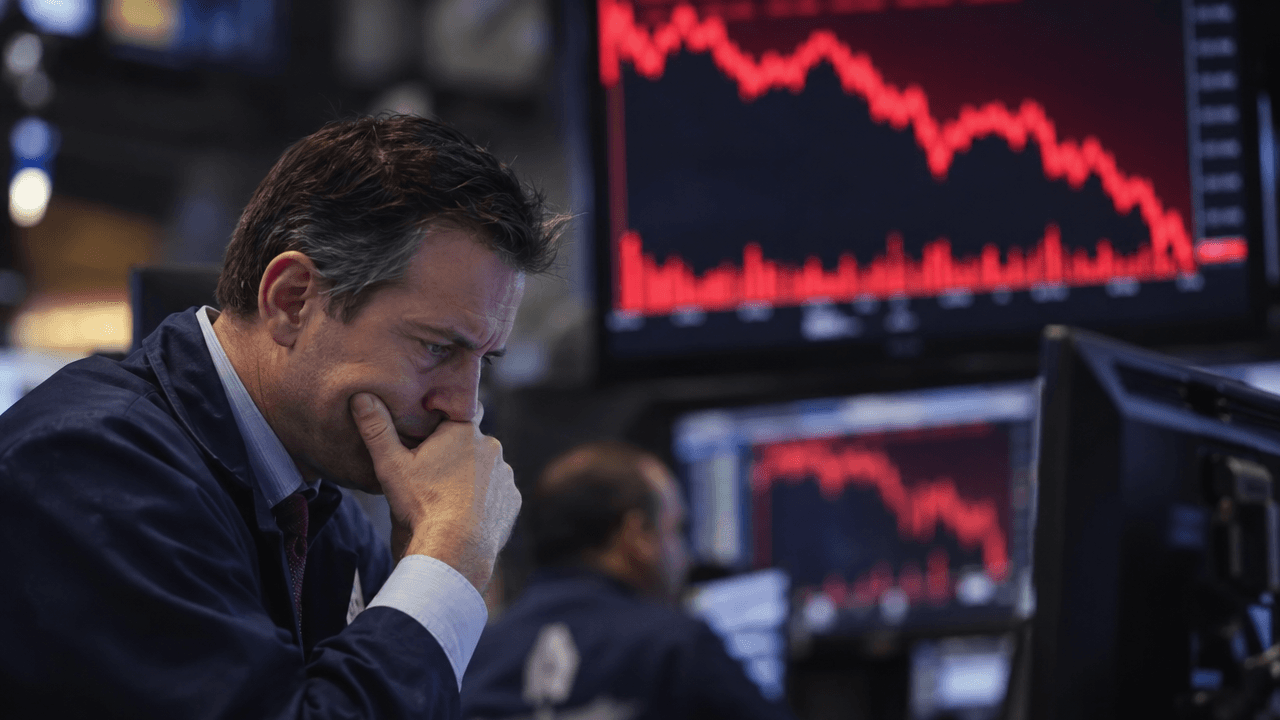
US stock-index futures are sliding sharply after a broad Wall Street selloff, signaling that investor anxiety has moved beyond a single company or sector. Dow futures were reported down roughly 840 points, while Nasdaq 100 and S&P 500 futures also fell heavily. The pressure reflects renewed doubts about stretched artificial-intelligence valuations, uncertainty surrounding Nvidia and a broader reduction in appetite for risk. [4]
The overnight move follows a difficult session in which the Dow Jones Industrial Average dropped 859.71 points, or 1.67%, to 50,748.46. [3] The selling illustrates how quickly optimism around AI-related growth can reverse when investors begin questioning whether share prices have risen faster than corporate earnings and cash flows.
What Is Driving The Selloff
The central concern is valuation. AI-linked companies have attracted enormous investment, propelled by expectations that demand for chips, data centers, cloud computing and automation will remain exceptionally strong. That enthusiasm has lifted several large technology stocks to valuations that leave little room for disappointing guidance, slower customer spending or higher financing costs.
When expectations become this elevated, even positive news may fail to satisfy investors. A company can report strong revenue growth yet see its shares decline if the market expected an even stronger result. This creates a fragile environment in which profit-taking can spread quickly from one major stock to an entire sector.
Nvidia has become the market’s most important test of the AI investment story. The company’s chips are central to the buildout of AI infrastructure, making its results a closely watched indicator of industry demand. However, leadership uncertainty and questions about the sustainability of the AI boom have added another layer of risk. Nvidia fell 4.1% during the preceding selloff, making it the heaviest weight on a market already under pressure. [6]
Why Nvidia Matters To The Major Indexes
Nvidia’s influence extends well beyond its own share price. As one of the world’s largest publicly traded companies, movements in Nvidia can have a meaningful effect on capitalization-weighted indexes such as the S&P 500 and Nasdaq 100.
Its business is also connected to a broad network of technology companies. Semiconductor manufacturers, cloud providers, software developers, server makers and data-center operators all benefit from, or depend on, continued AI spending. If investors begin to believe that companies are overbuilding capacity or taking on too much debt to fund expansion, selling can spread across the entire ecosystem.
Recent market action demonstrates that sensitivity. The Nasdaq Composite fell 2.49% to 24,509.76, while the S&P 500 declined 1.92% to 7,416.59. [2] The weakness was not limited to speculative AI names; declines in technology stocks also affected broader indexes and reduced confidence in higher-risk assets.
What Stock Futures Really Signal
Stock-index futures are contracts linked to the future value of major market indexes. They trade outside regular U.S. market hours and provide an early indication of investor sentiment before the opening bell. A sharp futures decline often reflects overnight reactions to earnings, geopolitical developments, interest-rate expectations or major moves in international markets.
However, futures are not a guarantee of where indexes will finish the day. Prices can change significantly before the opening and throughout the session as traders assess new information. Nvidia’s earnings, economic data, Treasury yields and comments from Federal Reserve officials could all alter the direction of markets.
This distinction matters for investors. Treating a futures decline as a certain prediction can encourage emotional decisions. A more disciplined approach is to view futures as a risk signal: they show that volatility may be elevated and that market participants are reassessing positions.
What Traders Should Watch Next
The first priority is Nvidia’s earnings and forward guidance. Investors will be looking for evidence that demand remains strong, customers can continue funding large infrastructure projects and profit margins can withstand increased competition. Revenue growth alone may not be enough; the market will also scrutinize order visibility, supply constraints and the pace of future capital spending.
The second focus is the behavior of Treasury yields. Higher yields can pressure growth stocks by making future earnings less valuable in today’s terms. They can also make bonds more attractive relative to equities, particularly when stock valuations are already elevated.
Third, traders should monitor market breadth. If declines remain concentrated in a few technology leaders, the selloff may represent sector rotation or profit-taking. If falling stocks significantly outnumber advancing stocks across financials, industrials, consumer companies and small-cap shares, the move could indicate a deeper deterioration in risk appetite.
Finally, investors should watch volume and volatility. Heavy selling volume combined with expanding volatility often signals forced repositioning rather than a routine pullback. That does not automatically mean a bear market is beginning, but it does suggest that position sizing and risk controls deserve closer attention.
Practical Takeaways For Simfi Traders
Simulated Finance traders can use this environment to practice decision-making without confusing market movement with certainty. Avoid entering a trade solely because futures are sharply higher or lower. Instead, identify the catalyst, define an invalidation level and calculate the potential loss before taking a position.
A useful exercise is to build scenarios. In a bullish scenario, Nvidia guidance supports AI demand and futures recover. In a bearish scenario, guidance disappoints or investors remain concerned about valuations, leading to further weakness in technology stocks. A third scenario involves a volatile, directionless market in which prices move sharply in both directions.
Traders should also consider correlation risk. Holding several AI-related stocks may appear diversified, but those positions can decline together when sentiment changes. Reviewing exposure by sector, factor and market capitalization can reveal risks that are not obvious from the number of individual trades.
Conclusion
The steep decline in U.S. stock-index futures reflects a market demanding stronger evidence that AI spending can justify extraordinary valuations. Nvidia remains the immediate focal point, but the broader issue is whether investor expectations have become too aggressive across technology and growth stocks.
For traders, the most valuable response is not prediction but preparation. Monitor earnings, yields, breadth and volatility; reduce unnecessary leverage; and let a defined risk plan guide decisions. Markets can recover quickly after a selloff, but disciplined execution remains essential when sentiment is changing faster than fundamentals.