
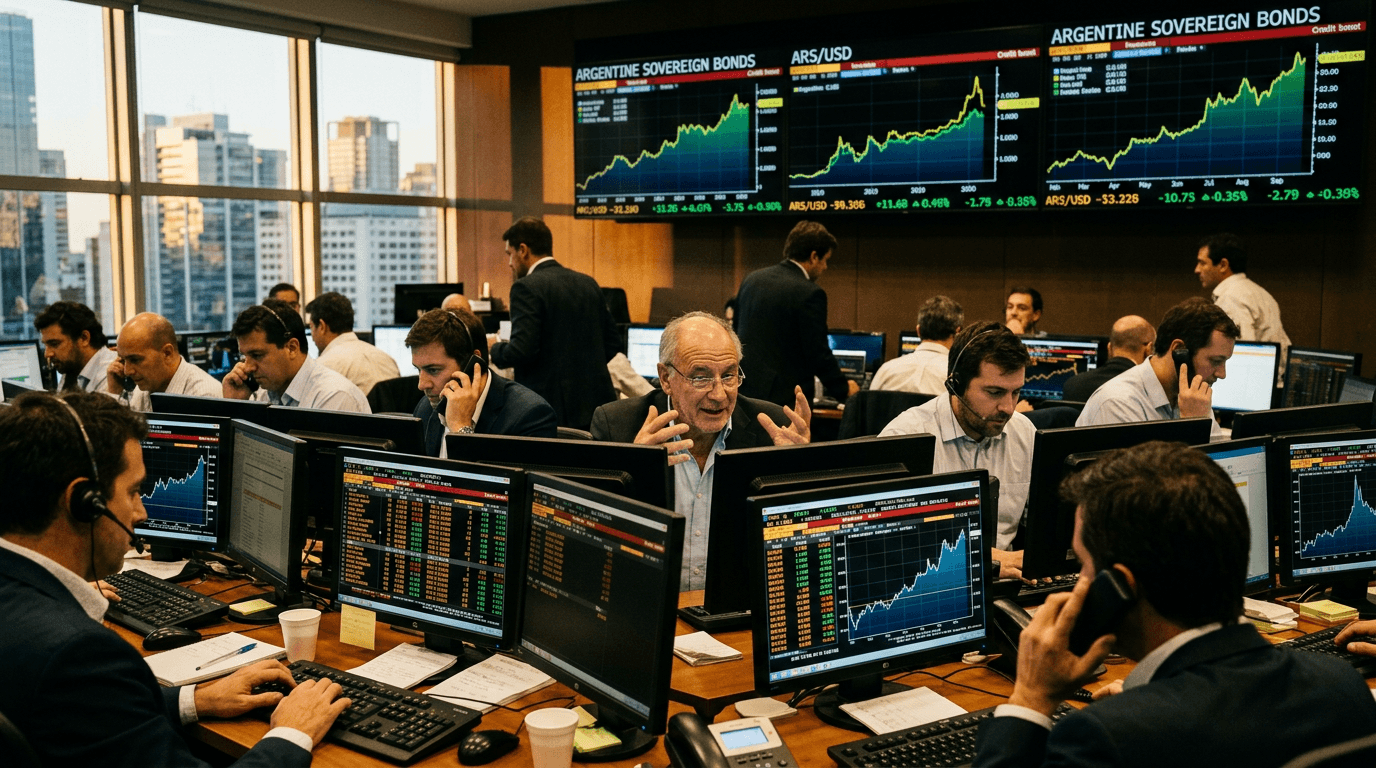
Argentine assets just got a small but meaningful vote of confidence from one of the world’s key multilateral lenders. The World Bank has approved a guarantee‑backed financing package for Argentina, a structure designed to unlock about $2 billion in market funding while partially shielding private lenders from default risk. For a country with a long history of sovereign stress, this move helps ease some immediate risk concerns and could improve sentiment around its bonds and the peso, even if it does not solve the deeper fiscal and inflation challenges.
ARGENTINA’S NEW LIFELINE: WHAT JUST HAPPENED
Argentina has been negotiating a $2 billion loan with private banks that would come with guarantees from World Bank institutions, giving creditors an extra layer of protection if the sovereign struggles to repay.[3][6] The newly approved deal combines two guarantees, with the first described as a policy‑based guarantee, a tool the World Bank has used in the past to support governments implementing agreed economic reforms.[3][5]
In practice, the guarantee means part of the credit risk is shifted from private lenders to a AAA‑rated multilateral. That makes it easier and cheaper for Argentina to borrow from the market than it would on a purely standalone basis. For a government still battling high inflation, large fiscal imbalances, and limited market access, this structure is a way to rebuild credibility without immediately testing investor appetite with an unenhanced bond.
This package comes on top of broader World Bank support for Argentina’s reform agenda, including earlier announcements of a multi‑year funding envelope aimed at stabilizing the economy and modernizing key sectors.[1] Together, these steps signal that major international institutions are willing to put real balance sheet resources behind the country’s adjustment efforts.
HOW GUARANTEE‑BACKED FINANCING WORKS
To understand why markets care, it helps to unpack what a guarantee‑backed financing package actually is. Rather than the World Bank lending the full amount directly, it provides guarantees that cover specific portions or risks of a loan or bond issued to Argentina by private investors.[2][4]
A policy‑based guarantee (PBG) typically backs the government’s repayment obligations linked to a set of policy and reform commitments. If the country fails to pay, the World Bank steps in to cover the guaranteed portion, and then seeks reimbursement from the sovereign on more flexible terms.[5] The second guarantee in this package has not been fully detailed publicly, but it likely complements the PBG by covering additional tranches or specific projects, further reducing perceived risk for lenders.[3][4]
For Argentina, the benefits are clear: - improved access to foreign currency funding - lower interest costs than purely sovereign risk pricing would imply - a signaling effect that reforms are on track and supported by a credible multilateral
For lenders and investors, the guarantee provides credit enhancement: instead of bearing full Argentina risk, they effectively hold exposure partly wrapped by the World Bank’s financial strength and preferred creditor status.
Why Markets See This As A Modest Positive
The immediate reaction from analysts has been to label the deal a modest positive for Argentina’s bond market and for peso sentiment. It does not transform the country’s credit profile overnight, but it does change the short‑term risk calculus in several ways.
First, the package helps smooth funding needs by securing a sizeable amount of external financing on improved terms. That can reduce near‑term default fears, especially around specific maturities or FX liquidity constraints. Second, the involvement of the World Bank tends to reassure markets that the government is committed to a reform path consistent with multilateral programs, including fiscal consolidation and inflation control.
Third, the structure can help rebuild a yield curve over time. If this guarantee‑backed loan trades well and Argentina meets its obligations, it could open the door to additional market operations, potentially with smaller or shorter‑dated enhancements. For bondholders, this raises the odds of more orderly market access rather than a binary “in or out” of the market.
However, the positive impact is inherently capped. The package is relatively small compared to Argentina’s overall funding needs, and it does not by itself fix underlying macro vulnerabilities. Investors are likely to treat this as a supportive signal, not a game‑changing regime shift.
What Traders Should Watch: Bonds, Peso, And Policy Path
For traders, the key is not just that a deal was approved, but how the market internalizes its implications over the coming weeks and months.
In sovereign bonds, you could see: - tighter spreads on Argentina’s external debt, especially on maturities most sensitive to near‑term default risk - greater differentiation between bonds: issues seen as closest to potential future guarantee structures may outperform - increased interest from crossover investors who previously viewed Argentina as too risky without some form of multilateral support
In FX, the peso’s reaction will hinge on whether traders believe the package meaningfully improves the balance of payments outlook. A guarantee‑backed loan in foreign currency adds to gross reserves and can buy time, but without credible disinflation and fiscal anchors, pressure can quickly resurface. Watch for: - changes in implied FX volatility - moves in offshore peso instruments and non‑deliverable forwards - shifts in local demand for dollar assets vs peso instruments
On the policy side, markets will scrutinize whether Argentina meets the reform milestones tied to the guarantee. Policy slippage could undermine the perceived value of the package and reignite risk concerns, while steady progress would strengthen the signaling effect and potentially pave the way for additional support.
Practical Takeaways For Simulated And Live Traders
For traders using simulated finance environments, this kind of event is an excellent case study in how multilateral actions filter through EM assets:
1) Think in terms of risk premia, not just headlines A World Bank guarantee reduces the tail risk of default on specific instruments, which should compress credit spreads and lower required yields for comparable risk. In a SimFi setup, you can test scenarios where spreads tighten moderately versus aggressively and see how portfolio P&L responds.
2) Focus on relative value within the capital structure Not all Argentine assets benefit equally. Sovereign bonds closer in tenor or structure to the guaranteed financing may rally more than longer‑dated or structurally subordinated paper. Simulated strategies can explore curve trades, switches between bonds, or baskets of EM credits where Argentina serves as a high‑beta component.
3) Integrate macro and micro views This package is a micro‑level credit enhancement against a still‑fragile macro backdrop. In practice, that argues for strategies that are constructive but not complacent: for instance, selectively long Argentine credit while hedging broader EM risk, or pairing Argentina trades with positions in countries whose bonds tend to move in sympathy.
4) Treat guarantees as conditional, not permanent Policy‑based guarantees come with strings attached. If reforms falter or relationships with multilaterals sour, future support could be scaled back. In a simulated environment, it is useful to model “good path” and “bad path” scenarios: one where credible policy continues and market access gradually normalizes, and another where volatility returns and spreads widen again.
For both simulated and live trading, the most robust edge often comes from understanding how these institutional moves alter probabilities at the margin, rather than trying to predict an all‑or‑nothing outcome.