
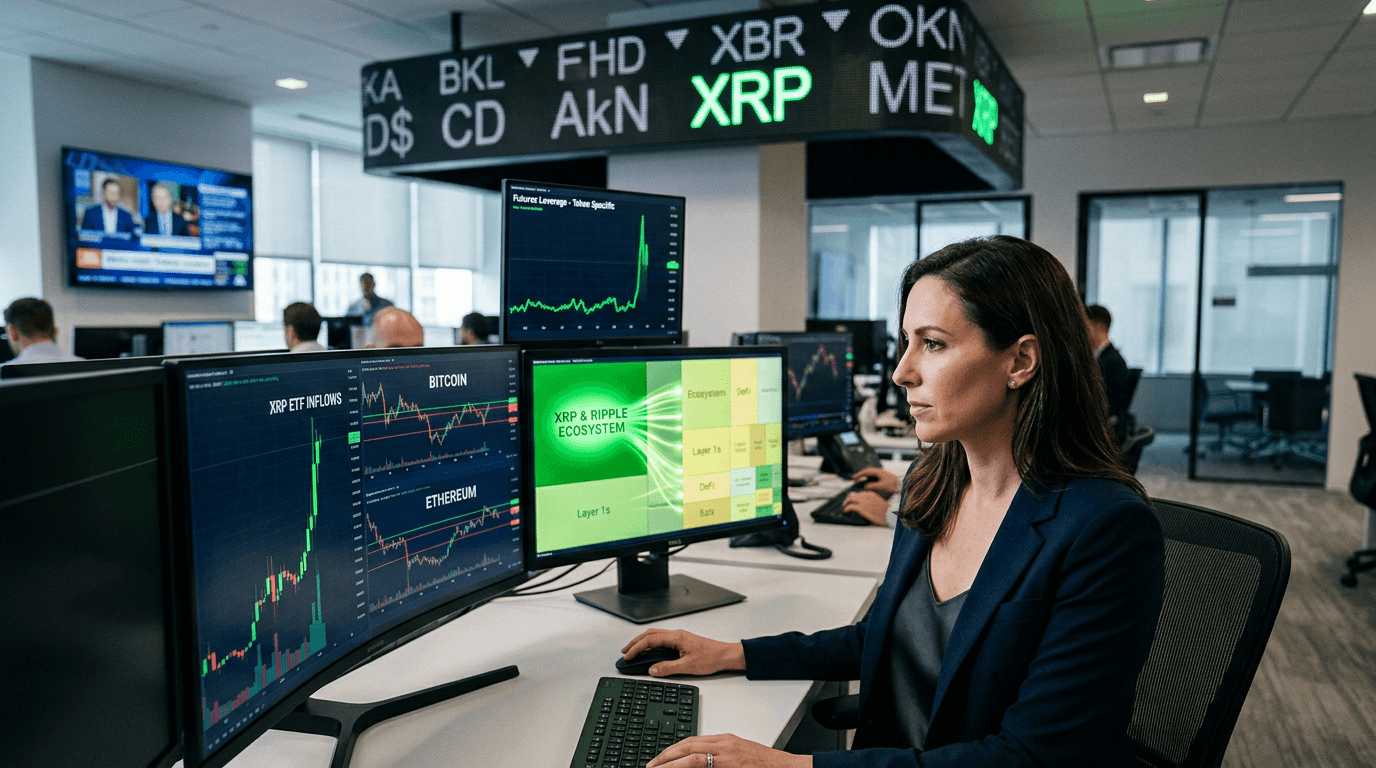
A wave of token-specific catalysts is reshaping the crypto landscape, with XRP emerging as one of the clearest examples of how flows, derivatives positioning, and ETF demand can drive performance even when the broader market is mixed.[1][2][3] For traders, the recent XRP story illustrates why understanding asset-level drivers is as important as tracking macro sentiment, and how sector rotation can play out beneath the surface of headline indices.[2][6]
Macro Backdrop, Micro Catalysts
While aggregate crypto benchmarks have struggled to establish a decisive trend, XRP has pushed into the mid‑$1.30s to low‑$1.40s, supported by robust spot demand and growing institutional interest via ETFs.[1][2][3] This divergence between a choppy market and a strong individual token highlights a familiar pattern from traditional finance: money rotates to names with clear narratives, liquidity, and catalysts, even when the overall risk environment feels uncertain.[2][6]
In XRP’s case, the narrative blends three components—ETF flows, derivatives repositioning, and ongoing regulatory and partnership developments—which together create a more durable story than a simple momentum-driven rally.[1][3][6] For traders on simulated and live venues alike, this combination is exactly the type of regime that rewards a more granular, token-by-token approach rather than a purely index-driven strategy.
Xrp Etf Inflows: A Signal Of Institutional Rotation
Spot XRP ETFs have become the focal point of recent market commentary, with several funds in major jurisdictions now holding well over a billion tokens and managing assets in the low-single billions of dollars.[1][2][10] Over the final week of August, XRP ETFs recorded about $110 million in net inflows—by far their strongest weekly reading of 2026 and more than double the previous yearly high.[2][3][6] Those flows lifted cumulative net inflows toward the $1.6–$1.7 billion region, alongside total net assets in the ballpark of $1.4–$1.5 billion across the complex.[3][6][10]
The pace of buying has also shown a notable consistency. Data point to extended streaks of consecutive daily inflows, including sessions with roughly $6 million of net demand, and additional tens of millions added across late August and early September.[3][6] That pattern matters more than any single day’s number because it suggests institutional portfolios are systematically building exposure, not simply trading headlines.
For traders, ETF flow trends are a powerful sentiment indicator:
1. Rising cumulative inflows with fresh weekly records indicate an ongoing allocation story rather than short‑term speculation.[2][6][10] 2. Persistent inflows during sideways or mildly corrective spot price action often imply that larger players are using consolidation as an entry point.[3][6] 3. ETF demand can tighten the relationship between XRP and broader risk assets, as more traditional portfolios begin to treat the token as part of a diversified allocation rather than a standalone speculative play.[1][2]
On a SimFi platform, monitoring ETF flow data in scenario-based backtests can help traders quantify how changes in institutional demand might translate into volatility, liquidity, and trend persistence.
Futures Open Interest: Leverage Is Moving, Not Disappearing
Alongside ETF activity, XRP futures markets have undergone a notable reshuffling. Total XRP futures open interest declined about 16% between mid and late August, falling from roughly 2.77 billion tokens to around 2.34 billion.[4][7][9] At first glance, that drop could be interpreted as a sign of fading speculative interest—but the venue-level data tell a more nuanced story.
Open interest on a major regulated futures exchange rose by around 36% over the same period, climbing to almost 400 million XRP and taking its share of total futures OI from about 10% in mid‑August to roughly 17% by the end of the month.[4][7][9] In notional terms, that shift translated into hundreds of thousands of contracts and several hundred million dollars’ worth of exposure, pushing the regulated venue ahead of leading offshore exchanges by open interest value.[7][9]
The key takeaway: leverage is migrating rather than disappearing.
1. A decline in aggregate open interest paired with a rise on regulated venues suggests that speculative activity is being re‑priced and re‑routed toward more institutionally friendly channels.[4][7][9] 2. This can reduce the likelihood of extreme, exchange-specific liquidation cascades, while still preserving sufficient derivatives depth for hedging and tactical positioning.[4][8] 3. For strategy design, the shift encourages greater attention to basis, funding, and liquidity conditions on both offshore and onshore venues, particularly when simulating scenarios that involve stress or rapid rotation.
Simulated finance environments can model this migration by adjusting assumptions about slippage, margin behavior, and cross‑venue correlations, allowing traders to stress‑test how different leverage distributions might impact their portfolios.
Token-specific Catalysts And Sector Rotation
Beyond flows and futures, XRP remains tied to a stream of partnership announcements and evolving regulatory narratives that differentiate it from more generic Layer‑1 or meme‑driven tokens.[1][6] When combined with strong ETF demand and a visible derivatives market, these factors create the kind of multi‑pillar story that often underpins sustained sector rotation.
In practice, token-specific catalysts can drive three forms of rotation:
1. Capital moving from broad beta (index trackers, major coins) into higher‑conviction themes like cross‑border payments or institutional settlement. 2. Rotation within the large‑cap space, where tokens with clearer regulatory paths and institutional wrappers (such as ETFs and listed futures) absorb flows from more opaque assets.[2][6] 3. Time‑based rotation, as traders shift focus sequentially from one narrative cluster (e.g., AI, real‑world assets) to another, with XRP currently positioned in the “adoption plus clarity plus access” bucket.
Understanding these dynamics is critical. A token can outperform not only because it “goes up,” but because it becomes the preferred vehicle for expressing a broader thesis—here, the thesis that regulated, institutionally accessible crypto assets may dominate the next leg of the cycle.[1][2][6]
Practical Takeaways For Simulated Finance Traders
For traders using platforms like E8 Markets to build and refine strategies in a SimFi environment, the XRP backdrop offers several actionable lessons:
1. Track flows, not just prices Consistent ETF inflows, cumulative AUM trends, and venue‑specific futures shifts provide early signals of rotation that price alone may not capture.[2][3][6][9] Integrating these inputs into simulated models can help identify when a token is moving from speculative to strategic ownership.
2. Differentiate leverage quality Not all open interest is created equal. A move from unregulated, high‑leverage venues toward regulated futures markets changes the risk profile of the asset, even if headline OI declines.[4][7][9] Simulations should reflect differences in margin rules, liquidation mechanics, and volume concentration.
3. Build token‑level playbooks Rather than treating “crypto” as a single bucket, construct playbooks for individual tokens based on their catalysts: ETF access, derivatives depth, regulatory trajectory, and ecosystem partnerships.[1][2][6] Use scenario testing to see how each driver might perform under various macro regimes.
4. Use sector rotation to manage risk Token-specific catalysts can be a tool for diversification. A portfolio that blends broad‑based exposure with targeted positions in narrative‑rich assets like XRP may better navigate periods when indices stall but select tokens continue to attract structural demand.[2][3][6]
Conclusion
The recent XRP developments—record ETF inflows, shifting futures open interest, and a steady drumbeat of token‑level catalysts—illustrate how much is happening beneath the surface of a “mixed” crypto market.[1][2][6][9] For traders, the message is clear: the next edge is more likely to come from understanding flows, venues, and narratives at the token level than from simply following headline indices.
In a simulated finance setting, this environment is an opportunity. By testing strategies that explicitly incorporate ETF data, derivatives positioning, and token-specific catalysts, traders can refine their ability to anticipate and navigate sector rotation—skills that translate directly into more robust decision‑making when real capital is at stake.