
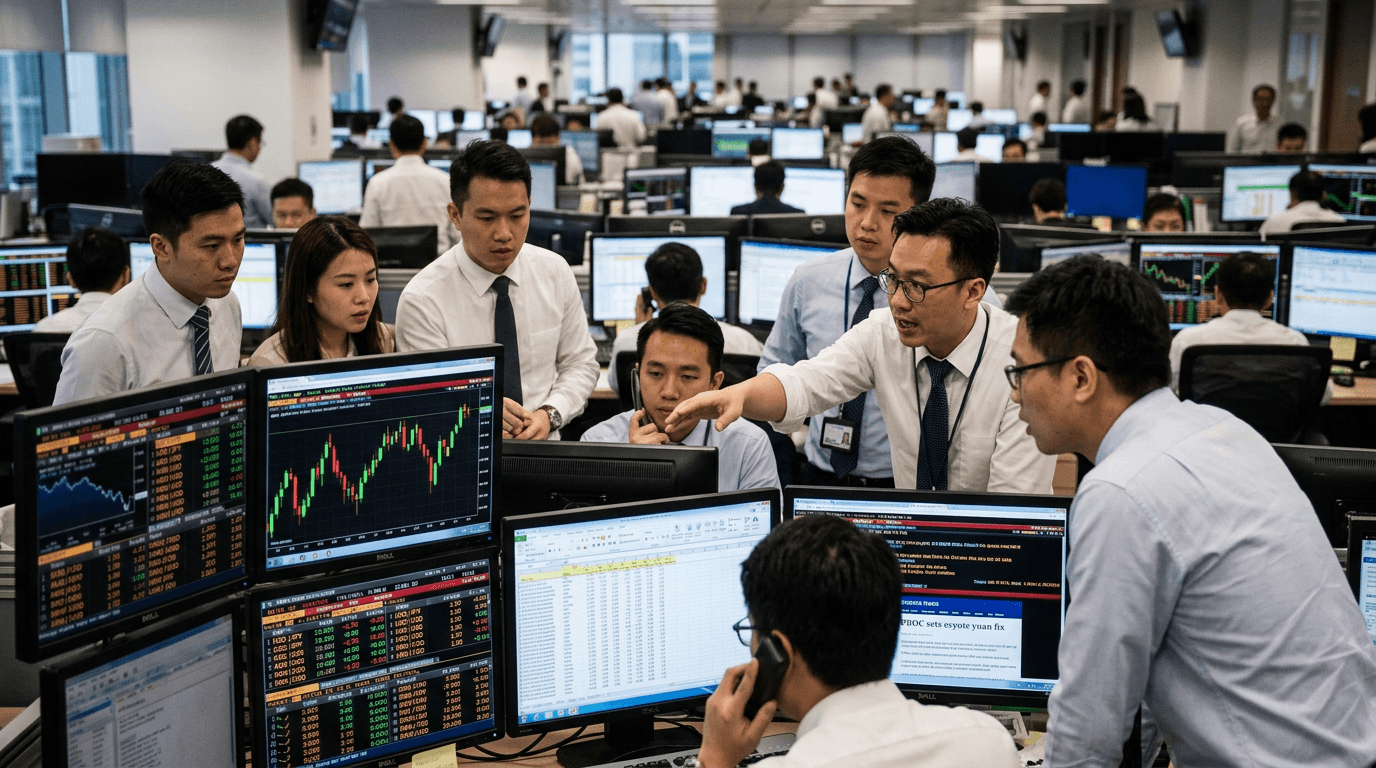
Asia’s currency market is sending clear signals again, with the Chinese yuan back at the center of regional moves as traders react to a mix of policy tweaks, daily fixing surprises, and shifting trade headlines.[2][6][7][12][13] For anyone trading Asia FX, equities, or futures—even in a simulated environment—understanding how these forces interact is becoming essential rather than optional.
Yuan swings are not just an FX story. They shape export expectations, influence where global capital flows, and feed directly into risk appetite across Asian stock indices and local futures markets.[1][5][7][9][14] When policy and trade narratives shift quickly, the speed of those adjustments can catch unprepared traders offside.
Drivers Behind The Latest Yuan Moves
The yuan’s daily reference rate—the PBoC’s midpoint fix—remains the single most important short‑term signal for the currency.[2][3][6][12][13] By setting the midpoint stronger or weaker than markets expect, the central bank can lean against prevailing trends or quietly endorse them.[2][3][6][12][13]
There have been multiple episodes where authorities set a stronger-than-expected midpoint to cap yuan losses during bouts of trade-related anxiety, limiting depreciation even as headline risk spiked.[2][12] Conversely, stretches of weaker fixings have suggested policymakers were willing to tolerate—or even encourage—a softer currency to cushion the impact of tariffs and support exporters.[13][15]
Beyond the fix, Beijing has rolled out tools to steady a fragile yuan, including steps to increase dollar liquidity parked in offshore hubs and adjust rules so corporates can borrow more overseas.[4] These measures aim to smooth capital flows and reassure markets that authorities are prepared to defend against disorderly moves.[4]
Global policy also matters. A dovish shift from the Federal Reserve—such as a chair signaling that rate cuts are on the table—has previously propelled the yuan to multi‑week highs as the dollar retreated.[10] At other times, uncertainty over Fed policy and expectations of a domestic rate cut in China have weighed on the currency, with the yuan underperforming regional peers.[8][15] The result is a currency caught between domestic easing needs and the external pressure of U.S. rates.
How Asia Fx Reacts To Policy And Trade Headlines
When trade tensions flare, Asia FX typically moves as a bloc, with the yuan acting as the anchor currency.[1][9][14] Past tariff announcements from the United States triggered broad declines in emerging Asian currencies, accompanied by yuan weakness and sharp falls in Chinese equities.[1][9] That pattern underscores how quickly trade headlines can morph into a regional risk‑off move.
Research on the trade war period shows Asian currencies experienced the strongest spillovers from yuan moves compared with other emerging markets, highlighting how tightly the region’s FX complex is tied to China’s currency.[14] As the yuan softened during tariff escalations, other Asian FX often followed, even when their own fundamentals had not dramatically changed.[14]
Not every episode is risk‑off. When optimism grows around Chinese reopening or perceived relief on tariffs, the yuan has led gains, sometimes rallying about 1% in a session and dragging parts of Asia FX higher.[5][7][13] In such cases, a softer dollar and improved export sentiment toward China have helped, even if other Asian currencies remained more muted due to lingering Fed hawkishness.[5][15]
Monetary policy cross‑currents add another layer. Periods when the Bank of Japan is in focus or when traders anticipate coordinated policy responses among major economies can see the yen and other Asian currencies move in tandem with the yuan, amplifying regional swings.[6][12] For FX traders, that means policy headlines in Tokyo, Washington, and Beijing can all hit Asia FX simultaneously.
Impact On Exports, Equities, And Futures
A weaker yuan can partially offset the impact of tariffs by improving price competitiveness for Chinese exporters, but it also raises concerns about imported inflation and capital outflows.[13][14] During past tariff escalations, authorities appeared to tolerate some depreciation, using softer fixings and targeted stimulus to support growth while avoiding a perception of uncontrolled devaluation.[9][13]
Stronger yuan phases—often built on firmer midpoint fixes and supportive policy messaging—send a different signal.[3][4][6][7] They can reflect confidence in domestic conditions, attract foreign inflows into bonds and equities, and reduce external debt pressures for Chinese firms, even as they slightly erode export pricing advantages.[3][4][6][7] For investors, this mix can translate into a bid for financial assets even if exporters underperform at the margin.
Trade headlines can quickly spill into equity markets. When the United States unveiled or threatened new tariffs in the past, Chinese stocks dropped around 2% on the day, with the yuan weakening and broader Asian risk assets following lower.[1] Conversely, developments such as court rulings or negotiations that hint at tariff relief have coincided with the yuan climbing to multi‑year highs and renewed optimism on export‑driven sectors.[7][13]
These dynamics flow directly into local futures positioning. As yuan and Asia FX volatility rises around policy meetings or trade announcements, traders adjust index futures, rates futures, and commodity exposures to hedge earnings risk and funding costs.[1][5][9][15] That feedback loop is why seemingly “FX‑only” headlines can trigger sharp moves in equity and rates curves across the region.
HOW TRADERS CAN NAVIGATE YUAN‑LED ASIA FX SWINGS
For active traders, the daily PBoC fix is a critical anchor. Comparing the midpoint to market expectations offers a real‑time gauge of policy intent: a stronger‑than‑expected fix tends to support the yuan and, by extension, regional risk sentiment; a weaker fix can signal tolerance for depreciation and raise caution on Asia FX and equities.[2][3][6][12][13]
Trade and tariff headlines should be treated as volatility events, not background noise. Past U.S. tariff threats have triggered broad declines in Asian currencies and risk assets, while limited or temporary tariff relief produced only fragile support for the yuan.[1][9][13] Traders can use these patterns to frame scenarios around new policy announcements, planning in advance how FX, equities, and rates might react.
Global central banks remain core drivers. Dovish surprises from the Fed that undercut the dollar have historically lifted the yuan and regional currencies, while renewed uncertainty over U.S. rates or underwhelming Chinese stimulus has hurt them.[8][10][11][15] Keeping a structured calendar of Fed, PBoC, and BOJ events, plus known trade negotiation milestones, can help traders anticipate where liquidity and volatility may cluster.
In a simulated environment such as a SimFi platform, traders can practice building cross‑asset views: expressing a bearish take on tariff risk via short positions in export‑heavy equity index futures alongside yuan‑sensitive FX pairs, or testing how a dovish Fed shock would reprice Asia FX and local bond futures.[1][5][7][9][15] The goal is not just to predict direction, but to understand correlations and manage risk across instruments.
Key Practical Takeaways
For short‑term strategies, treat the yuan fix and high‑impact trade or policy headlines as tradable catalysts rather than after‑the‑fact explanations.[2][6][7][12][13] Building rules around how you react to “strong” versus “weak” fixes and to tariff escalations versus de‑escalations can bring structure to your decision‑making.
For swing and position traders, monitor how persistent yuan trends align with macro narratives. Extended periods of weaker fixings and stimulus disappointment tend to favor defensive positioning in Asia FX and equities, while sustained yuan strength backed by credible policy tools and softer tariffs can justify a pro‑risk tilt.[4][7][13][15]
Finally, use simulated trading to stress‑test your assumptions. Run through historical scenarios—tariff shocks, surprise Fed pivots, sudden changes in Chinese stimulus—to see how your FX and equity books would have behaved.[1][5][8][10][11] That preparation can turn the next wave of yuan‑driven Asia FX volatility from a source of confusion into a potential opportunity.