
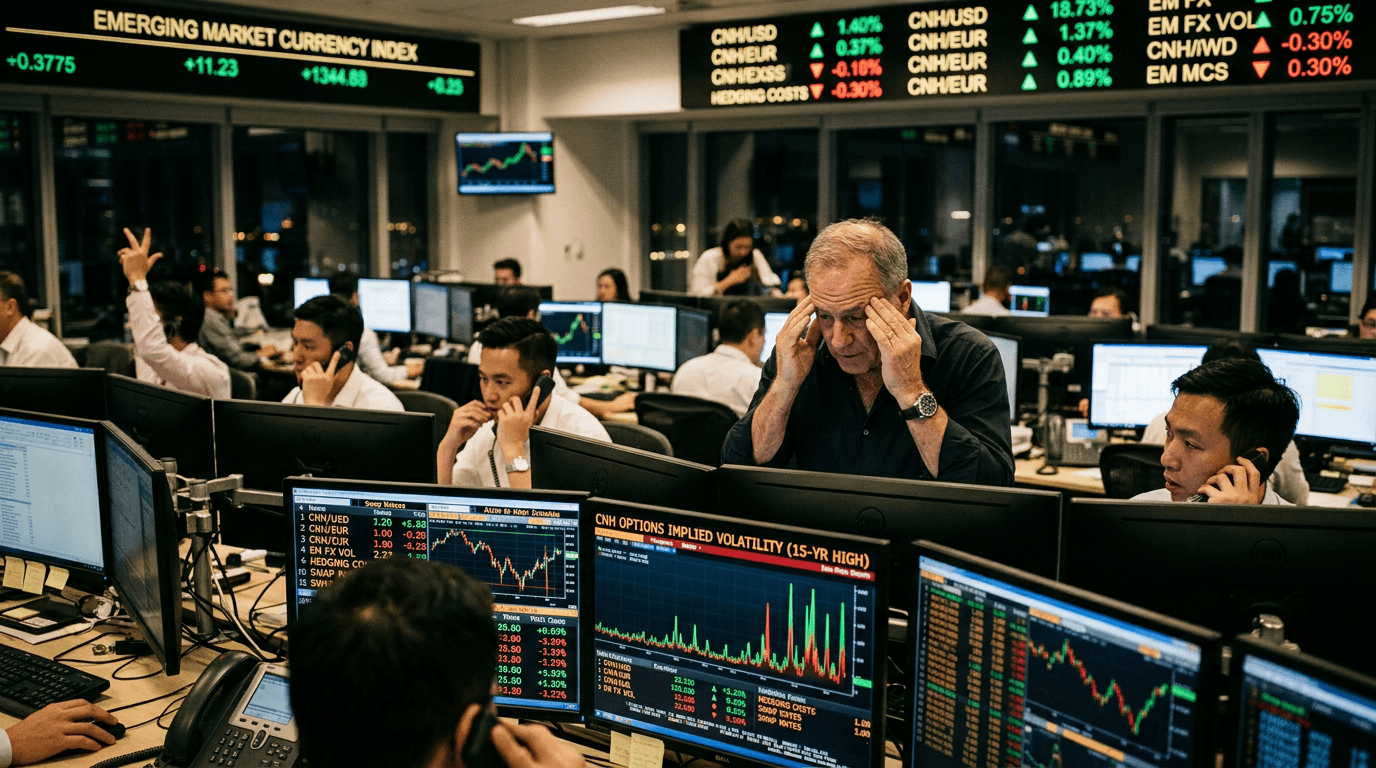
Option markets are sending a loud signal on China: the cost of buying downside protection on the offshore yuan has jumped to its highest level in roughly 15 years, highlighting how nervous traders have become about future FX swings and policy surprises from Beijing.[1][8] This spike in hedging costs is reshaping CNH crosses, rippling through emerging‑market currencies, and forcing both corporates and investors to rethink how they manage Chinese currency risk.[1]
WHAT’S HAPPENING IN YUAN OPTION MARKETS
In currency options, the premium paid for protection against a move in the exchange rate is a real‑time barometer of market fear and uncertainty.[1][11] For the offshore yuan (CNH), a widely watched gauge of the cost to hedge against currency moves has surged to levels last seen about 15 years ago, meaning traders are paying unusually rich prices for puts that protect them if the yuan weakens against the US dollar.[1][8]
This move is especially notable because, as recently as late 2025, longer‑dated risk reversals on USD/CNH had turned close to neutral for the first time in more than 14 years, indicating investors were paying roughly the same to hedge against yuan strength and weakness.[2][10][5] The latest jump in downside hedging costs marks a clear reversal of that balance: demand for protection against depreciation is now dominating, even after a period in which the currency had shown signs of resilience.[1][2]
The surge in implied volatility is not occurring in isolation. Trading activity in dollar‑yuan options has picked up significantly, with positioning in recent months often tilted toward scenarios where the Chinese currency makes sizable moves against the dollar.[15][8] At the same time, onshore markets have seen record volumes of FX options and forwards, underscoring how broad the hedging response has become across both financial players and real‑economy firms.[8][12][20]
WHY ARE HEDGING COSTS SO ELEVATED?
At the core of this move is a multi‑dimensional “China risk” that spans growth, policy, capital flows, and global demand.[1] Investors are grappling with uncertainty around how aggressively Beijing will support the economy, the balance between stimulus and financial stability, and the potential for changes in currency management or capital‑account rules that could alter the trajectory of the yuan.[1][17]
Global rate dynamics matter too. Research on FX hedging shows that when the gap between US dollar interest rates and local‑currency rates widens, the cost of traditional hedges via swaps and forwards rises, pushing some market participants toward options instead.[11] That shift can amplify option demand and lift implied volatility, particularly in currencies where policy signals are less predictable and capital flows are sensitive to sentiment, such as the yuan.[11][1]
Domestic behavior is adding another layer. Chinese companies have ramped up their use of FX derivatives to record levels as currency swings threaten to compress export margins and complicate the management of dollar debt.[6][12][20] Exporters and borrowers are racing to lock in more stable cash flows, while some firms have also become structural sellers of options in quieter periods to earn premium and fine‑tune hedge costs.[13][17] When uncertainty spikes, however, the balance shifts toward net protection‑buying, pushing hedging costs higher across tenors.[1][13]
Ripple Effects Across Cnh Crosses And Emerging Markets
Elevated yuan hedging costs do not just affect USD/CNH; they ripple through CNH crosses and broader emerging‑market FX sentiment.[1] When implied volatility on the yuan jumps, traders often reassess risk premia on Asian currencies that are closely linked to China via trade and capital flows, as well as on commodity‑linked currencies that depend heavily on Chinese demand.[1][18]
Higher volatility tends to make carry trades less attractive, as investors demand more compensation for holding higher‑yielding currencies funded in dollars or other low‑yield currencies.[11][18] If markets begin to price a wider range of outcomes for Chinese growth and policy, positions in EM FX that are implicitly tied to a stable yuan can see sharper swings, triggering more demand for hedges in those markets as well.[1][11]
The corporate response reinforces these dynamics. As Chinese exporters pile into currency hedges and outstanding forward settlements hit record levels, their flows can influence pricing in both spot and derivatives markets worldwide.[6][17][20] In calmer periods, heavy corporate option selling can suppress implied volatility, but when risk appetite shifts and protection‑buying dominates, the resulting move in vols can be abrupt, as the current 15‑year high in yuan hedging costs illustrates.[1][13]
Implications For Traders, Hedgers And Portfolios
For Chinese firms with dollar‑denominated liabilities, the rise in hedging costs directly affects funding strategy and profitability.[9][12] Companies that had relied on relatively cheap currency hedges now face a trade‑off between absorbing more FX risk on their balance sheets or paying up for protection, which can squeeze margins in sectors already under pressure from slower global demand.[9][17]
Global investors holding China‑linked assets—such as onshore bonds, offshore equities, or EM funds with substantial China exposure—need to revisit their currency risk frameworks.[16][1] A simple buy‑and‑hold approach to FX hedging may no longer be sufficient in an environment where option markets are pricing in larger, more frequent moves. Strategies that combine forwards, options, and dynamic hedging can help smooth the cost profile, but they require a clear view of risk tolerance and scenario planning.[11][16]
For discretionary FX traders, heightened yuan volatility brings both opportunity and danger. Rich option premiums create scope for volatility‑selling strategies, spreads, and more complex structures—but being systematically short yuan volatility with hedging costs at 15‑year highs is inherently risky.[1][11] Monitoring metrics such as implied volatility curves, risk reversals, and open interest in key tenors can help traders distinguish between justified hedging demand and potential overshooting.[1][13][15]
Using Simulated Finance To Navigate Yuan Volatility
One constructive way to respond to this environment is to move from reactive hedging to proactive scenario testing. Simulated finance platforms allow traders and risk managers to model how different paths for the yuan—ranging from orderly appreciation to sharp depreciation—would impact portfolios, margin requirements, and strategy performance before committing capital in live markets.[1][16]
By stress‑testing CNH crosses and EM FX baskets under higher implied volatility, users can identify which exposures are most sensitive to changes in hedging costs and where option protection adds the most value.[11][18] They can also experiment with alternative hedging mixes—such as shifting part of the hedge from long‑dated forwards into shorter‑dated options—to see how the cost‑risk trade‑off behaves under different policy and market scenarios.[11][16]
Crucially, simulated environments help traders practice execution and risk management around event‑driven moves, such as data releases, policy meetings, or regulatory headlines that could suddenly change the market’s view on China.[1][13] With yuan hedging costs at multi‑year extremes, having a tested playbook for volatility spikes is no longer a luxury—it is a core part of robust FX risk management.
As option hedging costs on the Chinese yuan climb to 15‑year highs, the message from markets is clear: participants are bracing for a broader range of outcomes in China’s economy and policy, and they are willing to pay up to insure against those risks.[1][8] For traders, corporates, and investors alike, the challenge is to turn this warning signal into action—by reassessing hedging strategies, understanding how CNH volatility can ripple through global portfolios, and using tools like simulated finance to stay ahead of the next move rather than merely reacting to it.[1][11][16]