
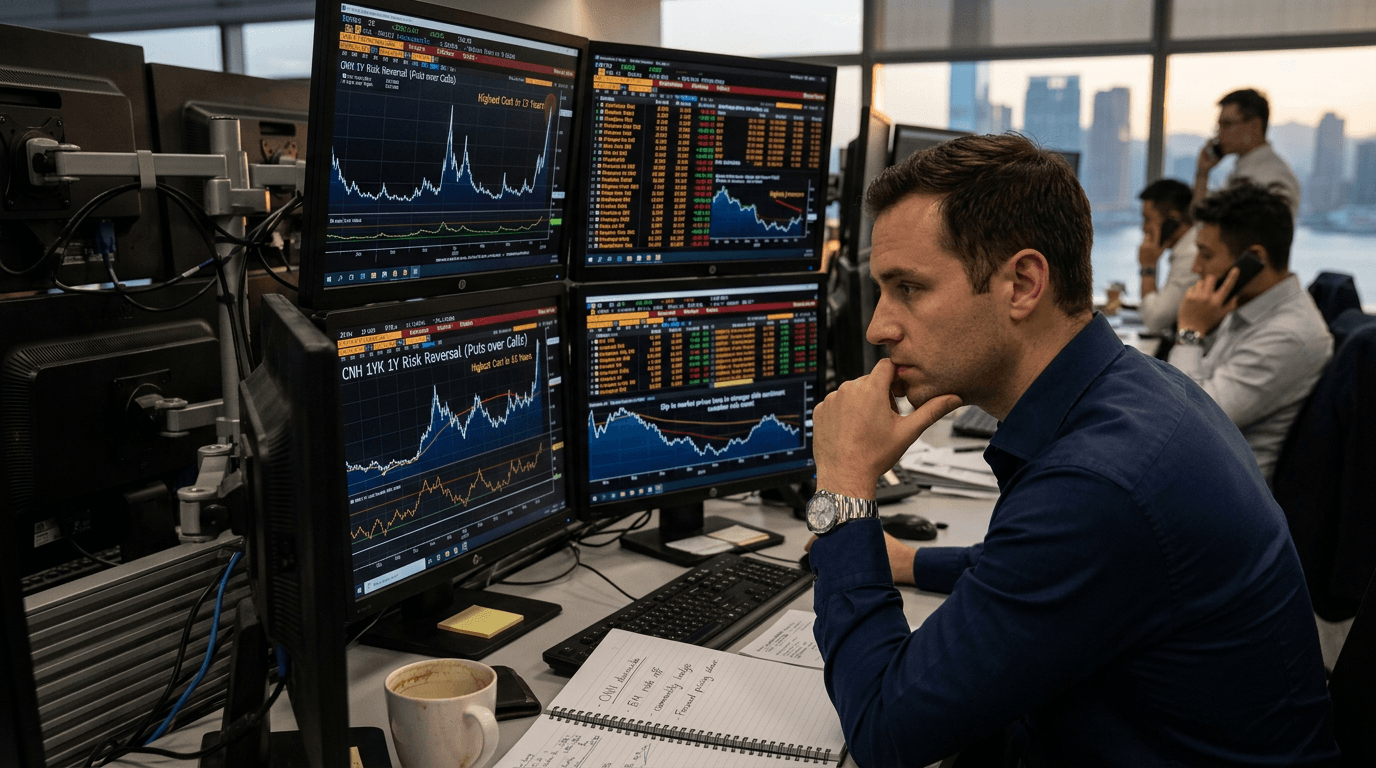
Option markets are flashing a clear warning signal on China: the cost of buying protection against offshore yuan downside has jumped to its highest level in roughly 15 years, underscoring how uneasy investors are about the country’s policy path and growth outlook.[1][15] This spike in hedging costs is rippling through CNH forwards, volatility pricing in FX options, and risk appetite in emerging‑market currencies and commodities linked to Chinese demand.
Why Hedging Costs Are At A 15-year High
In currency options, the price of downside protection is a direct measure of how much fear is in the market. For the offshore yuan (CNH), a widely watched option gauge of the cost to hedge against moves in the currency has climbed to levels last seen about 15 years ago.[1] That means traders are willing to pay unusually rich premiums for puts that protect them if the yuan weakens against the US dollar.
One driver is persistent uncertainty around China’s economic trajectory. Authorities are juggling conflicting priorities: supporting growth, managing property‑sector stress, stabilising capital flows, and defending financial stability, all while avoiding a sharp depreciation in the currency.[11][18] When policy signals are mixed, market participants tend to insure against downside scenarios rather than bet aggressively on a single outcome.
Structural features of the offshore market are also amplifying the move. Tight CNH liquidity and a record basis between onshore (CNY) and offshore forward rates have previously pushed offshore hedging costs sharply higher as the renminbi weakened against the dollar.[15] In periods of stress, CNH forwards can move violently, with six‑month USD/CNH forwards swinging by as much as 150 points in volatile sessions.[17] That combination of policy uncertainty and market structure makes downside hedging both more necessary and more expensive.
How Option Markets Are Pricing China Risk
Option markets distil a lot of information into a few key metrics. Implied volatility captures the expected magnitude of future price swings, while risk reversals show whether the market is paying more for downside or upside protection. In earlier episodes of yuan weakness, implied volatility for dollar‑offshore yuan surged to its highest levels in over a year, and one‑month risk reversals jumped to levels last seen several years before, reflecting a clear skew toward downside hedging demand.[5]
More recently, some longer‑dated risk reversals have turned neutral for the first time in about 14 years, indicating investors were paying roughly the same to hedge against yuan strength and weakness.[2] The latest surge in downside hedging costs is therefore notable: it suggests a renewed and concentrated demand for protection against depreciation, even after a period when the currency appeared more resilient.[2][5]
This shift is not confined to the FX options market itself. When investors pay up for yuan downside protection, they are essentially pricing in higher macro risk around China. That tends to spill over into emerging‑market FX and commodities tied to Chinese demand, as traders hedge broader exposure to a China‑centric slowdown. Higher implied volatility increases option premiums across related assets, raises margin requirements, and can dampen carry trades that rely on stable currency paths.
Cnh Forwards, Corporate Flows And Commodity Links
The forwards market is where many of these dynamics become tangible. Offshore RMB hedging costs have soared in the past when downward pressure on the renminbi and tight liquidity drove a record basis between CNY and CNH forwards.[15] Despite rising costs, corporates with US‑dollar borrowing exposures have often had little choice but to hedge offshore, because the CNH market is the most practical channel to manage their currency risk.[15]
Onshore, regulators have taken steps that can both encourage hedging and influence pricing. China’s State Administration of Foreign Exchange has promoted higher hedging ratios via so‑called window guidance, with banks lifting corporate clients’ FX hedge ratios to around 40% in some regions and about 30% nationally, up significantly from earlier years.[11] At the same time, cutting the FX risk‑reserve ratio for banks has reduced the cost of selling FX forwards to customers, giving importers more flexibility in locking in forward rates.[18] The net effect is more hedging activity, which can support market depth but also sustain demand for downside protection.
This matters far beyond the FX desks. When yuan risk reprices sharply, it can alter the economics of commodity trades and investment strategies tied to China’s industrial cycle. Futures on metals, energy, and agricultural products that depend heavily on Chinese demand often see volatility and risk premia adjust in tandem with big moves in CNH hedging metrics, as traders factor currency‑driven changes in import costs and capital flows into their positioning.
What It Means For Investors, Corporates And Risk Managers
For Chinese companies and global investors, the message is clear: yuan risk is both more volatile and more expensive to insure than it has been for many years. Chinese firms have already ramped up FX derivatives hedging to record levels, with net outstanding forward settlement contracts reaching their highest since records began in 2010 as the currency’s moves threatened export earnings.[9] That institutional behaviour is consistent with the spike in options pricing, reinforcing the signal that hedging is no longer optional but integral.
Global investors face a trade‑off. Offshore instruments such as CNH forwards, non‑deliverable forwards (NDFs), and options are relatively easy to access, with established infrastructure and broad support from custodians and prime brokers.[10][12] However, they can be more expensive, with wider bid‑ask spreads, less favourable carry, and basis risk when offshore rates diverge from onshore pricing in times of policy intervention.[10][15] Choosing the right mix of onshore and offshore tools, tenors, and structures has become a more strategic decision.
Newer hedging structures can help partially offset higher premiums. Onshore reforms have allowed corporates to use more sophisticated instruments like call spreads and capped forwards to reduce hedging costs compared with plain‑vanilla options.[16] While these are designed for the onshore market, the same principles apply offshore: structuring cost‑efficient collars, spreads, or zero‑cost forwards can make it more manageable to hedge in a high‑volatility regime.
Practical Takeaways For Simulated Traders And Strategists
For traders and portfolio managers using simulated finance platforms, elevated yuan hedging costs create a rich environment for strategy testing. When implied volatility and risk reversals are stretched, option markets often misprice tail risks, and the pay‑off profile of complex structures becomes more sensitive to model assumptions. A SimFi environment lets you experiment with:
– Building CNH downside hedges using puts and put spreads, and comparing their performance across different volatility regimes.
– Stress‑testing portfolios that combine EM FX, China‑linked equities, and commodities to see how a shock to yuan hedging costs propagates through cross‑asset correlations.
– Exploring basis‑risk scenarios where CNY and CNH diverge, and assessing how forward hedges perform when policy shifts change the relationship between onshore and offshore markets.[15][17]
The current backdrop also highlights the importance of dynamic hedging. As corporate hedging ratios rise and regulatory changes alter forward pricing,[11][18] static rules of thumb become less reliable. Simulated environments can help teams refine trigger levels for adjusting hedges, calibrate position sizes to implied volatility, and compare outcomes between unhedged, partially hedged, and fully hedged strategies over realistic market paths.
Ultimately, the 15‑year high in offshore yuan option hedging costs is a reminder that China risk is multi‑dimensional: it spans growth, policy, capital flows, and global demand. For anyone exposed to these themes—directly through CNH or indirectly through EM FX and commodities—understanding how option markets encode that risk, and practising how to manage it, is now a core part of the job.