
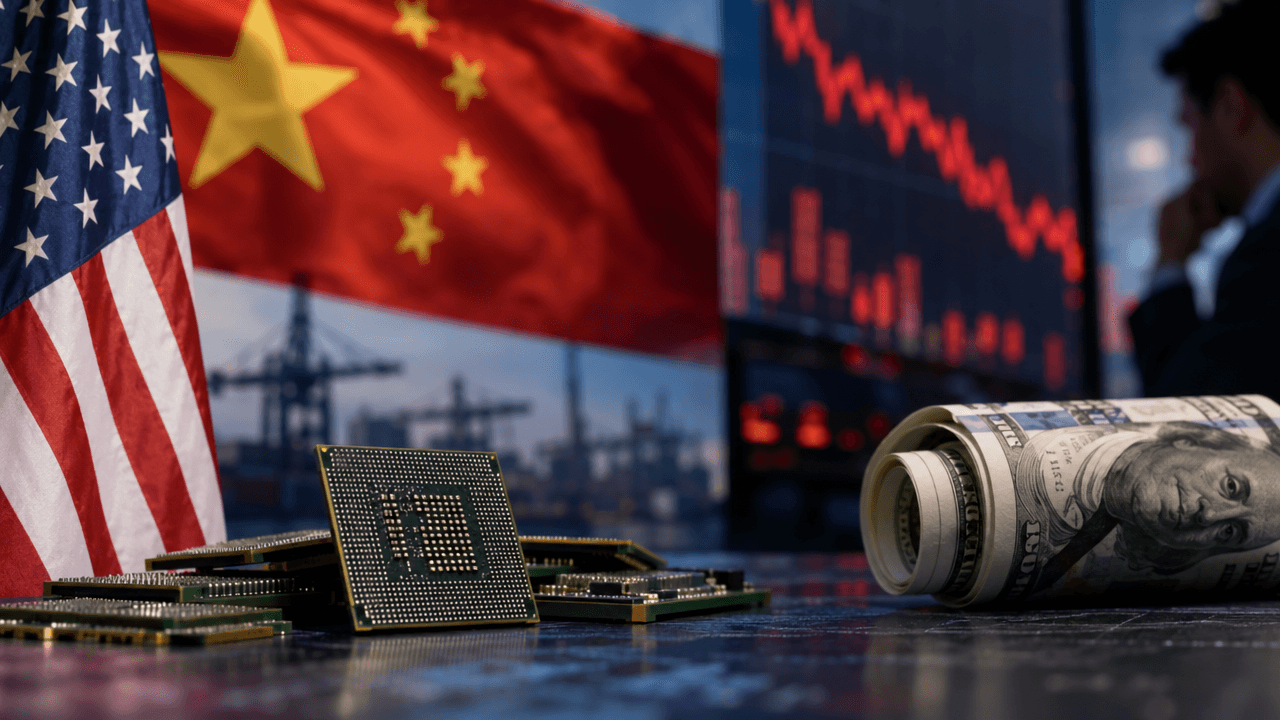
A new round of US restrictions on China’s access to advanced artificial intelligence chips has pushed investors into a broad risk-off posture, extending technology losses from Wall Street into Asian markets. The move has intensified concerns about the future of the global AI trade, raised the possibility of retaliatory measures from Beijing, and encouraged demand for traditionally defensive assets such as the US dollar.
The immediate market reaction was sharp. The Philadelphia Semiconductor Index fell more than 5% on Monday, while the Nasdaq lost more than 2%. Asian technology markets followed lower on Tuesday, with South Korea’s tech-heavy KOSPI falling about 2%, Taiwan’s stock market declining more than 2% at one point, and Hong Kong’s Hang Seng Tech Index dropping roughly 2.3%. [1][5][7]
Why The New Restrictions Matter
The latest US measures go beyond direct shipments of advanced chips to Chinese customers. They also target overseas data centers that could provide Chinese companies with remote access to high-performance computing capacity.
Under the proposed rules, operators in locations including Singapore, Malaysia, Thailand, Indonesia, and Brazil may need US licenses to export advanced AI chips made by companies such as Nvidia to customers in those countries. These restrictions are designed to close potential workarounds through which Chinese firms could rent computing power abroad rather than import the chips directly. [11][12]
That distinction is important because modern AI development depends on access to large clusters of powerful processors. If Chinese model developers cannot reliably access those systems, the impact could extend beyond chip purchases. Training costs may rise, development timelines may lengthen, and cloud providers could see slower growth in AI-related revenue.
The policy also increases uncertainty for semiconductor manufacturers, data-center operators, cloud companies, and investors. Even firms outside China may now face additional licensing requirements, compliance costs, and restrictions on how their infrastructure can be used.
Why Investors Are Selling Technology Shares
The selloff reflects more than a single policy announcement. Investors were already questioning whether the rapid rise in AI-related valuations had moved ahead of underlying earnings and cash flows. Nvidia’s closely watched earnings report has added another layer of sensitivity, with traders looking for evidence that demand for AI infrastructure remains strong enough to justify high valuations. [2][6]
The new restrictions challenge both sides of the AI investment story. For chipmakers, China represents a major potential market that may become more difficult to serve. For Chinese technology companies, reduced access to advanced processors could limit their ability to compete with US-based firms in cloud computing and large language models.
The result is a repricing of risk across the entire technology supply chain. Semiconductor designers, equipment manufacturers, cloud providers, data-center operators, and AI application companies may all be affected, even when their direct exposure to China is limited.
Chinese technology shares have suffered particularly heavy losses. Alibaba fell as much as 5.6% in Hong Kong, while Baidu dropped as much as 6.6%. The pressure has also reached AI model developers and hyperscalers, whose businesses depend on affordable access to advanced computing resources. [7]
How The News Is Affecting Other Markets
A risk-off move typically involves investors reducing exposure to volatile assets and increasing allocations to liquidity and perceived safety. That pattern was visible as technology and cyclical assets declined, while demand for the US dollar strengthened.
The dollar often benefits during periods of uncertainty because it remains deeply integrated into global trade and finance. International investors may also convert local currency into dollars when reducing exposure to emerging-market equities or repatriating capital. A stronger dollar, however, can create additional pressure for countries and companies with dollar-denominated debt.
Other markets have also reflected the shift in sentiment. Reports indicated that volatility was rising, while copper and oil prices were falling and Treasury yields were edging lower. These moves suggest that investors were considering a broader slowdown in global growth rather than treating the chip restrictions as an isolated technology-sector event. [10]
For traders, the key issue is whether the selling remains concentrated in AI-related shares or spreads into broader equity indexes, commodities, and credit markets. A contained technology correction could create selective opportunities. A wider decline would indicate that investors are reassessing global growth, corporate earnings, and geopolitical risk at the same time.
What Traders Should Watch Next
The first signal will be the market’s reaction to Nvidia’s earnings and forward guidance. Strong results may stabilize sentiment if they demonstrate that global AI demand remains robust. However, even strong earnings may not fully offset concerns about export controls and the possibility of slower growth in China-related revenue.
Traders should also monitor official responses from Beijing and any clarification from Washington about the timing, scope, and enforcement of the restrictions. Retaliatory action against US companies, rare-earth materials, cloud services, or other strategic industries could increase volatility.
Currency markets deserve close attention as well. Continued dollar strength would confirm that investors are seeking liquidity and reducing risk. At the same time, traders should watch Treasury yields, the VIX volatility index, semiconductor shares, and Asian technology benchmarks for evidence of stabilization.
A practical approach is to reduce dependence on one market theme. Traders can define risk before entering positions, use smaller position sizes during headline-driven sessions, and avoid assuming that a sharp decline automatically represents a buying opportunity. Correlations often rise during risk-off conditions, meaning diversification may provide less protection than expected.
The Bigger Picture
The latest AI-chip restrictions show how technology policy has become a major market force. Semiconductor supply chains are no longer shaped only by commercial demand and production capacity. Export controls, national-security priorities, and geopolitical competition now influence corporate earnings and investor valuations.
For markets, the central question is whether restrictions slow China’s AI development, accelerate domestic chip substitution, or simply redirect demand toward alternative suppliers. Each outcome could produce different winners and losers.
The immediate lesson is clear: AI exposure carries both technological upside and geopolitical risk. Investors who focus only on projected demand may overlook the policy decisions that determine where chips can be sold, how computing power can be accessed, and which companies can participate in the next stage of AI growth. In an increasingly fragmented technology landscape, disciplined risk management may matter as much as identifying the next big innovation.