
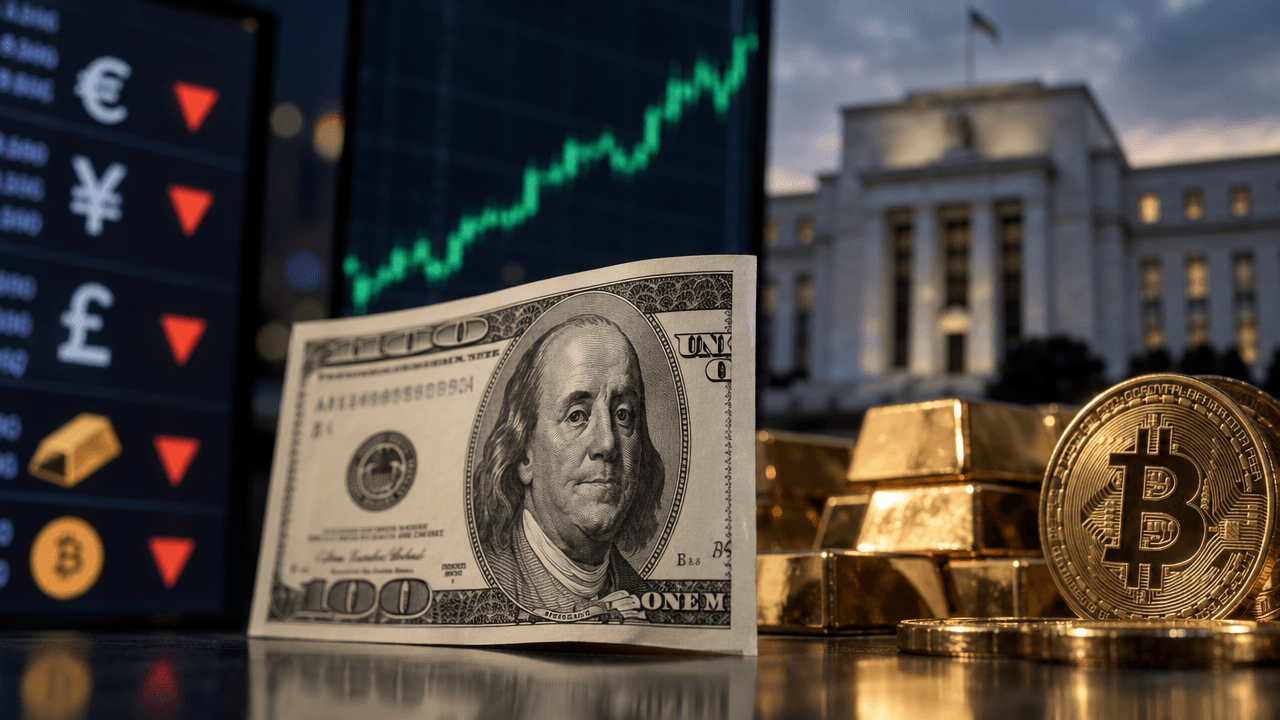
The US dollar has entered a renewed period of strength, with the Dollar Index climbing to its highest level since April 2025 as traders increasingly anticipate another Federal Reserve interest-rate increase. The index reached approximately 103.69 on Tuesday, extending a winning streak driven by hotter-than-expected US inflation and increasingly hawkish expectations for monetary policy. [11]
Markets are now treating a December rate hike as highly likely. CME Group futures recently implied roughly a 95% or greater probability of a 25-basis-point increase, while a smaller probability remained attached to a larger 50-basis-point move. [1][9] For traders, this shift matters because interest-rate expectations influence capital flows, currency valuations, bond yields and the relative attractiveness of risk assets around the world.
Why The Dollar Is Rising
Currency markets are forward-looking. The dollar does not strengthen only when the Federal Reserve raises rates; it can rally when investors believe rates will remain higher for longer or that future increases are more likely than previously expected.
Recent US inflation data played a central role in changing those expectations. Consumer prices increased more than economists anticipated in October for a third consecutive month, reinforcing concerns that inflation may be proving persistent. [3] Hawkish comments from Federal Reserve officials added to the pressure, with markets even briefly considering whether policymakers could deliver a larger-than-usual half-percentage-point increase in December. [6]
Higher expected US interest rates can attract international capital. Investors may move funds into dollar-denominated Treasury securities, money-market instruments or other US assets in search of better yields. That additional demand for dollars can push the currency higher, particularly when other major central banks are not expected to tighten policy as aggressively.
The rally also reflects momentum. A dollar that has been rising for several sessions can encourage trend-following traders to add long positions, while investors holding foreign assets may increase their currency hedges. This can amplify the initial move and produce sharper reactions across global markets.
PRESSURE ON EUR/USD AND OTHER CURRENCIES
The most direct impact is visible in currency pairs such as EUR/USD. Because the euro is the first currency in the pair and the dollar is the second, a falling EUR/USD generally means the dollar is strengthening relative to the euro.
A stronger dollar can weigh on the euro when traders believe the Federal Reserve will maintain a larger interest-rate advantage over the European Central Bank. It can also affect corporate earnings, trade competitiveness and imported inflation. European companies that purchase commodities priced in dollars may face higher costs when the euro weakens.
Emerging-market currencies can be even more sensitive. Many emerging economies have dollar-denominated debt, meaning a stronger dollar increases the local-currency cost of interest and principal payments. At the same time, investors may withdraw capital from higher-risk markets and redeploy it into US assets. This can create a combination of currency depreciation, tighter financial conditions and increased pressure on local central banks.
The Japanese yen and other low-yielding currencies may also struggle when US yields rise. However, currency markets are never one-directional. Intervention risks, domestic policy changes, economic surprises and shifts in risk sentiment can interrupt a dollar rally quickly.
Why Gold And Crypto Are Vulnerable
Gold often faces pressure when the dollar rises and interest-rate expectations increase. The metal does not pay interest, so higher Treasury yields can raise the opportunity cost of holding gold. A stronger dollar also makes gold more expensive for buyers using other currencies.
Gold recently remained near a more than one-year low as the firm dollar and expectations for a December Fed hike weighed on demand. [9] This does not mean gold must fall every time the dollar rises. Investors may still buy it as insurance against inflation, geopolitical risk or financial instability. But in the short term, higher real yields and a stronger dollar can create a challenging environment.
Crypto assets can experience similar pressure, although their market structure and risk profile are different. Bitcoin and other digital assets are often treated as high-beta or liquidity-sensitive instruments. When investors expect borrowing costs to rise, they may reduce exposure to speculative assets and favor cash or short-term government securities.
The effect is not purely mechanical. Crypto markets also respond to institutional flows, regulatory developments, network activity and investor positioning. Still, a stronger dollar can signal tighter global liquidity, which is generally a headwind for highly volatile assets.
Practical Takeaways For Simfi Traders
The first lesson is to monitor expectations, not only official decisions. The Federal Reserve’s meeting is important, but the largest market moves may occur before it if inflation data, employment figures or policymaker comments change the perceived probability of a hike.
Second, watch correlations without assuming they are permanent. A rising dollar may coincide with falling EUR/USD, weaker gold and softer crypto prices, but each market has its own drivers. Correlations can strengthen during periods of stress and break down when a separate catalyst takes control.
Third, position sizing matters. A crowded trade can reverse rapidly if inflation cools, the Federal Reserve sounds less hawkish or traders take profits after the decision. In a simulated trading environment, traders can study these scenarios without exposing real capital: compare a gradual dollar rally with a sudden reversal, then evaluate how stops, leverage and trade duration affect outcomes.
Finally, distinguish a 25-basis-point hike from a larger policy surprise. Markets have already priced in a high likelihood of a quarter-point move. If the outcome matches expectations, the dollar’s reaction may depend on the accompanying guidance. A larger hike or a signal of additional increases could extend the rally, while a less aggressive outlook could trigger a sharp pullback.
Conclusion
The dollar’s advance to its highest level since April 2025 reflects a major repricing of Federal Reserve expectations rather than a single isolated currency event. Stronger inflation data and hawkish policy signals have lifted projected US yields, supporting the dollar while pressuring EUR/USD, gold, emerging-market currencies and crypto assets.
For traders, the key is to follow the interaction between inflation, interest rates and risk appetite. The dollar may continue to benefit if US data remains firm, but markets can turn quickly when expectations become crowded. Careful scenario planning, disciplined risk management and an understanding of cross-asset relationships are essential in both live markets and SimFi practice.