
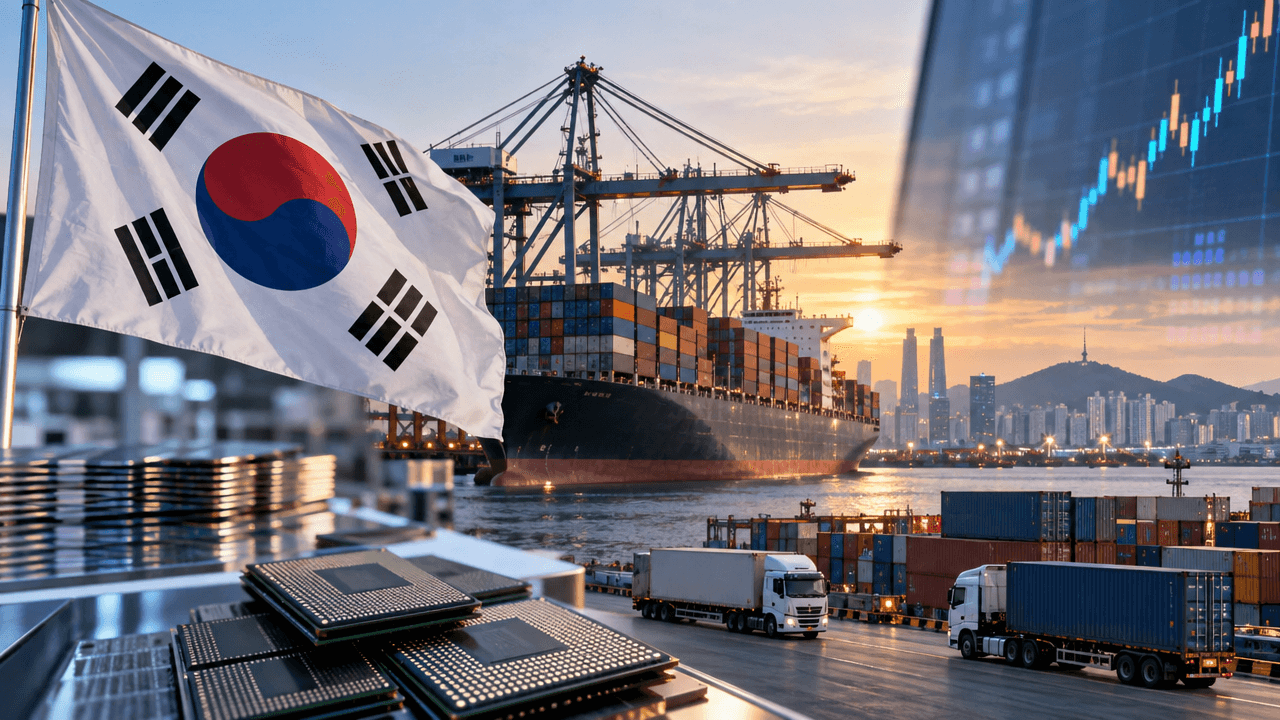
South Korea’s export engine is set to log its 16th consecutive month of growth in September, underscoring how the global AI chip boom is reshaping both the country’s economy and broader market sentiment[4]. For traders watching the Korean won, semiconductor-linked equity futures, and Asian growth proxies, this data point is more than a headline—it is a live stress test of the AI super-cycle narrative[4].
Global Trade Bellwether
South Korea is one of the world’s most trade-dependent economies, and its monthly export figures function as an early read on global demand across technology, autos, and industrial goods[4]. A Reuters poll of economists expects exports to rise around 62% year-on-year in September, extending the winning streak to 16 straight months and confirming that global appetite for Korean goods remains exceptionally strong[4].
High-frequency customs data for early September show just how powerful this momentum has become: exports surged roughly 78–89% versus a year earlier in the first 20 days of the month, with semiconductors doing most of the heavy lifting[9][10][12]. That pace suggests not only robust external demand but also an economy increasingly leveraged to a single, high-growth sector—chips linked to artificial intelligence infrastructure[11][12].
For traders and investors, this bellwether role means South Korean export releases can serve as a quick gauge of the health of global trade before other major economies publish their own data. Strong prints tend to support risk appetite, while any unexpected slowdown can be an early warning signal for equity, FX, and commodity markets.
Ai Chip Super-cycle Driving The Numbers
The core story behind the export streak is the AI-driven semiconductor super-cycle. In early September, chips accounted for close to half of South Korea’s outbound shipments, with estimates around 47–48% of total exports—an unprecedented concentration in one product category[2][5][13]. Semiconductor exports themselves have surged roughly 259% year-on-year in the first 20 days of the month, reaching more than $34 billion over that period alone[11][12][13].
This demand is closely tied to massive global investment in AI data centers and computing infrastructure. Major cloud and technology companies are racing to scale up AI capacity, driving sustained orders for memory and logic chips that power large-scale model training and inference[2]. As a result, South Korea’s trade profile has tilted decisively toward AI-related semiconductors, marking a structural shift rather than just a cyclical upswing[2][5].
The export boom is visible at the annual level as well. Year-to-date shipments have already surpassed last year’s full-year record, hitting roughly $709.4 billion and setting a new high for South Korean trade[14]. While this is positive for growth and fiscal revenues, it also increases sensitivity to any future slowdown in AI investment or changes in chip pricing. Understanding this concentration risk is critical for assessing both macro resilience and sector-specific vulnerabilities.
Implications For The Korean Won And Equity Futures
Export data is one of the key fundamental drivers of the Korean won, particularly in an environment where external demand is a primary growth engine. Strong, sustained export growth typically supports the currency by improving the trade balance and reinforcing confidence in the macro outlook. Conversely, any surprise disappointment relative to expectations could weigh on the won as markets reassess earnings prospects and capital flows.
The September release will also matter for semiconductor-sensitive equity futures and sector indices. Chip makers are at the heart of Korea’s equity market, and their earnings expectations are closely tied to the same AI orders driving the export numbers[2][5]. If the actual data exceed the already-optimistic forecasts, it may validate bullish positioning in semiconductor futures and related equity baskets. If the numbers underwhelm—especially after such strong early-month data—there could be a swift repricing of growth assumptions.
For traders, the key is to treat the export print as a catalyst within a broader macro and sector framework. Pre-release, it is common to see positioning adjustments in KRW crosses, KOSPI futures, and global semiconductor indices as participants align their exposure with consensus forecasts. Post-release, the focus shifts to how the data change the narrative: is the AI chip cycle still accelerating, plateauing, or showing signs of fatigue?
Signals For Asian Growth And Global Risk Sentiment
Because South Korea sits at the intersection of global technology supply chains and Asian manufacturing networks, its export performance sends important signals for regional growth. Early September data show demand for Korean goods rising sharply across major trading partners: shipments to China, the United States, Vietnam, and the European Union all registered strong double-digit gains[11]. That pattern suggests the AI-driven chip boom is not confined to one geography but reflects widespread investment in advanced computing capacity[11][12].
When exports from a key hub like South Korea are rising at such a rapid pace, markets often infer that industrial production, capex, and earnings in other Asian economies may follow. This can bolster sentiment toward regional equity benchmarks, high-beta currencies, and cyclical sectors such as shipping and industrial metals.
However, traders should also watch for signs that growth is becoming too reliant on a single theme. If AI chip orders level off or if trade frictions re-emerge in key markets, the impact could extend beyond Korea to broader Asia. Monitoring export composition—how much is chips versus autos, ships, and petrochemicals—helps distinguish between healthy, diversified trade growth and more fragile, concentrated cycles.
How Traders Can Use Simulated Finance To Position
For active traders and those learning to navigate macro-driven markets, South Korea’s export story offers a useful template for building and testing event-driven strategies within a simulated environment. A Simulated Finance (SimFi) platform allows participants to model how different export outcomes might affect FX, equity index futures, and sector baskets without risking real capital.
Practical ways to engage with this theme include
- Creating scenarios where exports beat, meet, or miss consensus, then mapping expected moves in the won, Korean equity futures, and global semiconductor indices.
- Testing correlation assumptions between South Korean export surprises and broader Asian equity benchmarks or high-beta currencies.
- Simulating options strategies around key data releases, such as volatility-selling or directional bets tied to the AI chip narrative.
- Evaluating how a slowdown in chip demand would ripple through other sectors—autos, shipbuilding, energy—and adjusting portfolio allocations accordingly.
By experimenting with these scenarios in a SimFi framework, traders can refine their playbooks for real-world data releases, learning how to structure trades, manage risk, and interpret market reaction when catalysts like South Korean exports hit the tape.
Conclusion
South Korea’s expected 16th consecutive month of export growth, powered by AI-related semiconductors, underscores how deeply the global economy is now intertwined with advanced technology investment[4][11][12]. The September data will be more than a statistic; it is a referendum on the durability of the AI chip super-cycle and a key input for pricing the Korean won, semiconductor-heavy equity futures, and regional growth assets[4].
While fewer working days in September may moderate the headline growth rate compared with August, the underlying trend remains one of exceptional strength tied to AI infrastructure demand[4][9][10]. Traders who understand both the opportunity and the concentration risk embedded in this story will be better positioned to navigate the next phase of the cycle—whether in live markets or through simulated strategies that prepare them for what comes next.