
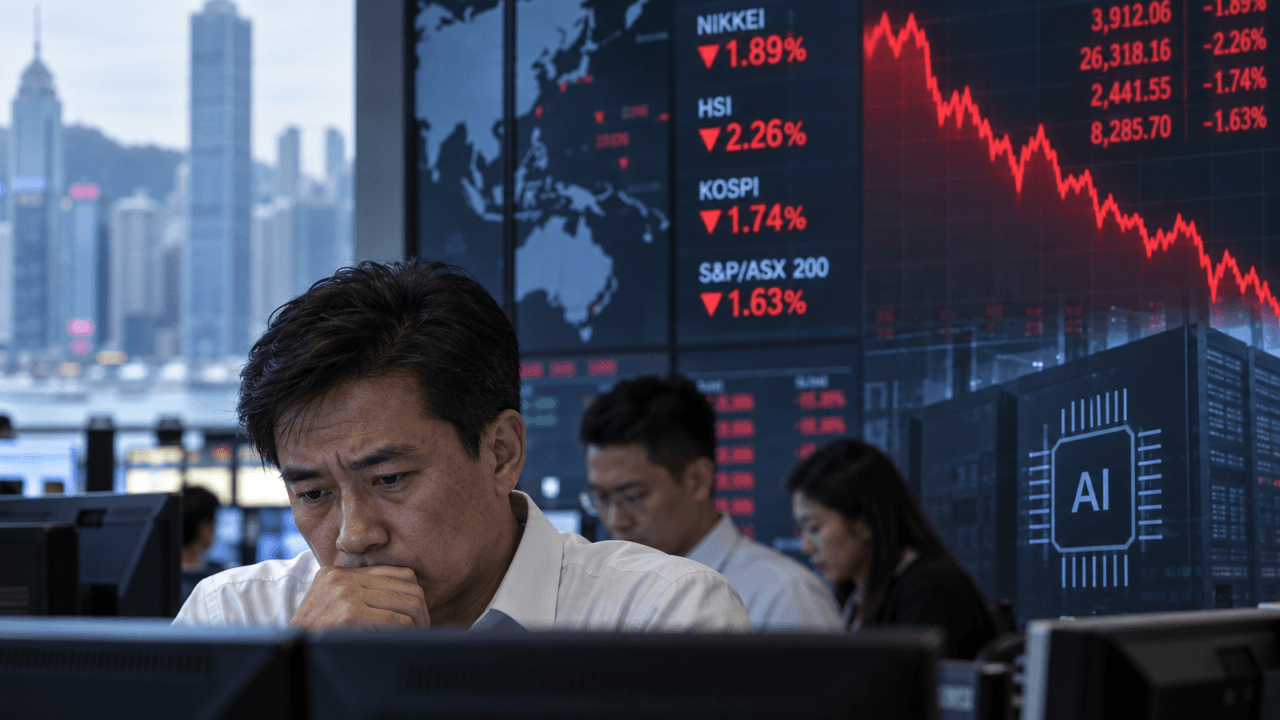
Asian stocks began the week under pressure as investors questioned whether the enormous cost of building the artificial intelligence economy can be justified by future revenues. The concern is no longer limited to whether AI companies can develop useful products. Markets are increasingly focused on how chipmakers, cloud providers, data-center operators, and power suppliers will finance the next phase of expansion—and whether those investments will generate adequate returns.
Japan’s Nikkei fell 2% on Monday after losing 5.4% during the previous week. South Korea’s benchmark also declined 1.6%, following a weekly drop of more than 14%. Technology shares led the retreat as investors reassessed valuations across Asia’s AI supply chain. [1][7]
The Funding Question Behind The Sell-off
AI development requires extraordinary upfront spending. Companies are investing in advanced processors, data centers, electricity generation, cooling systems, network infrastructure, and specialized software before many of the expected productivity gains have fully appeared.
That investment model creates a timing problem. Expenses arrive immediately, while revenue may take years to develop. If borrowing costs rise during that period, the financial hurdle becomes even higher. Higher government bond yields increase the cost of debt across the economy, while wider corporate credit spreads make it more expensive for companies perceived as risky to refinance or issue new bonds.
Investors are therefore asking a basic but important question: Will AI-generated revenue arrive quickly enough to cover the cost of the infrastructure being built today?
Economists have also warned that AI infrastructure could lose value faster than expected if technology changes rapidly. A data center designed around one generation of processors may require expensive upgrades before its original equipment has been fully depreciated. That possibility can reduce book values and weaken confidence in companies carrying large capital expenditures. [1]
Why Asian Markets Are Especially Sensitive
Asia has benefited significantly from the AI investment cycle. Semiconductor manufacturers, equipment suppliers, memory-chip producers, electronics companies, and data-center contractors have become central to the global technology build-out.
This creates opportunity, but it also increases concentration risk. When investors believe AI spending will accelerate, capital flows toward the companies supplying the hardware and infrastructure. Their share prices can rise rapidly as markets price in stronger earnings several years into the future. When doubts emerge, those same stocks can fall sharply because their valuations depend heavily on continued growth.
The recent declines show how quickly sentiment can change. A company does not necessarily need to report weak current earnings to be sold. It may be pressured simply because investors believe future orders, margins, or financing conditions will be less favorable than previously expected.
The impact can spread beyond technology. Falling share prices can reduce household wealth, weaken business confidence, and tighten financial conditions. Suppliers may delay expansion plans, while lenders may demand higher interest rates from companies with heavy capital requirements. This creates a feedback loop in which weaker sentiment makes future investment more expensive.
Inflation And Interest-rate Volatility
AI funding concerns are arriving at a difficult time for global markets. Investors are already monitoring inflation, energy prices, and the path of interest rates. Higher oil prices can raise transportation and production costs, making it harder for central banks to bring inflation under control. Rising inflation expectations may encourage policymakers to keep interest rates elevated for longer.
That combination is particularly challenging for growth stocks. Their valuations are based largely on profits expected years in the future. When interest rates rise, those future profits are discounted more heavily, reducing their present value.
AI investment can also contribute to inflation before it produces measurable productivity gains. Data centers require large amounts of electricity, while construction and equipment demand can place pressure on labor, materials, and supply chains. Central bankers have increasingly recognized that the investment boom may create price pressures ahead of the benefits promised by AI. [14]
For traders, this means AI stocks are being influenced by two forces at once: company-specific earnings expectations and broader macroeconomic conditions. A favorable product announcement may not be enough to offset a sharp rise in bond yields or a deterioration in credit markets.
What To Watch During Earnings Season
The coming earnings reports will help determine whether the market’s concerns are justified or premature. Investors will likely focus on capital expenditure plans, data-center demand, order visibility, debt levels, and management guidance.
Revenue growth alone may not satisfy shareholders. Markets will want evidence that companies can turn AI demand into durable cash flow. Important questions include whether customers are signing long-term contracts, how quickly infrastructure investments generate returns, and whether companies can fund expansion without excessive borrowing.
Margins will also matter. Rising energy, labor, equipment, and financing costs could reduce the profitability of AI projects even when sales remain strong. Companies that rely on debt may face more pressure than those with substantial cash reserves.
Traders should also watch the language used by executives. A shift from confident expansion plans to cautious spending guidance could affect the entire supply chain. Conversely, evidence of stronger-than-expected demand, improving utilization rates, or disciplined capital allocation could help stabilize sentiment.
Practical Takeaways For Traders
The current environment favors risk management over simple trend-following. Traders should avoid assuming that every technology decline represents a long-term buying opportunity. A stock can remain fundamentally attractive while still falling if valuations are too high or liquidity is deteriorating.
Monitor bond yields and corporate credit spreads alongside equity charts. These indicators can reveal whether pressure is concentrated within AI or spreading across the broader financial system. Track earnings revisions, not only headline results, because estimates for future quarters often drive market reactions.
Position sizing is especially important in volatile sectors. Smaller positions, defined exit levels, and diversified exposure can reduce the impact of sudden reversals. SimFi traders can use simulated accounts to test these techniques without risking capital, comparing strategies under different combinations of rising yields, weaker earnings guidance, and renewed AI demand.
The broader lesson is that a powerful technological theme does not eliminate traditional financial constraints. AI may transform productivity and corporate operations, but companies must still manage debt, cash flow, depreciation, and shareholder expectations.
Conclusion
Asian stocks are under pressure because investors are reassessing the financial foundations of the AI boom. The central issue is not whether artificial intelligence has potential, but whether projected revenues will arrive fast enough to justify the massive investment required today.
Until earnings provide clearer evidence, markets are likely to remain sensitive to bond yields, credit conditions, inflation data, and corporate spending guidance. For traders, disciplined risk management and attention to financing signals may be just as important as following the latest technology headlines.