
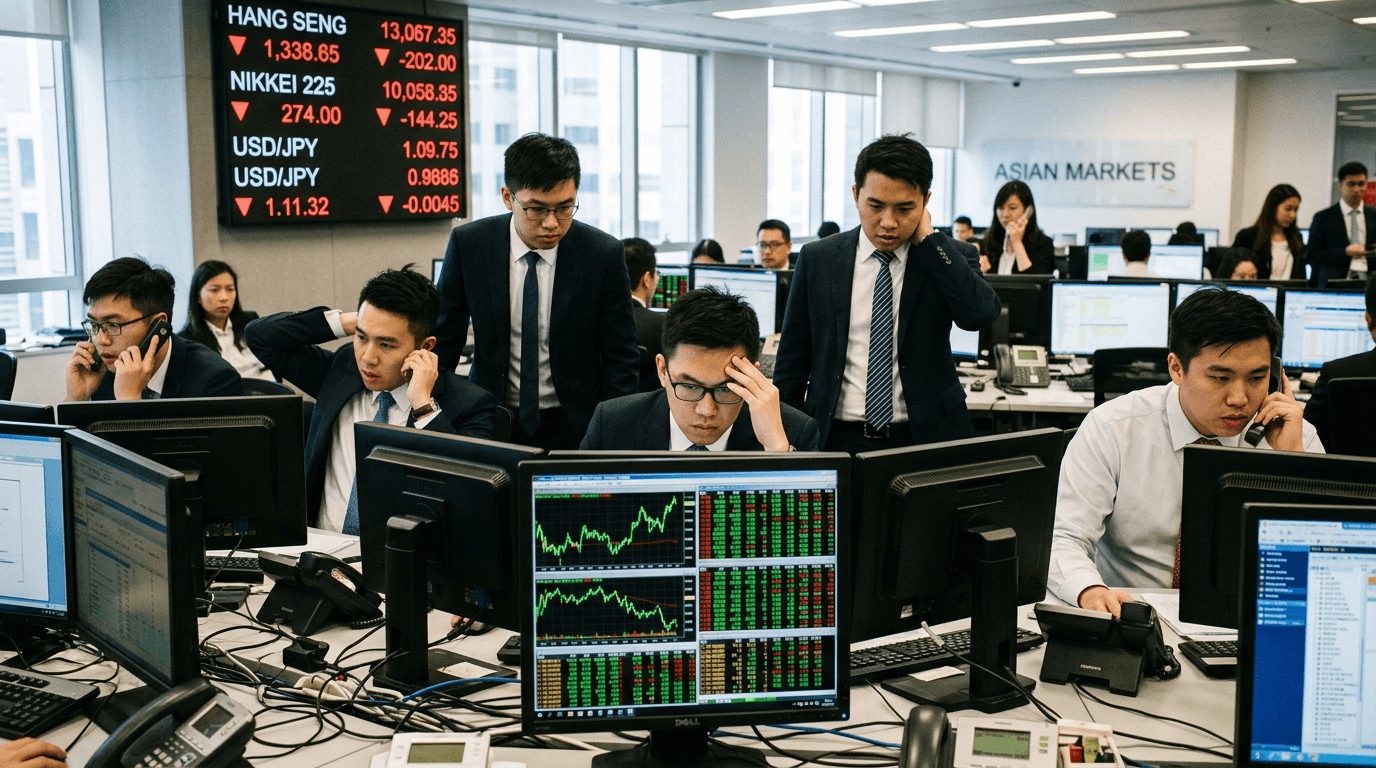
AI-linked darlings that powered Asia’s equity rally are suddenly on the defensive, and futures are telling you the mood has flipped from euphoria to caution. A sharp selloff in US tech and semiconductor names has spilled over into Asia, sending Kospi, Thai and Nikkei futures lower and pressuring regional currencies as the dollar strengthens on renewed Fed tightening bets and “US exceptionalism” narratives.[2][3] For traders, this is not just a one-day wobble but a stress test of how crowded the AI trade has become and how sensitive Asian markets remain to US rates and dollar dynamics.[2][4]
WHAT TRIGGERED THE LATEST ASIA RISK-OFF MOVE?
The immediate catalyst has been a sharp pullback in US technology and chip stocks after months of steep gains driven by artificial intelligence optimism.[3][4] As valuations in AI-linked names stretched, even modest disappointments in earnings or guidance from key US semis triggered outsized reactions and a rotation out of the sector.[3][4]
That weakness has now crossed the Pacific. Asia’s futures boards show heavy selling in markets with high AI and semiconductor exposure, including Korea’s Kospi and Japan’s Nikkei, alongside declines in Thai futures as broader risk sentiment wobbles.[2][3] The move is reinforced by higher US yields and growing expectations that the Federal Reserve may keep policy tighter for longer, encouraging investors to cut risk and seek safety in the dollar.[4]
How Ai Mania Turned Into An Ai-related Shakeout
For much of the past year, Asia’s “AI complex” – chipmakers, foundries, equipment suppliers and related hardware names – has been a primary driver of regional equity performance, particularly in Korea, Taiwan and Japan.[2][4] Korea has been at the epicenter, as investors crowded into large semiconductor and AI infrastructure plays, pushing valuations to levels that priced in years of growth.[2]
When a trade becomes this consensus, it is vulnerable to abrupt reversals. A few elements are now converging:
First, concerns about frothy valuations and the sheer scale of AI capex have raised questions about return on investment timelines, especially in hardware and semis.[3][4]
Second, investors are reassessing whether AI earnings upgrades can keep pace with price appreciation, especially in companies seen as “picks and shovels” for the AI boom.[2][3]
Third, geopolitical and macro risks – from Middle East tensions and oil price swings to uncertain growth trajectories in China – are undermining the willingness to hold high-beta AI names through volatility.[1][4]
As a result, AI-linked stocks in Asia are “finally blinking” after months of relentless gains, and the Korea-led selloff underscores how quickly sentiment can flip when a popular theme is heavily owned and highly leveraged.[2]
Why A Stronger Dollar Hits Asian Fx And Equities
Parallel to the equity move is a notable shift in FX, with several Asian currencies losing ground against the US dollar as haven demand rises.[3][4] The drivers are familiar but powerful:
US economic data and corporate earnings have continued to outpace many peers, reinforcing a narrative of “US exceptionalism” and drawing global capital into US assets.[4]
Higher-for-longer Fed expectations keep US yields elevated, improving the dollar’s carry appeal relative to many emerging and developed Asian currencies.[4]
When risk appetite fades, investors tend to unwind carry and EM FX exposure, repatriating capital and adding to dollar strength.[4]
For Asian economies, a stronger dollar can tighten financial conditions indirectly. Weaker local currencies can raise imported inflation risks, complicate policy for central banks, and pressure corporates with dollar-denominated debt. Equity markets often react negatively as foreign investors hedge or reduce local exposure when FX volatility rises, amplifying the impact already felt through AI-related equity selling.[3][4]
Implications For Traders In Equity, Fx And Futures
For traders active across cash equities, FX and futures – including those using simulated finance platforms to test strategies – this environment is rich in opportunity but demanding in risk management.
Equity index futures such as Nikkei, Kospi and Thai contracts are reflecting rapid shifts in sentiment, offering tactical short and long setups as markets price in AI repricing and dollar strength.[2][3] Short-term traders can seek to capture intraday volatility around key levels, but should be prepared for sharp reversals on any sign of stabilization in US tech or dovish shifts in Fed communication.
In FX, Asian currencies under pressure versus the dollar create directional and relative-value trades. Dollar-Asia pairs may trend higher when US yields rise and risk sentiment weakens, but cross-currency opportunities also emerge as markets differentiate between economies with stronger external balances or more credible policy frameworks.[3][4]
Correlation is a key theme. During risk-off episodes, equity indices, AI-heavy sectors, EM FX and credit often move in tandem. Traders who recognize when correlations are tightening can adjust position sizing, hedge more effectively (for example, using FX to offset equity risk), and avoid overexposure to the same macro factor via multiple instruments.
Key Takeaways And Practical Steps
Several practical lessons stand out from this AI-linked selloff and dollar-driven risk-off move:
First, monitor position crowding. When a narrative like “AI will transform everything” becomes the central pillar of a rally, it is vital to watch positioning, leverage, and valuation metrics, not just the story itself.[2][3]
Second, track the US rates–dollar–Asia triangle. US yields and the dollar remain primary transmission channels for global risk appetite into Asian assets. A stronger dollar often coincides with pressure on EM FX and equity futures, especially when tied to higher real yields.[3][4]
Third, integrate cross-asset signals into your process. Equity weakness in US tech, a spike in US yields, and a stronger dollar against Asian currencies are rarely independent. Building a routine to check these together can improve timing and risk control.[3][4]
Finally, use stress scenarios. Whether you trade live or practice via simulated environments, run “what if” scenarios around sharp AI de-rating, faster Fed hikes, or sudden reversals in the dollar. This helps reveal hidden concentration in AI-linked names, dollar sensitivity, or excessive exposure to a single macro theme.
Conclusion: Navigating The Next Phase Of The Ai Trade
The current hit to Asian equity and FX markets is less about the end of AI and more about the re-pricing of expectations, positioning, and policy risks. A Korea-led AI selloff, sliding Kospi, Thai and Nikkei futures, and weaker Asian currencies against a stronger dollar all point to a market that had moved too far, too fast, and is now rebalancing under the weight of US tech volatility and tighter Fed expectations.[2][3][4]
For traders, the challenge is to move beyond the headline and understand the underlying drivers: AI valuation risk, the US rates and dollar backdrop, and the interconnectedness of equity and FX markets. Those who can combine thematic awareness with disciplined risk management and cross-asset thinking will be best placed not only to withstand this phase of volatility, but to identify the next set of opportunities when the dust settles and markets start to distinguish between genuine AI winners and overstretched hopefuls.