
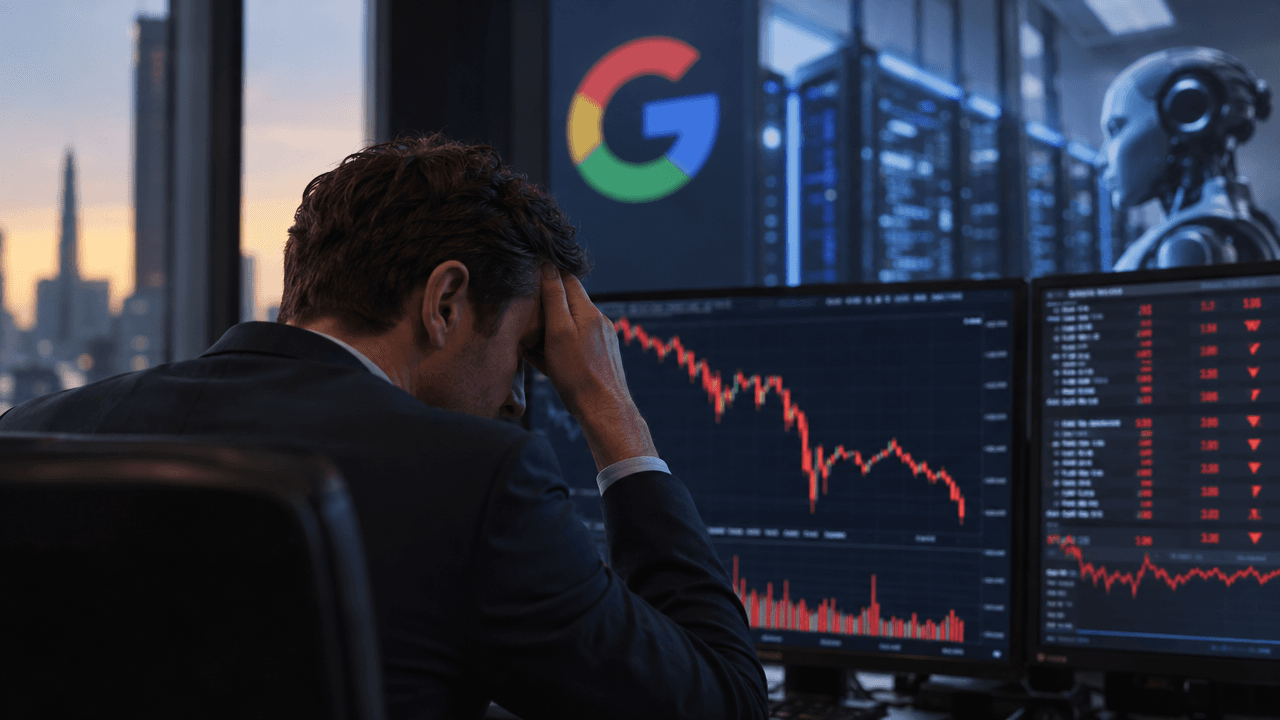
U.S. equity futures fell sharply after Alphabet’s latest results reignited concerns about whether the enormous cost of artificial-intelligence investment will produce meaningful returns quickly enough. Nasdaq 100 futures declined more than 1%, with reports putting the drop at roughly 266 points, while S&P 500 futures also moved lower. Alphabet shares fell about 10% in after-hours trading after the company’s quarterly performance disappointed investors. [1][5]
The reaction was larger than a routine earnings miss. Alphabet has been viewed as one of the companies best positioned to benefit from AI, supported by its search engine, cloud business, data centers, and machine-learning expertise. If even a technology leader is struggling to convert AI spending into near-term earnings and cash flow, investors may begin questioning the valuations and investment plans of the entire sector.
WHY ALPHABET’S RESULTS MATTERED
Alphabet’s results highlighted the tension at the center of the current AI trade: companies must spend aggressively today to build computing capacity, but investors still expect visible financial returns in the near future.
The company’s Google Cloud revenue reportedly more than doubled from a year earlier, demonstrating strong demand for AI infrastructure and cloud services. However, weaker-than-expected profitability and negative quarterly free cash flow overshadowed that growth. Alphabet’s free cash flow was reported at negative $9.07 billion, while its full-year capital expenditure forecast remained between $195 billion and $205 billion. [2][13]
Capital expenditure includes spending on data centers, processors, networking equipment, and other infrastructure required to train and operate AI systems. These investments can support future revenue, but they also reduce cash available to shareholders and place pressure on margins in the short term.
For markets, the central question is no longer whether AI demand exists. It is whether demand will grow fast enough to justify the cost of meeting it.
The Ai Investment Cycle Faces A Profitability Test
Technology companies have committed hundreds of billions of dollars to AI infrastructure. That spending has created a powerful market narrative, benefiting semiconductor manufacturers, cloud providers, data-center operators, and software companies. It has also helped drive major indexes higher because a relatively small group of large technology stocks represents a substantial share of benchmark performance.
Alphabet’s report challenged the assumption that higher AI spending automatically produces higher profits. Investors are now looking more closely at several measurements: revenue generated by AI products, cloud operating margins, capital expenditure growth, free cash flow, and the time required to earn back infrastructure investments.
This shift is important because markets price future expectations, not just current results. A company can report rapid revenue growth and still see its shares decline if expenses are rising faster than sales or if management signals that spending will accelerate further.
The negative response also arrived after a strong run in technology shares. Nasdaq 100 futures dropped about 1.3% in one market report after the underlying index had gained for three consecutive sessions. [1] When valuations are elevated, disappointing guidance or rising costs can produce an outsized reaction as traders reduce exposure and protect profits.
What The Sell-off Means For Broader Markets
The immediate pressure is concentrated in growth and technology stocks, but the implications extend beyond the Nasdaq. Large technology companies influence index funds, retirement portfolios, volatility measures, and investor sentiment across global markets.
A decline in U.S. equity futures can also create a negative risk signal for foreign exchange and cryptocurrency markets. Traders often reduce exposure to higher-risk assets when technology shares weaken, particularly if the sell-off reflects concerns about economic growth, corporate investment, or stretched valuations. Bitcoin and other digital assets may therefore experience additional volatility even though they are not directly tied to Alphabet’s earnings.
At the same time, the market reaction should not be interpreted as proof that the AI investment cycle is ending. Microsoft reportedly rose nearly 3% after delivering stronger quarterly results, supported by growth in its Azure cloud infrastructure business. [7] That contrast shows that investors are becoming more selective rather than abandoning technology altogether.
The market may increasingly reward companies that can demonstrate immediate monetization while punishing those that announce rising investment without clear evidence of returns.
Practical Lessons For Simfi Traders
For traders using a simulated finance platform, this event offers a useful case study in managing earnings risk.
First, distinguish between a company’s headline revenue growth and its cash-flow performance. Strong sales do not necessarily mean that a business is generating investable profits. Free cash flow, operating margins, and capital expenditure can provide a clearer view of financial pressure.
Second, monitor the relationship between expectations and results. Alphabet’s decline was driven not only by its reported figures but also by the gap between those figures and what investors had already priced into the stock. A company can beat its previous-year results and still fall if it fails to meet market expectations.
Third, watch premarket and futures markets without treating them as guaranteed forecasts. Futures reflect positioning, liquidity, and overnight sentiment. They can signal potential opening pressure, but the cash market may reverse direction once investors digest management commentary, analyst revisions, and developments from other companies.
Finally, manage concentration risk. When a portfolio is heavily exposed to a single theme such as AI, one earnings report can affect several correlated positions at once. SimFi traders can test position sizing, stop-loss rules, hedging strategies, and staged entries without risking real capital.
The Bigger Market Message
Alphabet’s earnings reaction marks a more demanding phase for the AI trade. Investors still recognize the technology’s long-term potential, but they increasingly want evidence that spending is translating into durable revenue, stronger margins, and sustainable cash generation.
For the broader market, the next catalyst will be whether other major technology companies validate Alphabet’s concerns or demonstrate that AI investment is already producing attractive returns. Until that question becomes clearer, elevated volatility may remain a defining feature of equity, currency, and crypto markets.
The most important lesson is not that AI has failed. It is that enthusiasm is no substitute for cash flow. In the next stage of the cycle, companies and traders alike will be judged on how effectively they convert ambitious investment into measurable results.