
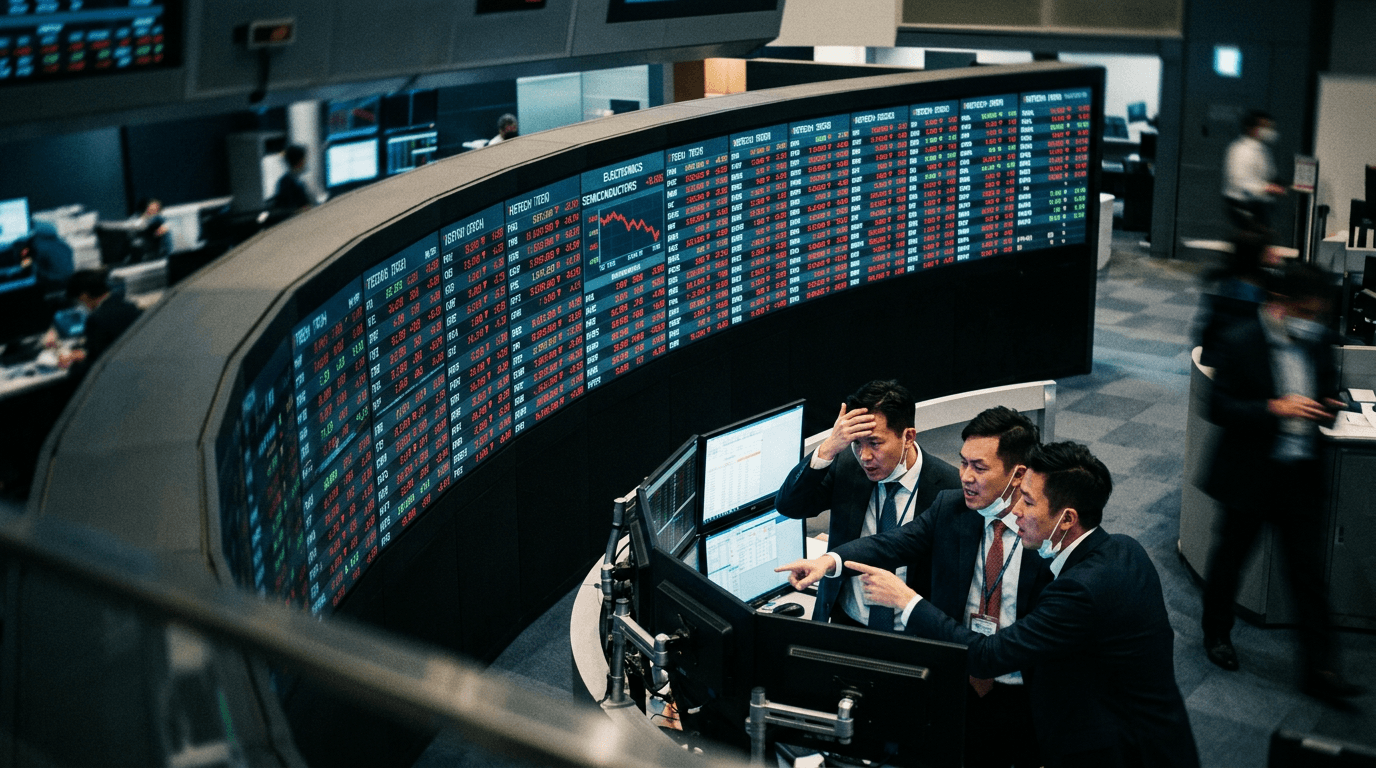
Asian equity markets stepped back from record highs after Apple’s surprise decision to sharply raise prices on some of its flagship devices rattled confidence in the tech-led rally.[1][4][5] The move, aimed at offsetting soaring memory and storage costs tied to the AI boom, triggered a sell-off in regional technology names and a broader shift into risk-off positioning across global markets.[1][4][5] For traders, the episode is a clear reminder that even the strongest AI narratives carry real-world demand and margin risks that can quickly reprice expectations.[1][12]
What Happened In Asia
Asian stock indices, which had recently pushed into record territory on the back of AI and semiconductor optimism, slipped as tech-heavy benchmarks led the retreat.[1][4][5] Nasdaq futures declined in Asian trading, mirroring the reversal in U.S. tech sentiment after Apple’s stock fell sharply on the pricing news.[4][5] The weakness in equities spilled over into growth-sensitive currencies, as investors trimmed exposure to risk assets in favor of safer havens.[4][5]
Apple’s share price drop followed announcements of hefty price hikes for iPads and MacBooks, a notable shift given the company’s usual strategy of gradual, predictable pricing changes.[4][5][14] These increases were framed as a response to surging input costs for advanced memory and storage components, which are in high demand thanks to AI-related workloads.[5][11][14] The result was a fast re-rating of expectations not only for Apple’s volumes and margins, but also for the broader tech complex that has ridden the AI wave.
In Asia, where many firms sit along the semiconductor and hardware supply chain, traders reacted by locking in profits in names that had benefited most from the AI run-up.[1][5] Chipmakers, component suppliers, and AI-adjacent hardware firms were particularly sensitive as investors questioned how much of the cost pressure they could pass on without damaging demand.[1][5][12]
WHY APPLE’S PRICE HIKES MATTER BEYOND APPLE
On the surface, price hikes by a single company might look like a company-specific story. In reality, Apple’s decision acts as a high-profile stress test of how far end users are willing to go to absorb the cost of the AI build-out.[4][5][14] When the world’s most valuable consumer tech brand feels compelled to raise prices significantly, it signals that input cost pressures are no longer trivial or easily absorbed in-house.[5][11][14]
Apple’s move highlights a key tension: AI infrastructure requires massive investments in chips, memory, and energy, but consumers and enterprises still operate with finite budgets.[9][12][15] If device and service prices rise too quickly, adoption may slow, upgrade cycles may lengthen, and volume assumptions embedded in earnings forecasts can come under pressure.[3][9][12] That is exactly what markets began to price in as investors reassessed growth trajectories in both hardware and AI-focused names.
The sell-off also underscores how concentrated positioning has become. Global equity performance has been heavily reliant on a handful of mega-cap tech names and chipmakers, amplifying the market impact when one of these leaders delivers a negative surprise or signals new headwinds.[2][6][12] Apple’s price hikes served as a catalyst for traders to take profits and rebalance away from crowded AI trades, at least in the short term.[2][5][12]
The Ai-chip Boom: Upside And Hidden Risks
The AI-chip boom has been a powerful tailwind for semiconductor and memory manufacturers, boosting pricing power and margins as demand outstrips supply.[9][12][14] High-performance GPUs, advanced DRAM, and cutting-edge storage solutions have commanded premium prices, supporting stellar earnings for key suppliers.[2][9][12] Yet this environment also creates vulnerability: when input inflation reaches the consumer, the risk of demand destruction rises.
If device makers like Apple push through aggressive price hikes, the upgrade cycle could become more bifurcated: premium customers may continue to buy, but mass-market segments may delay purchases or downshift to cheaper alternatives.[3][8][14] That scenario could squeeze unit volumes while leaving suppliers exposed to eventual normalization in chip pricing as capacity catches up.[3][9][12]
There is also timing risk. Companies are investing heavily in AI capacity today based on very optimistic demand projections several years out.[3][6][12] If the AI adoption curve proves bumpier than expected—due to regulation, budget constraints, or slower real-world productivity gains—earnings volatility could rise for both chipmakers and downstream hardware players.[3][6][15] This is the backdrop against which markets interpreted Apple’s price hikes: not just a cost-push story, but a potential early sign of friction in the AI growth narrative.[1][3][12]
Implications For Traders Using Simulated Finance
For traders operating on SimFi platforms like E8 Markets, this episode offers a live case study in how narrative-driven rallies can reverse when fundamentals and sentiment collide. In a simulated environment, traders can test how portfolios respond when a single high-conviction theme—such as AI chips—faces a shock from an unexpected source like consumer pricing.[3][6][12]
Several practical lessons stand out. First, concentration risk matters: portfolios overweight in mega-cap tech and semiconductors can experience outsized drawdowns when leaders stumble.[2][5][12] Running stress tests where a key name or sector drops 5–10% in a day can reveal vulnerabilities before real capital is at risk. Second, correlation can spike at the wrong time. When sentiment turns, highly correlated AI and tech names may move together, reducing the benefits of diversification traders thought they had.[2][6][12]
SimFi environments allow traders to rehearse these dynamics under different scenarios: Apple surprising with margin pressure instead of price hikes, regulators tightening AI rules, or a faster-than-expected normalization in chip prices.[3][6][15] By experimenting with sector rotation, hedging with index futures, or adjusting currency exposure when risk-off flows hit, traders can build playbooks that translate directly to live markets.
How To Position Around Ai And Tech Volatility
In practical terms, traders can take several steps to navigate the volatility revealed by Apple’s pricing move. One is to separate the AI value chain into distinct segments—chip designers, foundries, memory suppliers, hardware OEMs, cloud providers, and software/application layers—rather than treating “AI stocks” as a monolith.[3][9][12] Each segment faces different sensitivities to pricing, regulation, and end-user demand, which can create relative-value opportunities.
Another step is to focus on risk management around key catalysts. Product launches, pricing announcements, and major earnings reports from AI bellwethers can produce outsized moves, as this episode shows.[2][5][12] Using simulated trading to practice pre- and post-event positioning, scenario analysis, and stop-loss discipline can make traders more prepared when real announcements hit.
Finally, traders can look beyond pure growth metrics and pay close attention to margins, capital intensity, and cash flows. High revenue growth in AI-related segments is appealing, but if it relies on ever-rising input costs and aggressive pricing to consumers, the sustainability of that growth becomes a central question—as Apple’s decision has illustrated.[3][9][12]
Conclusion
Asian markets’ pullback from record highs after Apple’s steep price hikes is more than a one-day headline; it is a snapshot of an AI-driven market wrestling with the realities of cost, demand, and concentration risk.[1][4][5] The reaction in regional tech shares, currencies, and global futures shows how quickly sentiment can swing when a flagship company tests the limits of what customers will pay.[1][4][5] For traders, especially those honing their edge in simulated environments, the key takeaway is clear: understand the full economics of the AI value chain, respect the power of crowded trades, and build strategies that can withstand sudden shifts when the narrative meets the numbers.[2][3][12]