
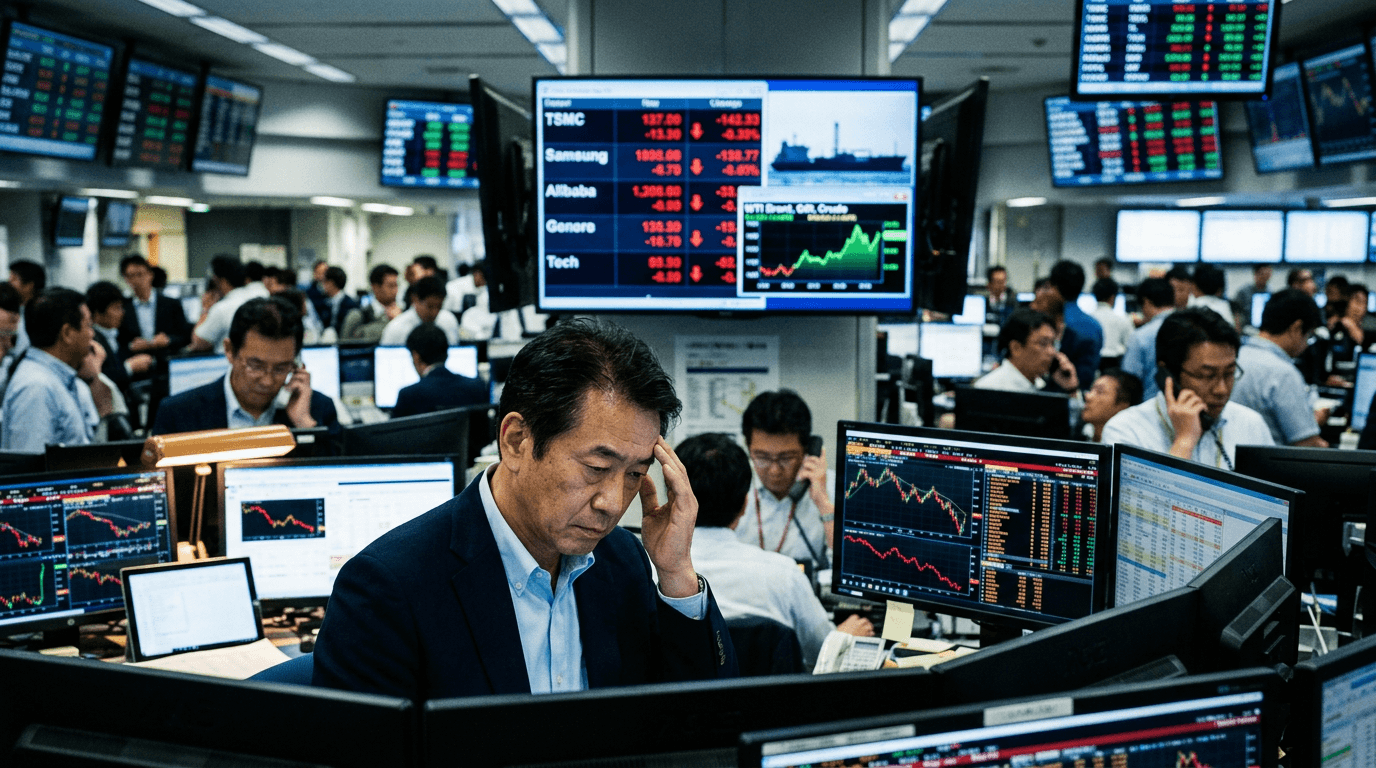
Asian equity markets are entering a critical juncture, caught between rising Gulf tensions, surging oil prices and an AI-powered tech rally that now faces a decisive earnings test.[1][8] For traders, this is less a simple risk-on/risk-off story and more a complex puzzle of geopolitics, inflation expectations and sector rotation playing out across futures and cash markets.[1][3]
Market Backdrop: Caution In Asia
Over recent sessions, Asia-Pacific indices have traded hesitantly, with broad regional gauges hovering near short-term lows or moving sideways as investors weigh higher energy costs against still-resilient tech momentum.[1][2] The escalation of conflict in the Gulf has pushed oil prices higher, reinforcing inflation concerns for import-dependent Asian economies and dampening appetite for cyclicals and consumer names.[1][8] Index futures tied to global benchmarks such as the S&P 500, Nasdaq and Euro Stoxx have shown increased intraday volatility, reflecting a tug-of-war between risk appetite in AI-linked stocks and broader macro uncertainty.[1][6]
The result is a patchwork market: some Asian technology-heavy indices show relative resilience, while broader benchmarks that capture banks, consumer, industrials and small caps lag behind.[2][8] This divergence is central to understanding current risk sentiment, and it sets the stage for a high-stakes earnings week in global tech.
Ai Trade Under Scrutiny
The AI trade has been the primary engine of equity gains in Asia and globally, with semiconductor makers, cloud platforms and data-center infrastructure names driving indices to or near record highs despite ongoing conflict risks.[8][9] In Asia, tech-focused benchmarks have outperformed broader indices since Middle East tensions intensified, even as non-tech sectors show signs of strain from higher energy costs and margin pressures.[8]
Yet valuations in key AI beneficiaries are now stretched, and markets have already seen episodes where disappointing chip or hardware earnings triggered sharp reversals in AI-linked shares.[6] A packed slate of major US and global tech earnings will therefore act as a stress test for the AI narrative: either reinforcing confidence that profit growth can justify premium pricing, or exposing the rally to abrupt repricing if guidance falls short.[1][6]
For traders, this is not just about single-stock risk. Index futures tied to tech-heavy benchmarks can amplify moves, with options positioning and systematic strategies potentially adding momentum to either upside breakouts or downside unwind.[6]
OIL, INFLATION AND ASIA’S FRAGILE SENTIMENT
Higher oil prices are a critical second pillar of this story. Asia is heavily reliant on imported energy, so sustained increases in crude tend to feed through into headline inflation, squeeze real incomes and raise input costs for manufacturers and service providers.[1][8] That pressure is already visible in weaker performance of consumer discretionary and transportation stocks across regional indices, even as AI beneficiaries push tech sub-indices higher.[8]
Inflation concerns also complicate the policy backdrop. If markets start to price in more persistent price pressures, expectations for central bank easing can be scaled back, lifting yields and the discount rate used for valuing long-duration growth assets, including some AI names.[2][5] This creates a feedback loop: higher oil and inflation worries weigh on sentiment, but strong AI earnings could counteract those fears and keep overall risk appetite supported—at least in the tech complex.[1][9]
In practice, this yields a two-track market where defensives and rate-sensitive sectors trade cautiously, while AI-linked segments remain more closely tied to earnings headlines and momentum flows.[2][8]
Implications For Traders And Simulated Finance Users
For traders—and for participants in simulated finance environments like E8 Markets—this backdrop is an ideal laboratory for stress-testing strategies across asset classes and themes. Cross-asset volatility in equity index futures, energy contracts and FX pairs linked to oil-importing economies presents a rich set of scenarios to model.[1][3]
Several practical implications stand out
1) Sector dispersion matters more than index direction. A flat or hesitant regional benchmark can mask strong moves beneath the surface, particularly between AI-linked tech and energy-sensitive consumer stocks.[2][8]
2) Earnings season is now a macro event. Major AI and tech earnings will influence not just single names but regional sentiment, futures curves and correlation structures across indices.[1][6]
3) Geopolitics is a volatility catalyst, not a simple trend. Gulf tensions and any news on shipping routes or energy supply can quickly alter inflation expectations, FX moves and sector leadership.[1][8]
SimFi platforms allow traders to build and test multi-layered strategies—combining index futures, sector rotations and event-driven trading—without capital at risk. This environment is particularly useful when markets are driven by overlapping narratives, as they are now.
Practical Playbook For E8 Markets Users
In a simulated setting, traders can approach the current landscape with a structured playbook:
Focus on scenarios rather than forecasts Instead of predicting exact outcomes of the Gulf conflict or tech earnings, design scenarios: strong AI beats with stable oil, weak AI guidance with rising oil, or mixed earnings amid easing tensions.[1][6] For each scenario, define expected behavior in major regional indices, tech sub-indices, energy-linked equities and relevant FX pairs, then test how portfolios perform under those conditions.
Experiment with sector rotation strategies Use virtual portfolios to rotate between AI-rich tech baskets and more defensive sectors like utilities or staples, adjusting exposure as oil prices and inflation expectations shift.[2][8] Analyze whether diversification into non-tech sectors genuinely reduces drawdowns during AI pullbacks, or whether correlations spike during stress events.
Study futures and options around earnings Simulate strategies in index futures around key tech earnings dates, such as straddle-like approaches that aim to capture volatility rather than direction.[1][6] Track how implied volatility behaves before and after announcements, and how futures curves respond to surprises in guidance or capex plans related to AI infrastructure.
Integrate macro triggers Build rules that respond to macro triggers: oil breaking certain levels, headlines suggesting escalation or de-escalation in the Gulf, or inflation data surprising consensus.[1][8] Test whether systematic responses—such as reducing leverage or rebalancing away from the most rate-sensitive names—improve risk-adjusted returns in your simulated track record.
Conclusion: Navigating A Two-track Market
Asian markets are entering a delicate phase where geopolitical risk, energy prices and an AI-led tech boom collide, creating a two-track market with elevated dispersion and cross-asset volatility.[1][3][8] The upcoming wave of major tech earnings will either validate the AI trade’s leadership or expose its vulnerabilities, with implications that go far beyond individual stocks.[1][6]
For active traders and E8 Markets participants, this environment is challenging but rich with learning opportunities. By treating AI earnings, oil dynamics and Gulf headlines as interconnected drivers rather than isolated events, and by testing strategies in a simulated framework, traders can refine their ability to navigate complex regimes before deploying real capital. The key is to stay analytical, scenario-driven and disciplined—using the current hesitation in Asian shares not as a reason to stand still, but as a chance to build more robust, adaptable trading approaches for the next phase of the cycle.[1][2][8]