
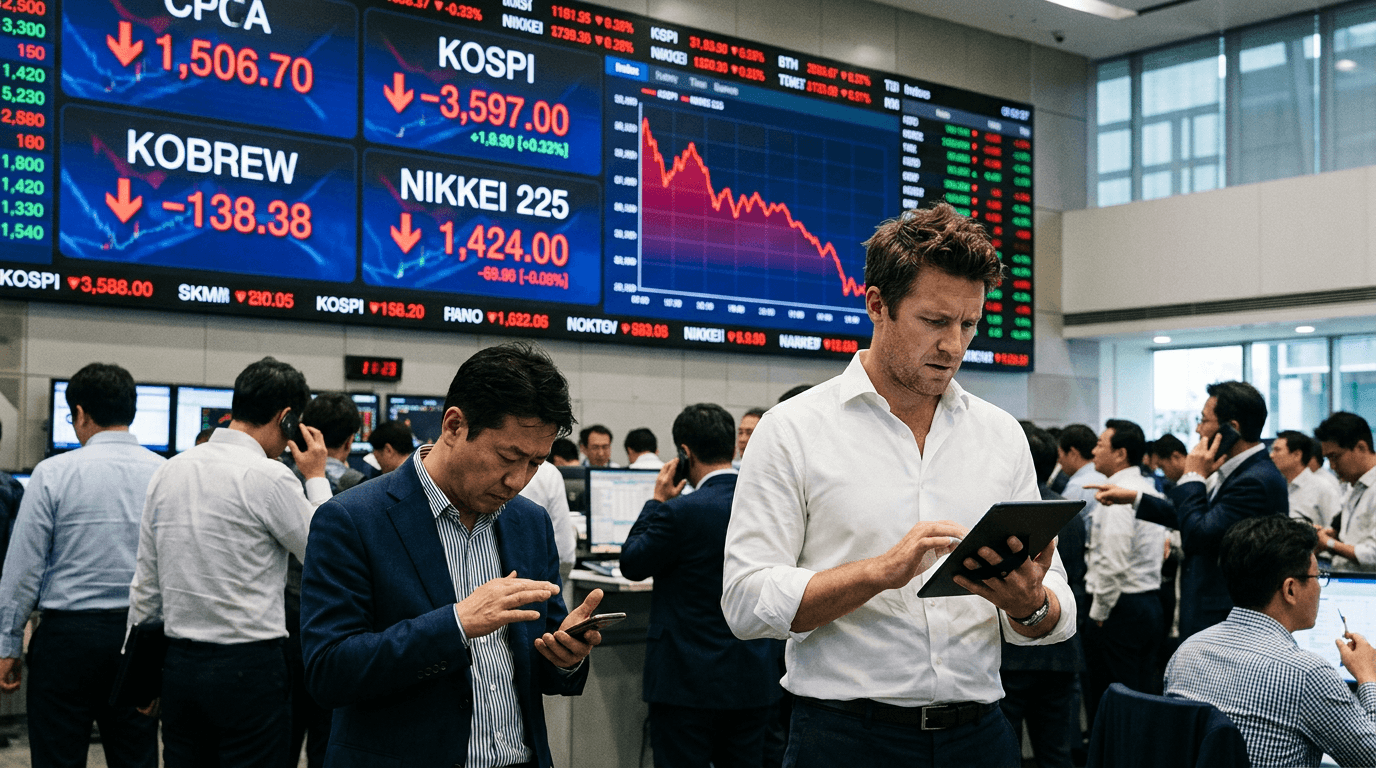
Asia's Financial Markets Face Volatility
Asian stock exchanges are experiencing acute volatility as geopolitical tensions in the Middle East disrupt the region's financial stability. The South Korean KOSPI index has plunged by 4.26% to 5052.46, while Japan's NIKKEI 225 has fallen by 1.58% to 51063.72. These declines underscore widespread investor anxiety over the economic repercussions of energy supply disruptions and escalating inflation pressures.
Strait of Hormuz Closure: A Catalyst for Market Turbulence
The current market instability is driven by the closure of the Strait of Hormuz, following a military conflict involving Iran, the United States, and Israel that erupted on February 28, 2026. This strategic maritime chokepoint is vital, accounting for roughly a quarter of the global seaborne oil trade. The implications for Asia are particularly severe, as the region relies heavily on oil imports from the Persian Gulf.
The Upward Surge of Oil Prices
The closure of the Strait of Hormuz has removed nearly 20% of global oil supplies, causing oil prices to soar. If the disruption persists into the second quarter of 2026, West Texas Intermediate crude could reach $98 per barrel, potentially escalating to $115 if the situation extends through two quarters. In more pessimistic scenarios, prices could spike to $132 by year-end. These increases directly translate into higher energy costs for Asia-Pacific economies that depend heavily on imported petroleum.
The energy market's reaction has been swift and severe, with Brent crude prices climbing above $90 per barrel. This marks a stark contrast to 2025, when West Texas Intermediate crude averaged just $65 per barrel, highlighting the vulnerability of global energy markets to geopolitical disruptions and the particular exposure of Asian economies to these supply volatilities.
Ripple Effects Beyond Energy Markets
The economic impact of the Strait of Hormuz disruptions extends beyond oil prices. Rising energy costs are triggering increases in fertilizer prices, maritime transport costs, and insurance premiums. These inflationary pressures threaten food security and household purchasing power across Asia's developing economies. Many countries in the region already face fiscal constraints and high debt burdens, limiting their ability to absorb the increased cost of living.
Asian equity markets are factoring in these economic headwinds. The KOSPI's 4.26% decline reflects investor concerns about South Korea's vulnerability to elevated oil prices. Similarly, the NIKKEI 225's 1.58% decline indicates anxiety about sustained energy cost inflation in Japan. These declines suggest investors are reassessing earnings forecasts and growth expectations across sectors sensitive to energy prices.
Impact on Global Growth Dynamics
Federal Reserve research quantifies the potential damage to global economic growth from extended Strait closures. A complete closure that removes 20% of global oil supplies could reduce global real GDP growth by 2.9 percentage points in the second quarter of 2026. Even if the Strait reopens after one quarter, global real GDP will remain below pre-closure levels through the end of 2027.
These growth projections highlight why Asian markets are selling off so aggressively. The region's export-dependent economies cannot afford prolonged global growth deceleration. China, South Korea, and other Asian manufacturing hubs rely on robust international demand for their goods. If global growth slows by nearly 3 percentage points due to energy disruptions, the consequences for Asian export volumes and corporate earnings will be severe.
What Investors Should Watch
The duration of the Strait of Hormuz closure is a critical variable influencing market outcomes. If the conflict resolves quickly and shipping resumes within one quarter, markets can begin to price in recovery. However, if the disruption continues for two or three quarters, oil prices will remain elevated, prolonging the drag on global economic growth and maintaining downward pressure on equity valuations.
Additionally, the divergent reactions across Asian markets warrant attention. The KOSPI's steeper decline compared to the NIKKEI 225 suggests that investors perceive South Korea as more vulnerable to energy shocks than Japan. This differential pricing reflects the importance of energy imports in each economy and their capacities to absorb inflation. Investors should monitor how individual Asian economies respond to persistent energy cost pressures through fiscal and monetary policy measures.
The plunge in Asian futures and equity indices reflects genuine concerns about the economic damage that energy supply disruptions inflict on import-dependent economies. As long as geopolitical tensions persist in the Middle East, Asia's markets will remain susceptible to volatility driven by energy price movements and inflation fears. Market participants should remain vigilant regarding any developments that could extend or shorten the Strait of Hormuz closure and its global growth implications.
---
News Impact Score: 8