
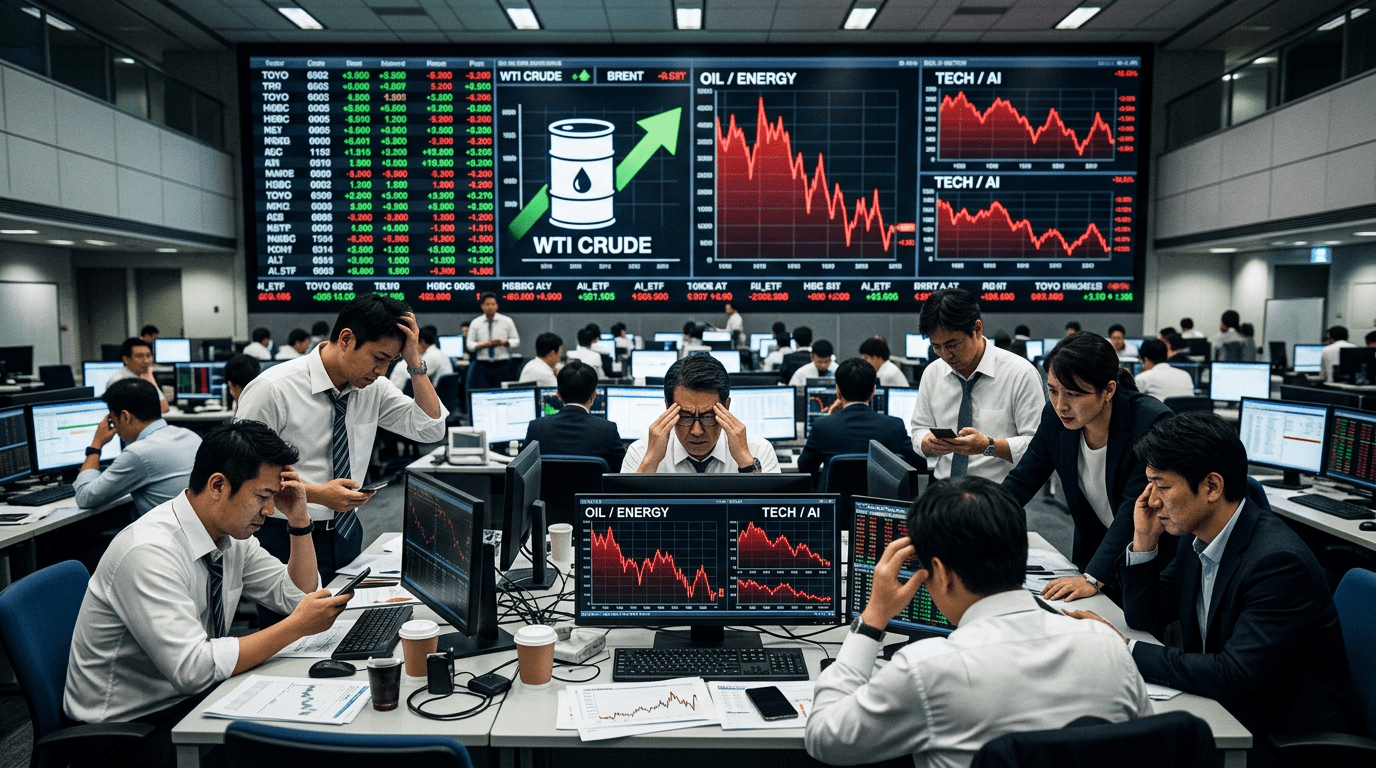
Asian markets are entering a new phase of caution as the Gulf conflict pushes oil higher, rekindles inflation fears, and forces investors to reassess how much risk they want to take in the AI-led equity rally.[4][5] Instead of the broad, momentum-driven gains that dominated much of the past year, price action is increasingly being shaped by day‑to‑day headlines on energy and earnings, with futures pointing to more sector rotation and choppy trading conditions.[4]
Global Backdrop: Gulf Conflict And The Oil Shock
Recent escalations in the Gulf and broader Middle East have repeatedly driven sharp moves in crude, with episodes of fighting, strikes, and even claims that the Strait of Hormuz has been closed sending oil prices surging.[6][13] In several trading sessions, Brent crude has jumped by high single‑digit percentages and pushed above the mid‑$80s per barrel, reinforcing fears that energy costs could stay elevated for longer.[2][13]
These spikes are not just a local story. Asia’s major economies—Japan, South Korea, India—are significant importers of oil and gas, so higher prices feed directly into input costs, consumer inflation, and trade balances.[14] When oil has surged in recent months, Asian equity indices have typically responded with broad declines, especially in markets like Tokyo and Seoul where growth and tech sectors carry heavy index weights.[10][14]
Bond markets and currencies have also reacted to the inflation shock narrative. Rising oil has pushed government bond yields higher as traders price in the risk of more persistent inflation and, by extension, a longer period of restrictive monetary policy.[5][14] At the same time, the U.S. dollar has tended to strengthen against the yen and other Asian currencies as global investors seek liquidity and perceived safety during bouts of Gulf‑related risk aversion.[4][14]
ASIA’S AI RALLY MEETS A REAL‑WORLD STRESS TEST
The timing of this Gulf‑driven oil volatility is important because it collides with an extended, AI‑themed equity rally that has left valuations in many tech and semiconductor names stretched.[5][10] In recent months, Asia‑Pacific indices have often been led higher by chipmakers, cloud infrastructure plays, and other beneficiaries of the global AI build‑out, particularly in Korea and Taiwan.[5][10]
Yet each flare‑up in Middle East tensions has exposed how fragile sentiment can be around these high‑beta AI names. Episodes of rising oil and rate expectations have coincided with pressure on AI stocks in Korea’s tech‑heavy KOSPI and on similar themes in Japan, as investors reassess how much they are willing to pay for future growth under tighter financial conditions.[10][13] In some sessions, chip stocks have led declines on Wall Street as well, underscoring that AI‑linked volatility is not confined to Asia.[10][13]
This dynamic highlights a key market lesson: narrative‑driven rallies—like the current AI wave—are particularly sensitive to macro shocks that affect discount rates, such as energy‑led inflation and interest‑rate repricing. When oil jumps and bond yields rise, the present value of long‑duration growth stories falls, and traders must decide whether the AI earnings outlook genuinely justifies the higher risk and valuation multiple.[5][10][14]
How Tech Earnings Could Reprice The Ai Narrative
Compounding this macro tension is a busy calendar of major global tech earnings, which is widely seen as a litmus test for the AI trade.[4][10] Recent reports have already shown that investor expectations around AI‑related demand and margins are high, and any disappointment can trigger outsized moves in both U.S. and Asian tech benchmarks.[10][13]
In past quarters, AI‑exposed names have faced bouts of profit‑taking when guidance has been only “good” rather than spectacular, or when management has cautioned about supply constraints, capex cycles, or the pace of monetizing AI services.[10][13] Given that many Asian chipmakers and hardware suppliers sit deep in the AI ecosystem, their earnings and forward‑looking comments are closely watched as leading indicators of whether AI spending is broadening or plateauing.[5][10]
For traders, the combination of Gulf‑induced macro uncertainty and high‑stakes earnings creates a classic two‑front risk scenario. On one front, any escalation in the conflict can reprice oil, inflation expectations, and yields in a matter of hours.[6][8][14] On the other, a single disappointing earnings print from a megacap AI bellwether can trigger global sector rotation away from tech and into more defensive or energy‑linked plays.[4][10][13]
What This Means For Active Traders And Simfi Participants
In this environment, index futures in both Asia and the U.S. are responding less to pure FX moves and more to the interplay of energy prices and sector‑specific news flow.[4] Traders are seeing frequent intraday swings as markets weigh higher input costs against the potential for strong AI‑driven earnings, with risk appetite shifting between growth, value, and commodity‑linked sectors.[4][5]
For participants on simulated finance platforms, this backdrop is an ideal live case study in cross‑asset risk management. Rather than treating equity, oil, and FX as separate silos, the Gulf conflict forces traders to model how an oil shock might ripple into inflation data, central‑bank expectations, yield curves, and ultimately the valuation multiples placed on AI and other growth stories.[5][10][14]
It is also a reminder that concentration risk matters. Portfolios heavily tilted toward AI and tech can underperform sharply when macro conditions move against long‑duration assets, even if the underlying technology story remains compelling. Practicing diversification—across sectors, factors, and regions—helps reduce the chance that one narrative, whether AI or energy, dominates total returns.
PRACTICAL PLAYBOOK: NAVIGATING AN OIL‑AND‑AI MARKET
For traders looking to refine their approach, several practical takeaways stand out:
First, monitor Gulf headlines and oil price action alongside tech earnings calendars, not in isolation. A surprise on either front can quickly change volatility regimes and correlations, especially between growth stocks and rates.[4][5][10]
Second, pay attention to how bond yields and the dollar react to each oil move. Rising yields and a stronger dollar often signal a tightening of financial conditions, which tends to weigh more heavily on high‑valuation AI and tech names than on shorter‑duration sectors.[5][10][14]
Third, use simulated trading environments to stress‑test AI‑heavy portfolios under different oil and rate scenarios. By running playbooks where oil spikes, yields climb, or AI earnings surprise either positively or negatively, traders can better understand how their strategies might behave and where hedges or diversification could add resilience.
Finally, recognize that narrative cycles evolve. AI remains a powerful secular theme, but markets will periodically reprice it against macro realities like energy shocks, geopolitical risk, and the cost of capital. The traders who adapt fastest are typically those who link their bottom‑up stock views to a clear top‑down macro framework.
As Gulf tensions keep oil prices elevated and inflation risks alive, Asian markets are showing that even the most popular growth stories must pass repeated stress tests. For traders and investors, this is less a reason to abandon AI than a prompt to upgrade their risk tools, broaden their perspective, and treat every rally as something to be actively managed rather than passively assumed.