
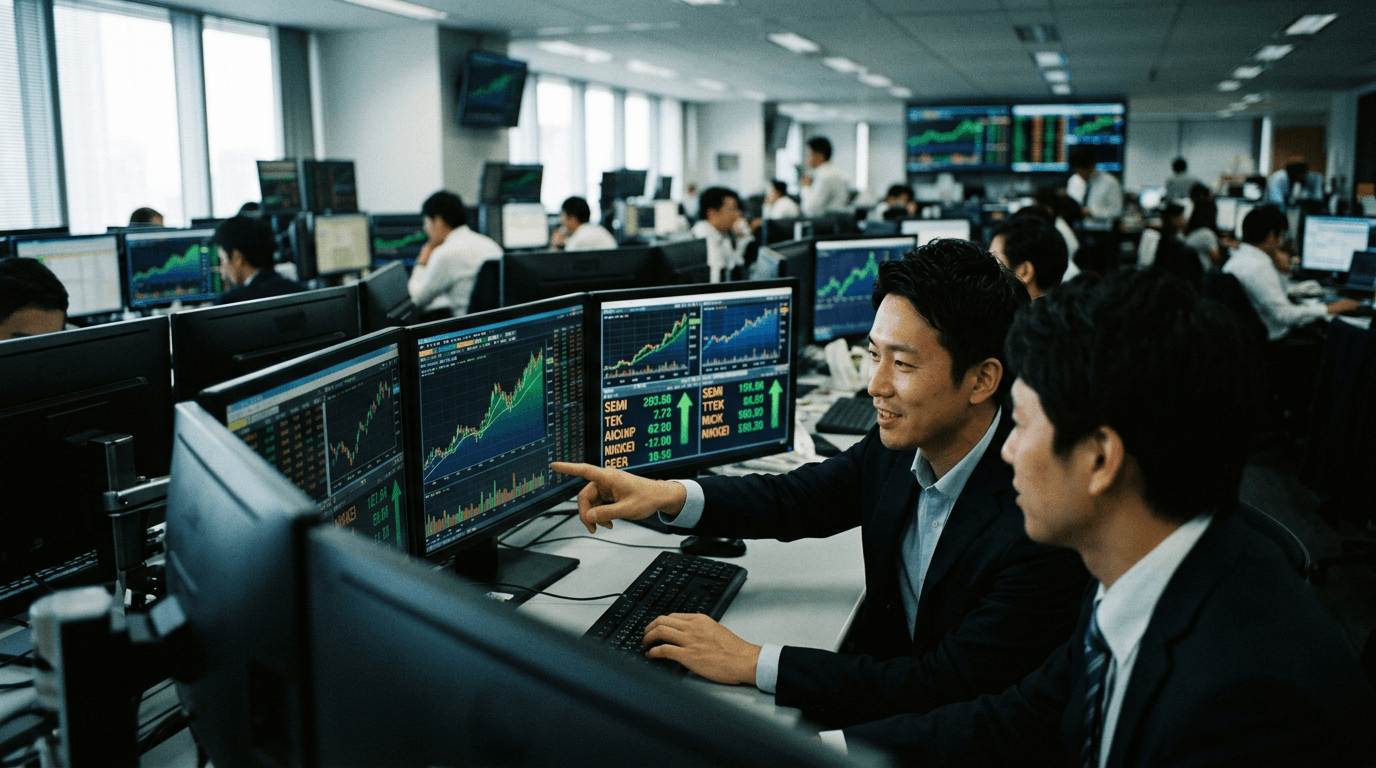
Asian equity markets are proving resilient, with stocks and semiconductor shares rebounding even as higher oil prices and persistent geopolitical tensions keep macro risks firmly on the radar.[2][10][14] The latest upswing underscores how quickly risk appetite can swing back when investors see opportunity in beaten‑down technology names and anticipate easier global monetary policy.[1][5][10]
Markets Snap Back
The rebound in Asia has been tightly linked to the recovery in U.S. markets, where major indices moved higher after a period of tech‑led volatility.[1][9][15] In recent sessions, the Dow Jones Industrial Average, S&P 500, and Nasdaq Composite all pushed into positive territory, helped by strength in large technology and semiconductor stocks.[1][15] That positive tone spilled over into Asia, where regional benchmarks such as the MSCI Asia Pacific Index have logged some of their strongest daily gains since earlier in the year.[2]
South Korea’s Kospi has been a standout, surging in multiple sessions as investors returned to heavyweight chipmakers.[2][11][12] Japan’s Nikkei and Taiwan’s Taiex have also climbed, supported by renewed demand for tech and AI‑linked shares.[2][9][14] In Hong Kong and across broader emerging Asia, performance has been more mixed, but the bias has shifted back toward risk‑on, particularly in sectors tied to digital infrastructure and advanced manufacturing.[2][9]
The key takeaway: equity markets remain highly sensitive to global tech sentiment. When Wall Street stabilizes and chip stocks rally, Asia tends to follow quickly, reflecting deep integration across global supply chains and investor positioning.
Semiconductor Leadership And The Ai Trade
Semiconductor stocks are once again at the center of the rebound story. In the U.S., chipmakers such as Micron Technology, Advanced Micro Devices, Nvidia, and Intel have posted strong gains, with broader semiconductor indices jumping around 5% in a single session.[1][12][14] These moves are being driven by ongoing optimism around artificial intelligence, cloud computing, and data‑center demand, even after periodic corrections in AI‑linked names.[2][12][14]
In Asia, the same theme is playing out through local champions. South Korea’s Samsung Electronics and SK Hynix have led rallies in the Kospi, helping push the benchmark sharply higher after steep earlier declines.[2][11][12] Taiwan’s chip‑focused market has also benefited, reflecting its critical role in global semiconductor fabrication and AI hardware.[2][14] Investors appear willing to look through near‑term volatility in order to maintain exposure to the long‑term AI build‑out, which continues to drive capital expenditure and demand for advanced chips.[2][14]
For traders, the lesson is clear: semiconductor stocks are increasingly the “beta engine” of regional equity markets. They amplify both sell‑offs and rebounds, making them central to any strategy that aims to capture shifts in risk appetite.
Oil, Geopolitics, And Risk Sentiment
What makes the current rebound notable is that it is happening against a backdrop of higher oil prices and ongoing geopolitical risk. Crude futures recently rose around 5% after a series of sharp declines, highlighting renewed concern about supply disruptions and regional conflict.[14] At the same time, tensions in the Middle East have remained a persistent macro risk, even if they have periodically eased enough to allow markets to refocus on economic data and corporate earnings.[10][12]
Normally, rising oil prices and heightened geopolitical uncertainty would be expected to weigh on equities, particularly in energy‑importing economies in Asia. Higher input costs can pressure margins, while war risk tends to push investors toward safe‑haven assets. Yet recent trading suggests that when investors believe central banks—especially the Federal Reserve—may cut rates in response to softer economic data, that policy backdrop can offset some of the drag from oil and geopolitics.[5][10][11]
Another important nuance: oil moves are being interpreted not just as a supply story, but also as a demand signal. To the extent higher prices reflect solid global activity, markets can treat them as confirmation that the world economy is still expanding, supporting cyclical sectors and risk‑sensitive assets.
Implications For Risk Assets And Fx
The rebound in equities is being mirrored in risk‑sensitive currencies and index futures. When Asian stocks move higher on the back of tech strength and expectations of looser policy, high‑beta FX—such as those of commodity exporters and emerging markets—tend to gain as well. Equity futures tied to major indices in the U.S. and Asia have shown “follow‑through buying,” signaling that investors are willing to add risk rather than simply cover shorts.
Safe‑haven assets, by contrast, have seen more tempered flows. Periods of market stress have still triggered moves into gold, U.S. Treasuries, and defensive currencies, but these have quickly reversed when headlines shift back toward easing geopolitical tensions and supportive central bank narratives.[10][12] This push‑and‑pull between risk assets and havens highlights a key feature of the current environment: macro risks are high, but they are not consistently dominant.
For traders, this means that cross‑asset relationships—equities, FX, rates, and commodities—are crucial. Understanding how chip stocks, oil prices, and bond yields interact can reveal whether a move is broadly supported or likely to fade.
How Traders Can Navigate This Environment
For market participants, the combination of rebounding Asian equities, surging semiconductor shares, and elevated macro risks creates both opportunity and complexity. Volatility around tech and energy can be sharp, but the underlying themes—AI adoption, digital infrastructure, and shifting monetary policy—are longer‑term drivers that can anchor a strategic view.[1][2][5][10][12][14]
A practical approach is to separate the structural story from the tactical noise. Structurally, the AI and semiconductor cycle remains intact, with Asian and U.S. chipmakers positioned at the core of future growth.[2][12][14] Tactically, higher oil prices and geopolitical headlines will continue to generate sudden swings in sentiment, offering short‑term trading setups in indices, sector baskets, and related FX pairs.
Simulated finance platforms can be particularly useful in this environment, allowing traders to test scenarios such as “chip‑led rebounds during oil spikes” or “risk‑on rotations when central bank expectations change” without real capital at risk. By experimenting with hedging—using energy exposure to offset tech risk, or safe‑haven assets to cushion equity positions—traders can refine strategies before deploying them in live markets.
The current rebound in Asian stocks and semiconductor shares shows that markets can climb a wall of worry when the earnings and policy backdrop are supportive. For active traders and investors, the challenge is not just predicting the next move, but building robust, well‑tested approaches that can handle both the rallies and the shocks that define today’s macro landscape.