
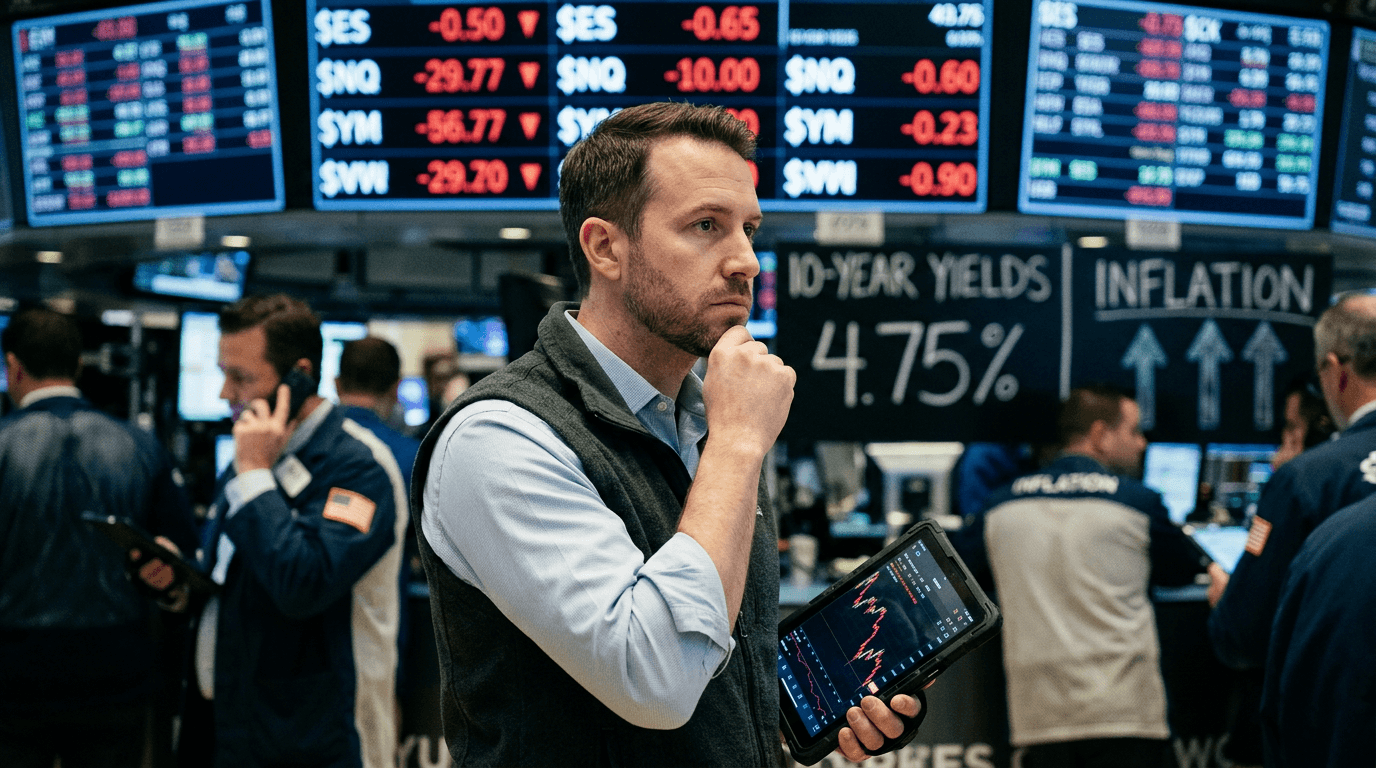
US equity index futures have paused after a strong run, with contracts on the Dow, S&P 500, and Nasdaq‑100 trading around flat to slightly lower as traders reassess the impact of stubbornly high bond yields and renewed inflation concerns[2][4][10]. At the same time, the 10‑year US Treasury yield is holding near the 4.7%–4.75% area, its highest levels in roughly 19–20 months, underscoring a macro backdrop that is challenging for risk assets[8][9]. For traders, this is a classic “crossroads” moment: the trend is intact, but the macro headwind is strengthening.
Market Snapshot: Futures Stall As Yields Push Higher
Recent sessions have seen US equity index futures lose momentum, with Dow and S&P 500 contracts fluctuating around unchanged and Nasdaq‑100 futures modestly in the red after earlier gains[2][4][10]. The stall comes after a period in which major indices notched repeated weekly advances and, in some cases, fresh highs, suggesting that investors are increasingly reluctant to add exposure at elevated valuations in the face of rising yields[1][6].
On the rates side, the 10‑year US Treasury yield has pushed up toward 4.75%, testing multi‑month highs and reversing earlier declines that followed announcements of larger bond buybacks[8][9]. This move reflects not only concerns about the government’s borrowing trajectory, but also persistent uncertainty around the Federal Reserve’s reaction function as inflation measures remain above the 2% target[8][9][12].
Fed officials have signaled that if inflation stays too high or re‑accelerates—particularly amid energy price shocks and geopolitical tensions—they are prepared to consider further rate hikes rather than cuts[7][11][12]. Market‑based probabilities now embed a non‑trivial chance of additional tightening later this year, with some futures pricing tipping above the 50% mark for a potential move[14]. In that environment, a pause in equity index futures is a rational expression of caution rather than outright panic.
Why High Yields Are A Headwind For Equity Index Futures
Higher long‑term yields increase the discount rate applied to future cash flows, which mechanically lowers the present value of equities—especially growth sectors whose earnings are expected further out in time. Tech‑heavy indices like the Nasdaq‑100 behave like “long‑duration” assets, so they tend to be more sensitive when the 10‑year yield reprices sharply higher.
Rising yields also raise the hurdle rate for all risk assets. When investors can earn close to 5% in relatively safe government bonds, they demand a higher expected return from equities to justify the risk. If earnings expectations or margins look vulnerable, index futures buyers become more selective and position sizes shrink.
Finally, elevated yields often tighten financial conditions indirectly. Corporate borrowing costs rise, valuations compress, and volatility in rates markets can spill over into equities. For index futures traders, this means intraday swings may be driven as much by moves in the Treasury curve and Fed‑speak as by company‑specific news or earnings.
SECTOR, FX, AND CROSS‑ASSET RIPPLE EFFECTS
The current backdrop is particularly challenging for technology and other growth‑oriented segments of the equity market. Recent futures flows have shown relative weakness in Nasdaq‑100 contracts compared with the Dow, reflecting the higher rate sensitivity of mega‑cap tech and unprofitable growth names[2][4][10]. In contrast, more value‑tilted sectors—such as financials and select cyclicals—can sometimes benefit from steeper curves and higher net interest margins, though that support is not uniform.
Higher US yields also influence currency markets. When the 10‑year Treasury trades significantly above yields on other developed‑market government bonds, the US dollar tends to find support against low‑yielding currencies, as global investors rotate into dollar assets to capture the yield advantage[8][9]. This yield‑driven dollar strength can pressure US multinationals via FX translation and export competitiveness, adding another layer to the equity outlook.
Beyond equities and FX, commodities and energy‑linked assets remain sensitive to the inflation narrative. Elevated oil prices can fuel inflation anxiety and push rate‑hike probabilities higher, feeding back into bond yields and equity valuations[7][14]. Traders looking at index futures in isolation risk missing the cross‑asset signals that often precede larger equity moves.
Practical Playbook For Index Futures Traders
In this environment, futures traders benefit from anchoring their strategy around a few core principles:
1) Track yield levels and their “pain thresholds.” Knowing where the 10‑year has previously triggered equity pullbacks—such as the recent tests near 4.75%—helps frame risk around key macro levels[8][9]. When yields approach or break those levels, consider tightening stops or reducing leverage.
2) Distinguish between trend and regime. A short‑term stall in index futures does not automatically mean the broader uptrend is over. However, a sustained period of high and volatile yields alongside sticky inflation can mark a regime shift in which low‑rate playbooks (e.g., aggressive growth chasing) stop working.
3) Use scenario analysis. Map out equity futures responses under different paths for inflation and Fed policy. For example: - Inflation cools, yields drift lower, and futures resume their climb. - Inflation plateaus, yields stay elevated, and futures chop sideways with higher intraday volatility. - Inflation re‑accelerates, the Fed hikes again, yields break higher, and futures correct more sharply.
Simulated trading environments, such as those offered in the SimFi space, are well‑suited to stress‑testing these scenarios without capital at risk. By repeatedly trading Dow, S&P 500, and Nasdaq‑100 futures under varying yield and inflation assumptions, traders can refine entries, exits, and position sizing before deploying real money.
4) Respect cross‑asset correlations. Incorporate Treasury yield and dollar indices into your futures dashboard. If both yields and the dollar are breaking higher simultaneously, that combination often signals a tougher hurdle for risk assets and warrants more conservative futures positioning.
KEY TAKEAWAYS FOR SIMFI AND REAL‑MONEY TRADERS
For traders using simulated platforms to build skills, this macro phase is an opportunity to practice:
- Adjusting strategies quickly as yields move between regimes.
- Rotating between equity indices (e.g., preferring Dow or S&P over Nasdaq when rate sensitivity is high).
- Integrating macro events—Fed speeches, inflation releases, geopolitical headlines—into short‑term trade plans.
- Testing risk‑management rules that automatically respond to moves in benchmark yields.
The goal is not to predict every tick in yields or futures, but to develop a disciplined process that remains robust whether the 10‑year is at 3%, 4.75%, or higher. A well‑rehearsed process in simulation tends to translate into better execution when capital is on the line.
Conclusion
US equity index futures are sending a clear message: after strong gains, the market is unwilling to push aggressively higher while long‑term yields sit near cycle highs and inflation worries persist[2][4][8][9][12]. This pause is less a sign of capitulation than a rational response to a tougher macro trade‑off. For traders—particularly those honing their skills in simulated environments—the current backdrop is an ideal laboratory for learning how equity futures behave when the cost of money is rising, the Fed’s next move is uncertain, and cross‑asset relationships matter as much as single‑stock stories. Mastering that playbook now can provide a durable edge long after yields and inflation settle into their next regime.