
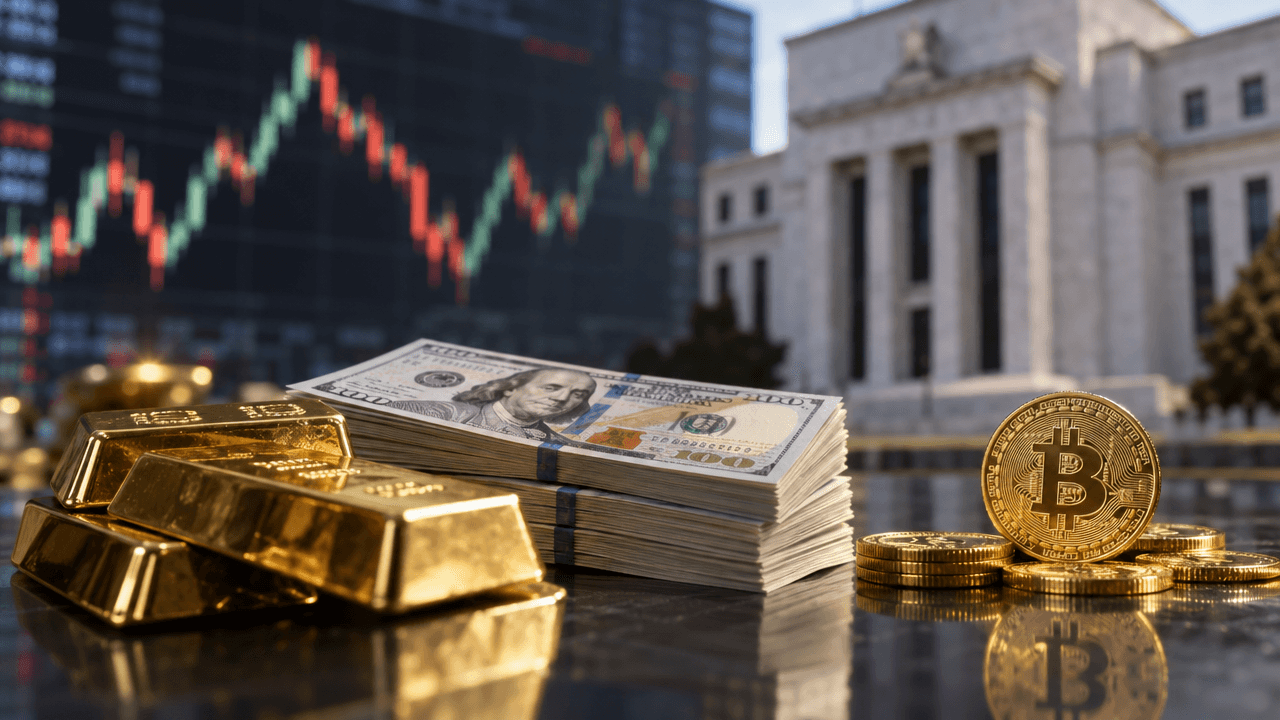
A 10-year Treasury yield near 5.24% is more than a bond-market statistic. It is a powerful signal for nearly every major financial market. Because U.S. government bonds help set the baseline for global borrowing costs and asset valuations, persistently high yields are forcing traders to reassess the appeal of stocks, currencies, gold, cryptocurrencies, and other rate-sensitive instruments.
The benchmark yield held around 5.24% on October 9, 2026, after reaching levels not seen since 2002. Over the previous month, the yield increased by roughly 0.27 percentage points, highlighting how quickly financing conditions have tightened. [10] The move reflects a combination of inflation concerns, heavy government borrowing, fiscal uncertainty, and expectations that interest rates may remain restrictive for longer.
WHY 5% MATTERS TO MARKETS
Bond yields and prices move in opposite directions. When investors sell Treasury securities, their prices decline and their yields rise. A 10-year yield above 5% means investors can receive a relatively attractive return from a government-backed asset without taking the same level of corporate or equity risk.
That changes the calculation for portfolio managers. When Treasury yields were near historic lows, investors often moved into technology stocks, speculative growth companies, emerging markets, and cryptocurrencies in search of higher returns. At 5% or higher, safer income becomes more competitive.
The yield also affects the discount rate used to value future corporate earnings. A company expected to generate profits many years from now becomes less attractive when investors can earn a higher return in Treasury bonds today. This is especially important for high-growth companies whose valuations depend heavily on distant earnings.
Higher yields also raise borrowing costs for businesses, households, and governments. More expensive loans can discourage investment, reduce housing affordability, and pressure companies with large refinancing needs.
THE DOLLAR’S COMPLICATED RESPONSE
Higher U.S. yields often support the dollar because international investors may buy dollar-denominated assets to capture better returns. Recent market commentary identified the yield advantage as a significant tailwind for the greenback, while the dollar also benefited from weakness in competing currencies. [2]
However, the relationship is not always straightforward. If Treasury yields rise because investors are confident in U.S. economic growth, the dollar may strengthen in an orderly way. If yields rise because of concerns about inflation, government debt, or the sustainability of fiscal policy, currency markets may become more volatile.
A stronger dollar can create additional pressure outside the United States. Emerging-market borrowers with dollar-denominated debt may face higher repayment costs, while foreign investors holding U.S. assets must also manage currency risk. For forex traders, the key question is not simply whether yields are high, but why they are high and whether the increase is accelerating.
Equities And Rate-sensitive Assets
Equity-index futures are particularly sensitive to changes in long-term yields. Rising rates can weigh on stocks in two ways: they increase corporate financing expenses and make bonds more attractive relative to equities. Reuters reported that U.S. stocks declined when the 10-year yield climbed to its highest level since 2007, illustrating the immediate connection between yields and equity sentiment. [11]
The most vulnerable areas are usually long-duration assets. These include high-growth technology companies, unprofitable businesses, real estate investment trusts, utilities, and other sectors whose valuations depend on low financing costs or predictable future cash flows.
This does not mean every stock must fall when yields rise. Banks and some value-oriented companies may benefit from a stronger nominal-growth environment. Companies with strong balance sheets, limited refinancing needs, and consistent cash flow may also hold up better. Still, elevated yields typically increase the market’s demand for earnings quality and reasonable valuations.
Gold And Cryptocurrency Under Pressure
Gold does not pay interest. When Treasury yields rise, the opportunity cost of owning gold increases because investors can earn more income from government securities. A stronger dollar can add another headwind, since gold is priced in dollars and becomes more expensive for buyers using other currencies. Recent market analysis linked yields above 5.2% and a dollar index above 101 with weaker demand for non-yielding assets. [6]
Cryptocurrency markets face a similar liquidity challenge, although their response can be more dramatic. Digital assets often benefit when real yields are low and investors are willing to accept greater risk. As bond yields rise, speculative capital can retreat toward cash and government securities.
Crypto traders should also watch liquidity conditions, stablecoin flows, exchange-traded fund activity, and broader equity sentiment. A high-yield environment does not automatically guarantee falling cryptocurrency prices, but it can reduce the amount of capital available for aggressive positioning.
Practical Takeaways For Traders
The first priority is to monitor both the level and direction of the 10-year yield. A stable yield near 5.24% may be easier for markets to absorb than a sudden move toward 5.5%. Speed often matters as much as the absolute number.
Second, compare the 10-year yield with inflation expectations and real yields. Rising nominal yields caused by stronger growth may affect markets differently from rising yields caused by persistent inflation or fiscal stress.
Third, avoid treating correlations as permanent rules. Higher yields may support the dollar in one session and weaken it in another if traders interpret the move as evidence of economic instability. Gold may fall initially but later recover if inflation concerns intensify.
Finally, position sizing and risk management are essential. Elevated yields can create sharp cross-asset moves, particularly around inflation data, employment reports, Treasury auctions, and central-bank communications.
Conclusion
Treasury yields near 5.24% have reestablished bonds as a serious alternative to riskier assets while raising the cost of capital across the global economy. The dollar may receive support from higher returns, but fiscal and inflation concerns can make that relationship unstable. Equities, gold, and crypto are all being forced to compete with a more attractive risk-free yield.
For traders, the central lesson is clear: interest rates remain the market’s transmission mechanism. Understanding why yields are moving—and how quickly—is essential for interpreting the next move in currencies, equity-index futures, commodities, and digital assets.