
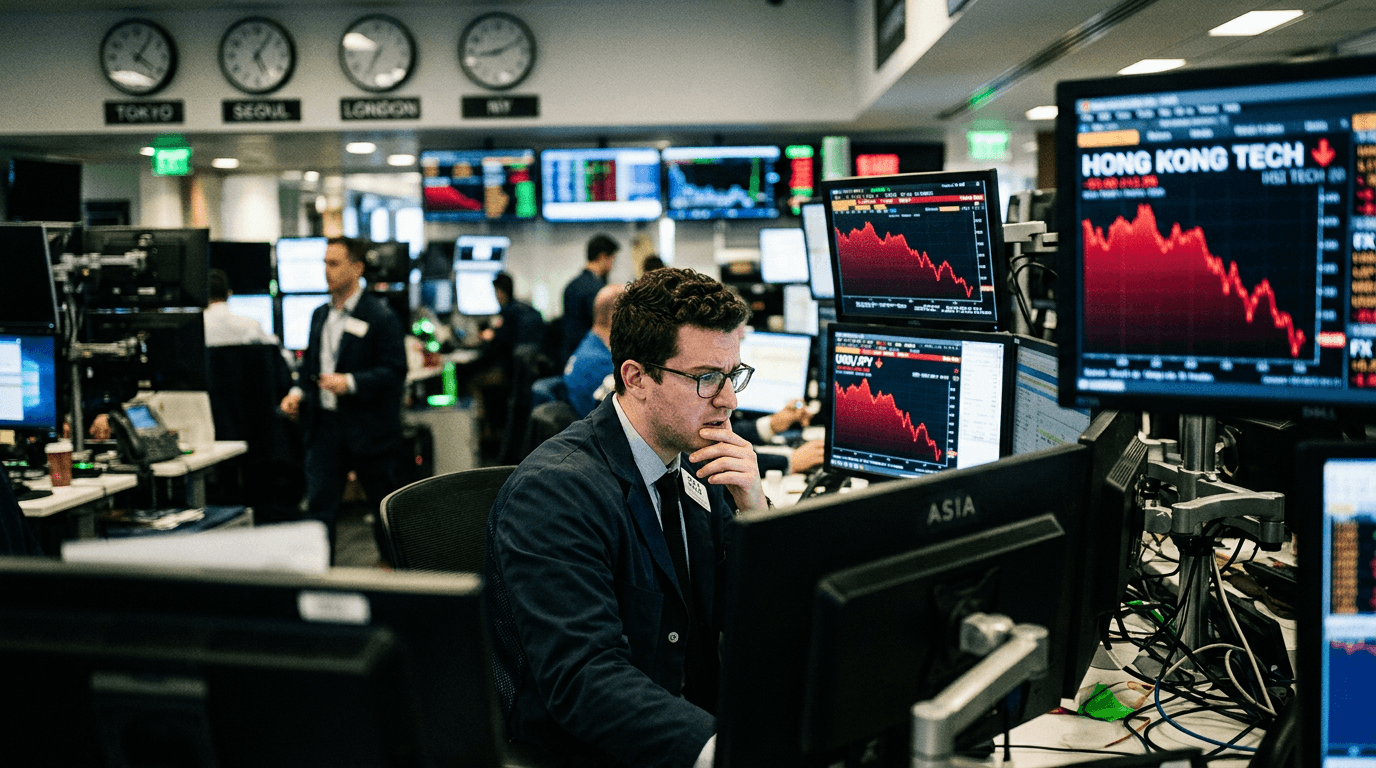
Asian equity markets just reminded traders how quickly sentiment can flip when a crowded trade comes under pressure. A sharp selloff in technology shares sent benchmarks in Japan and Taiwan down as much as 6%, with Japan’s Nikkei sliding into formal correction territory after falling more than 10% from its late-June peak.[1][7] The move was not confined to cash equity markets: the risk-off tone rippled into index futures and foreign exchange, reinforcing how intertwined global risk assets have become in the age of AI-driven tech rallies.[4]
WHAT’S BEHIND THE ASIAN TECH SELLOFF?
Technology has been the clear leadership sector in Asia this year, with semiconductor and AI-related names attracting substantial flows and pushing indices to record or near-record highs.[8][11] That kind of outperformance tends to leave markets vulnerable to abrupt reversals when investors start questioning valuations or the durability of earnings growth. Recent sessions have seen heavy profit-taking in chipmakers such as Samsung Electronics and SK Hynix, both of which have posted double-digit percentage declines that dragged South Korea’s Kospi lower by 7–9% in a single day.[8][11][12]
The trigger is less about a single headline and more about a combination of factors. Investors are reassessing whether the massive capital spending on AI infrastructure will translate into sustainable profitability, and whether current earnings expectations already price in several years of growth.[3][11] At the same time, advances from new AI model releases, including Chinese entrants, are intensifying competitive pressures and raising questions about which firms will capture long-term economics.[6] When these concerns collide with elevated positioning and high valuations, even modestly negative news can produce outsized moves.
It is also important to note that the Asian tech selloff is part of a broader global pattern. U.S. indices like the Nasdaq and S&P 500 have come under pressure as investors rotate out of richly valued software and chip names, with futures pointing to weaker openings on several recent sessions.[6][8][13] Asian markets, which trade ahead of Europe and the U.S. time zones, are effectively “pricing in” that global tech weakness, often magnifying it because of their heavy sector concentration.
How Risk-off Sentiment Flows Into Index And Commodity Futures
When cash equity markets in Asia tumble, the immediate spillover is visible in equity index futures, both locally and across regions. A 5–6% drop in major benchmarks tends to push regional futures lower as traders hedge portfolios or position for continued volatility.[1][7] For example, declines in Asian tech names have been accompanied by selling in Nasdaq 100 futures and dips in broader U.S. index contracts as investors extrapolate weaker demand for chips, cloud infrastructure, and AI hardware.[8][13]
Equity futures are not the only instruments affected. Risk-off episodes frequently coincide with moves in commodity futures, particularly in energy and industrial metals. When investors fear that a tech-led slowdown could spill into broader growth, contracts linked to oil and copper can face pressure as traders reduce exposure to cyclical assets.[9][14] At the same time, elevated geopolitical tensions in regions like the Middle East can partially offset this effect by supporting oil prices, creating a more complex picture for macro traders.[7][12][14]
For active traders and SimFi participants, these interactions underscore why it is critical to think in terms of cross-asset correlations rather than isolating a single market. A sharp drop in Asian tech can influence expectations for global growth, earnings, and policy, which then feed into stock index futures, bond yields, and commodity curves. Practicing scenario analysis—such as simulating how a 5% tech drawdown impacts equity and FX exposures—helps build the reflexes needed to navigate such conditions.
Fx: Safe-haven Flows And Pressure On Growth Currencies
Foreign exchange markets often act as the first “macro lens” through which equity shocks are interpreted. In broad risk-off environments, traders typically gravitate toward safe-haven currencies like the U.S. dollar, Japanese yen, and Swiss franc, while reducing exposure to commodity-linked and high-beta currencies such as the Australian dollar, New Zealand dollar, and certain emerging-market FX.[4] These moves reflect a preference for liquidity and perceived stability when equity volatility spikes.
However, the relationship is not always straightforward. Recent sessions have shown that the yen, traditionally seen as a haven, can sometimes languish even as global stocks fall, particularly when interest-rate differentials make it expensive to hold.[9] That nuance matters for traders: relying on old “rules of thumb” without monitoring current rate dynamics and positioning can lead to surprises.
The key takeaway for FX participants is to track how tech-led equity moves shift expectations for central bank policy and global growth. If investors believe that an AI-driven investment boom is cooling, they may reassess the path of rates, which in turn influences yield-sensitive currencies and carry trades.[2][9] For instance, cooling inflation and less urgent rate-hike risk in the U.S. have recently been positive for bonds even as tech shares struggle, adding another layer of complexity to the FX landscape.[2]
Practical Lessons For Active And Simulated Traders
For traders using live or simulated environments, the Asian tech selloff offers several practical lessons:
First, concentration risk is real. When a single sector—like semiconductors or AI hardware—dominates index performance, portfolio drawdowns can be severe when sentiment turns. Monitoring sector weights and stress-testing portfolios against sharp moves in leaders such as TSMC, Samsung, or SK Hynix is essential.[2][8][11]
Second, lead–lag relationships matter. Asia often trades after the U.S. closes and before Europe opens, so overnight moves in Nasdaq futures and key U.S. tech names can set the tone for the next Asian session.[6][8][13] SimFi traders can practice building trade plans that incorporate these time-zone dynamics, such as using index futures and FX pairs to hedge exposures going into the open of major Asian exchanges.
Third, risk management should adapt to volatility regimes. When markets move from a calm environment to one where 5–8% daily swings in major indices become possible, position sizing, leverage, and stop-loss placement must be recalibrated. Simulated trading is a powerful way to test how different strategies perform under stress without putting real capital at risk, helping traders refine their approach before volatility hits live portfolios.
LOOKING AHEAD: WHAT COULD STABILIZE OR EXTEND THE SELLoff?
Whether this tech-led tumble in Asian shares becomes a short-lived shakeout or the start of a longer correction will depend on several factors. Upcoming earnings from major chipmakers and AI-exposed firms will be scrutinized for evidence that demand and margins can keep pace with expectations.[2][3] Clear guidance on AI spending plans, cloud budgets, and hardware orders could help rebuild confidence if they support the growth narrative.
Policy and macro data will also play a role. Cooler inflation readings and reduced pressure for rate hikes have recently been supportive for bonds, even as tech underperforms.[2] If that pattern continues, it could create a more benign backdrop where investors feel comfortable rebalancing into quality growth names at lower prices. Conversely, any sign that growth is faltering more broadly could extend risk-off moves across equities, futures, and FX.
For traders and investors—whether operating in live markets or via simulated platforms—the current environment is an opportunity to deepen understanding of how sector-specific shocks propagate through global assets. By studying episodes like the Asian tech selloff, testing responses in a risk-controlled setting, and staying alert to cross-asset signals, market participants can turn volatility from a source of anxiety into a catalyst for learning and improved decision-making.