
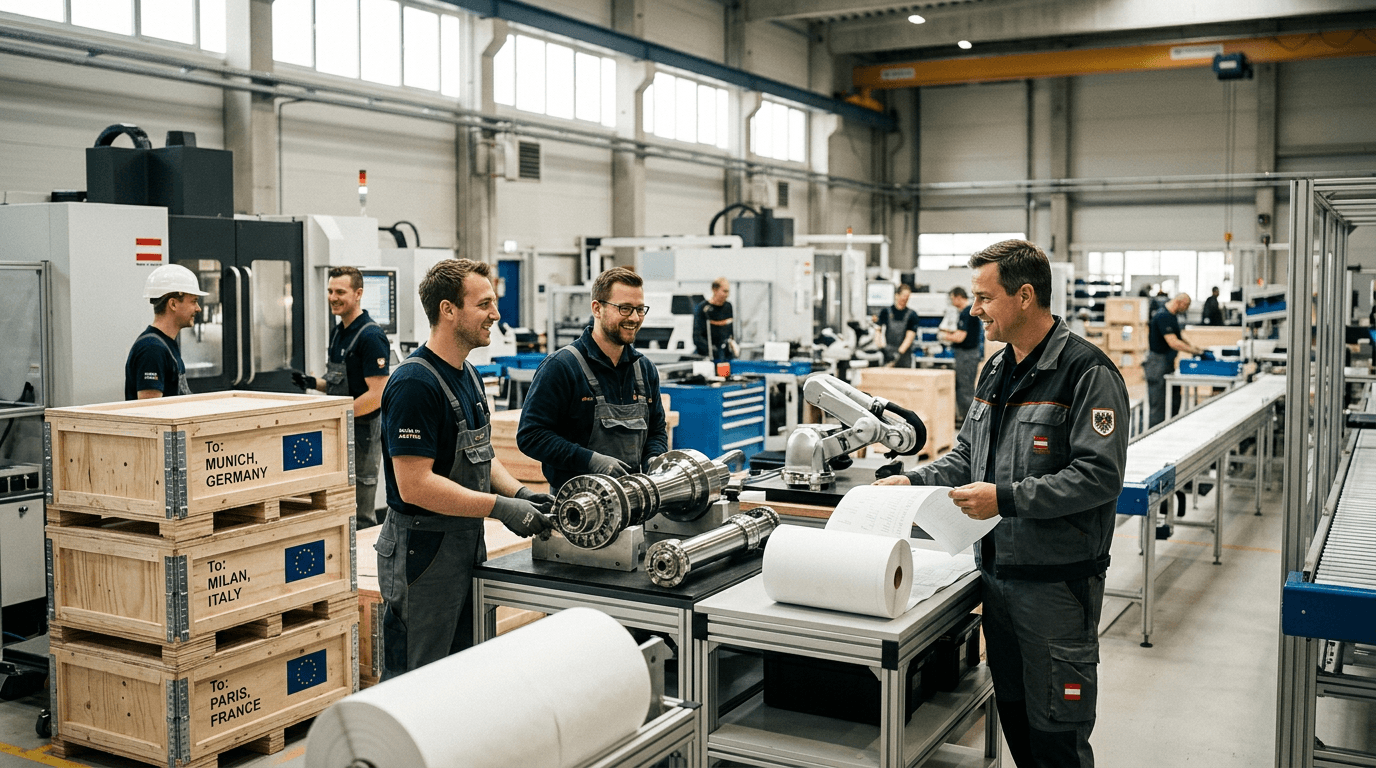
Austria's Manufacturing Sector: A Strong Rebound Signals New Horizons
Austria's manufacturing industry is witnessing its most robust resurgence in nearly four years, marked by a notable rebound in new orders and a surge in business confidence not seen since early 2022. This upswing signifies a pivotal turning point for Austria's economy, which has grappled with nearly two years of contraction following extended industrial challenges. For traders and investors with an eye on European economic health, these developments suggest that a recovery cycle might be on the horizon, with significant implications for futures markets and broader economic forecasts.
A Promising Shift in New Orders
In February 2026, Austria's manufacturing sector experienced a notable rise in new orders, a refreshing change after months of contraction. The Purchasing Managers' Index (PMI) climbed to 49.4 from 47.2 the previous month, marking the highest reading in three months, according to the UniCredit Bank Austria Manufacturing PMI survey in partnership with S&P Global. While a PMI of 49.4 remains technically below the 50-point expansion threshold, the upward trajectory is as crucial as the absolute number. The month-over-month increase of more than two points illustrates genuine momentum, particularly significant given Austria's recent economic history. This improvement is largely attributed to the growth in new orders, indicating that demand is stabilizing after a prolonged period of weakness in export-dependent manufacturing sectors.
Balancing Costs and Building Optimism
Despite the positive momentum in orders, Austrian manufacturers continue to operate in a "retrenchment mode," characterized by aggressive cost-cutting measures. Purchasing activity remains subdued, and pre-production inventories have been declining for 44 consecutive months. Workforce numbers fell at their fastest rate in four months, with manufacturers citing cost-reduction strategies as the primary reason for staff reductions. This paradox of stronger orders alongside workforce cuts reflects the complex reality facing many European manufacturers: balancing revenue growth with structural cost management to enhance profitability after years of margin compression.
Adding to competitive pressures, input costs have surged at the fastest rate in over three years, while output charges increased for the first time since April 2025. These price dynamics create a delicate balancing act for manufacturers, who must decide whether to absorb higher costs or pass them on to customers. The willingness to raise output prices for the first time in eleven months suggests growing confidence that the market can absorb price increases, a positive sign for industrial profitability.
Remarkably, despite these immediate operational challenges, business confidence has soared. Manufacturers report being "increasingly optimistic" about activity levels over the next twelve months, with expectations reaching their highest level since January 2022. This represents a four-year high in forward-looking sentiment, indicating that firms believe structural improvements in market conditions are emerging. The survey noted that "February's survey results signaled a notable improvement in business expectations across the manufacturing sector to the highest in just over four years," with manufacturers expressing hope for improved market conditions in construction and plans for new product launches.
Broader Economic Implications for Austria
Austria's manufacturing recovery gains critical context when viewed against the nation's recent economic trajectory. Real GDP fell by 0.7 percent in 2024 for the second consecutive year, with manufacturing bearing the brunt of the decline at negative 5.6 percent. Motor vehicles and transport equipment suffered particularly severe contractions at negative 15.8 percent, while computer products and electrical equipment fell 9.5 percent. This two-year recession has weighed heavily on Europe's manufacturing-dependent economy, making the current recovery signals meaningful for broader economic prospects.
The February 2026 PMI data aligns with earlier forecasts suggesting that industrial production would show signs of recovery in 2025. The Austrian Institute of Economic Research (WIFO) noted in their June 2025 business cycle report that "although there are increasing signs of an improvement in the manufacturing sector in the current year, uncertainty remains above average." This assessment remains relevant, as geopolitical factors and unpredictable tariff policies continue to create headwinds.
Implications for Investors and Traders
The stabilization in Austria's manufacturing sector carries weight beyond Austrian borders. As a significant eurozone economy with deep integration into European supply chains, Austria's manufacturing health serves as a barometer for broader European industrial strength. The combination of renewed order growth and dramatically improved business confidence suggests that European manufacturing may have found a bottom and begun recovering from the 2024-2025 downturn.
For futures traders and macro investors, the data points to a potentially constructive environment for European economic assets in coming quarters. While immediate operational headwinds remain—staffing reductions, inventory drawdowns, and rising input costs—the forward-looking confidence suggests these challenges are viewed as temporary. Successful navigation of the current cost environment, coupled with emerging demand, could position Austrian manufacturers well for accelerating growth if market conditions continue to improve and external uncertainties abate.
The February 2026 manufacturing PMI represents more than a single month's data point; it reflects a meaningful inflection in business sentiment and a potential return to industrial growth after years of contraction. For those monitoring European economic recovery, this is a development worth watching closely.
News Impact Score: 6