
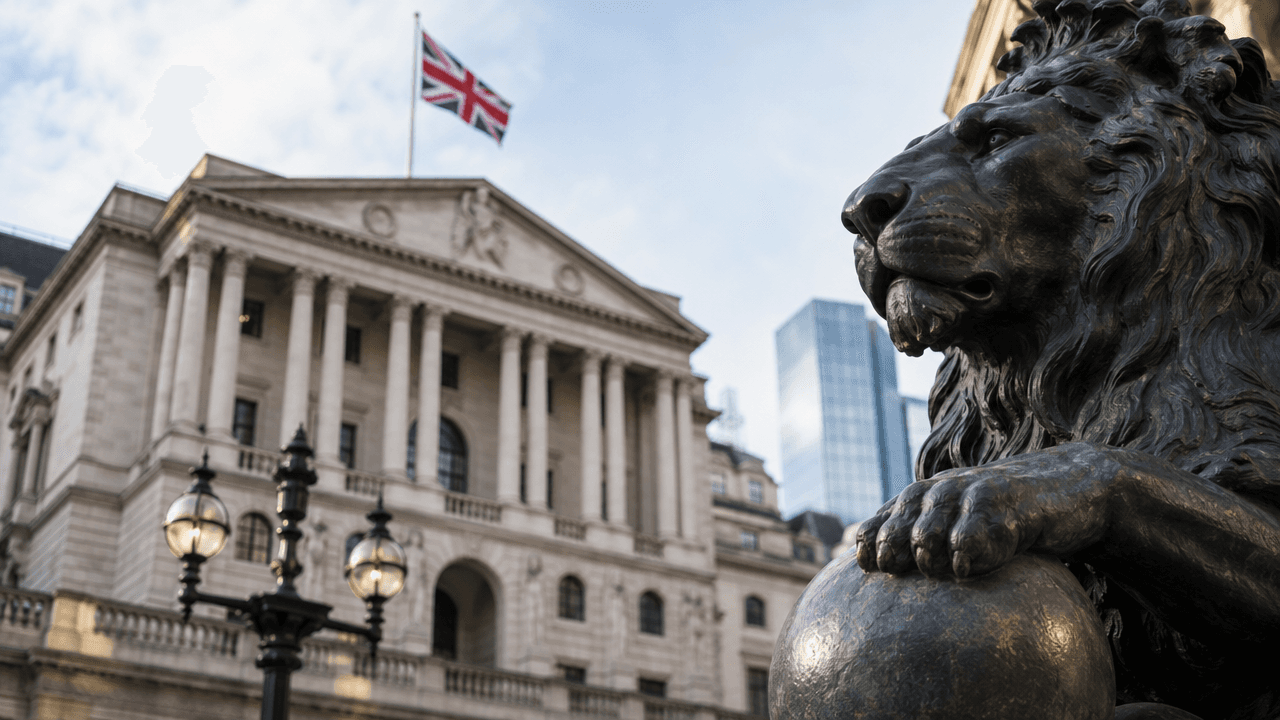
The Bank of England has raised Bank Rate by 25 basis points to 4%, delivering its first rate increase in more than three years. The decision marks a significant shift in the UK monetary-policy debate: inflation risks have strengthened again, even as policymakers remain concerned that higher borrowing costs and energy prices could weaken economic growth.
The Monetary Policy Committee voted 8–1 in favour of the increase at its meeting ending on 4 November. Catherine L Mann preferred a larger 50-basis-point rise to 4.25%, highlighting the committee’s concern that inflation could become more persistent. The next Bank Rate decision is scheduled for 17 December 2026. [2]
Why The Bank Of England Raised Rates
The immediate catalyst is a renewed rise in energy prices linked to the prolonged conflict in the Middle East. UK consumer-price inflation reached 3.5% in September, well above the Bank’s 2% target. The Bank now expects inflation to rise to approximately 5% by the middle of 2027 before gradually declining as energy-price effects fade and restrictive monetary policy weighs on demand. [2]
Energy prices create a difficult challenge for central banks. A rise in oil and gas prices directly increases household bills, transport costs and business expenses. It can also lead to indirect effects if companies pass higher costs on to consumers or workers seek larger pay increases to protect their purchasing power.
So far, the Bank has found limited evidence of significant second-round effects in wages and prices. However, policymakers warned that these effects often emerge with a delay. The longer energy prices remain elevated, the greater the risk that businesses rebuild profit margins through higher prices and employees seek compensation through stronger wage settlements.
The rate increase is therefore partly a preventive measure. By making borrowing more expensive, the Bank is attempting to limit excess demand and prevent temporary energy inflation from becoming embedded in expectations.
The Growth And Inflation Trade-off
The decision illustrates the difficult balance facing the UK economy. Higher interest rates can help return inflation to target, but they also increase monthly payments for households with variable-rate mortgages, raise financing costs for businesses and discourage new borrowing.
The Bank noted that economic activity had been more resilient than expected in recent months. Global growth has supported UK exports, while investment connected to artificial intelligence has provided an additional boost. Consumer demand has also held up despite higher energy costs, although confidence indicators suggest that this resilience may not last. [2]
There are already signs of pressure from tighter financial conditions. Benchmark two-year mortgage rates had risen by nearly 50 basis points since the beginning of September, while new mortgage approvals were falling. Lending to businesses remained comparatively strong, but firms facing higher energy bills and interest costs may become more cautious over time. [2]
This creates a central risk for investors and policymakers. If demand remains firm, further tightening could be needed to control inflation. If households and companies reduce spending sharply, the economy could slow without requiring many additional rate increases.
What It Means For Markets
A higher Bank Rate generally supports a currency by improving the relative return available on sterling-denominated assets. The prospect of tighter UK monetary policy can therefore support the pound, particularly against currencies issued by central banks that are expected to remain more accommodative.
However, sterling’s reaction is not guaranteed. If traders interpret the rate increase as a response to worsening energy costs and weakening growth, the currency could face competing pressures. Market participants will focus not only on the 4% decision, but also on whether the Bank signals additional increases.
UK government bonds are also sensitive to the announcement. Higher expected policy rates typically push short-dated gilt yields higher because investors demand greater returns to compensate for the prospect of tighter monetary conditions. Longer-dated yields may also rise if markets anticipate persistent inflation, although concerns about slower growth can limit that move.
For equities, the impact is likely to vary by sector. Banks may benefit from improved lending margins, although weaker borrowing demand and higher credit risk could offset that advantage. Growth-oriented companies are generally more sensitive to higher interest rates because future profits become less valuable when discounted at a higher rate.
Consumer-facing businesses, property companies and highly leveraged firms may face greater pressure. Their costs of financing rise while households have less disposable income. Defensive sectors and companies with strong balance sheets may prove relatively more resilient.
What Traders Should Watch Next
The Bank has stressed that monetary policy is not on a predetermined path. Future decisions will depend on energy prices, wage growth, business pricing behaviour, inflation expectations and the amount of spare capacity in the economy. [2]
For traders, the most important distinction is between a one-off insurance increase and the beginning of a sustained hiking cycle. The November minutes contained both perspectives. Some policymakers argued that further tightening could be required if inflation pressures persist, while others described the move as conditional and dependent on incoming evidence.
Key indicators to monitor include monthly CPI inflation, private-sector wage growth, services inflation, employment data and business surveys. Energy futures will remain particularly important because they influence both the Bank’s inflation forecasts and household purchasing power.
Traders should also compare UK data with policy expectations in the United States and eurozone. Currency markets respond to interest-rate differentials, not to one central-bank decision in isolation. A stronger-than-expected UK inflation report could reinforce sterling and raise gilt yields, while weaker growth data could produce the opposite reaction.
The Bigger Picture
The Bank of England’s move to 4% confirms that inflation management remains its immediate priority, even at the risk of slowing the economy. The increase is modest in size, but meaningful in signal: policymakers believe the renewed energy shock has created enough upside risk to justify tighter financial conditions.
For market participants, the decision reinforces the importance of reading central-bank communication alongside headline rate changes. Sterling may gain support, borrowing-sensitive UK assets may come under pressure, and interest-rate volatility could remain elevated.
The clearest takeaway is that the next phase of UK monetary policy will be data-dependent. If energy prices fall and domestic inflation continues to ease, the Bank may pause. If wage and price pressures broaden, another increase could follow. Until that evidence arrives, traders should manage exposure carefully, distinguish short-term market reactions from longer-term trends, and avoid assuming that a single rate hike defines the entire policy cycle.