
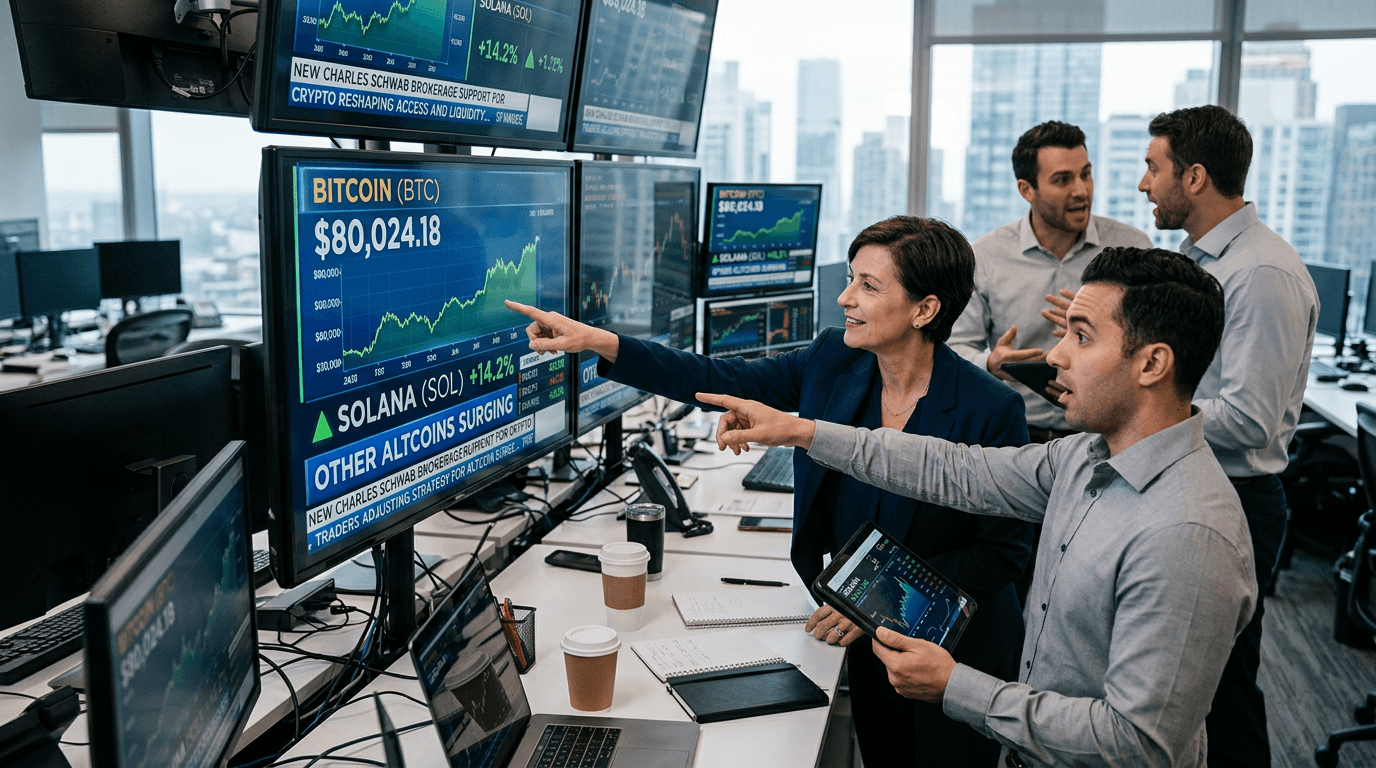
Bitcoin is holding steadily above the crucial $80,000 threshold, signaling that the latest crypto rally is more than a fleeting spike and reinforcing the narrative that the long “crypto winter” may be giving way to a new risk-on cycle.[3][8][13] At the same time, altcoins such as Solana are outperforming majors, with sharp moves higher driven by a powerful catalyst: new support from mainstream brokerage giant Charles Schwab for direct trading in Solana, Avalanche, and Chainlink.[2][5][9][11] Together, these developments are reshaping how traders think about access, liquidity, and derivatives exposure across the digital asset complex.[1][5][10]
BITCOIN’S MOVE ABOVE $80,000
Bitcoin has reclaimed levels above $80,000, marking its strongest prices since mid-May and a clear break from the lows of early summer.[3][8][13] Recent prints near $80,000–$81,000 represent roughly a three-month high, with intraday spikes toward the low $81,000s as leveraged short positions have been forced to cover.[1][3][10] Since mid-August, Bitcoin’s gains are estimated at around 25–28%, putting August on track to be one of its best months since late 2024.[6][8][13]
Macro catalysts are playing a key role in this move. A softer U.S. dollar and efforts by U.S. policymakers to stabilize the bond market have revived interest in what some analysts call the “debasement trade,” pushing investors toward assets perceived as hedges against currency and debt risks.[6][8] This combination of macro tailwinds and technical momentum has powered a broad recovery in crypto market sentiment, with liquidations of bearish positions amplifying the upside as price breaks key levels.[3][10][13]
For traders, Bitcoin holding above $80,000 is more than just a psychological milestone. It confirms that buyers are willing to defend higher ranges, which can shift options skew, futures basis, and risk models tied to the leading crypto benchmark.[1][6][10] In a simulated or paper-trading environment, this is an ideal backdrop to test strategies that rely on trend persistence, momentum ignition, and volatility clustering around major price thresholds.
Solana Leads Altcoin Surge On Schwab Support
While Bitcoin sets the tone, Solana has emerged as one of the standout altcoin performers, with recent gains in the high single to low double digits over a 24-hour window.[2][5][7] Solana has broken through the $100 level and traded in the $100–$110 region, marking roughly a seven-month high and reinforcing its status as a leading high-performance smart-contract platform.[2][5][7]
The immediate catalyst has been Charles Schwab’s announcement that it plans to add spot trading in Solana, Avalanche, and Chainlink to its Schwab Crypto platform for U.S. retail clients.[2][5][9][11] Schwab, which oversees more than $13 trillion in client assets, previously offered direct crypto access only to Bitcoin and Ethereum, making this expansion a significant broadening of mainstream access to selected altcoins.[2][9][11][15] Shortly after the announcement, Solana’s price jumped by roughly 9–13% over 24 hours, underscoring how quickly markets react to new sources of potential inflows.[2][5][7]
Beyond spot markets, the rally has boosted activity and sentiment in futures and derivatives linked to Solana and the other newly supported tokens, as traders reposition ahead of anticipated retail demand.[5][7][9] For altcoin markets more generally, brokerage integration can effectively act as a new “on-ramp,” deepening liquidity and expanding the investor base beyond specialized crypto exchanges.
Why Brokerage Access Matters For Crypto And Derivatives
Schwab’s move is part of a broader trend: large traditional brokers and financial institutions are progressively moving from passive exposure via ETFs and structured products toward direct, spot crypto trading for their clients.[12][14][15] Earlier this year, Schwab began rolling out Bitcoin and Ethereum trading inside standard brokerage accounts, with crypto accessible alongside stocks and other conventional assets.[12][14][15] Adding Solana, Avalanche, and Chainlink is the next step in that evolution, signaling growing comfort with a selected subset of altcoins that have meaningful liquidity and use cases.[2][5][9][11]
Mainstream brokerage support changes the market mechanics in several ways. First, it widens distribution, allowing retail investors who might never open a dedicated crypto exchange account to access these tokens through familiar platforms.[9][11][14] Second, it introduces new capital pools that can respond to news, narratives, and macro shifts, potentially increasing both upside and downside volatility as participation broadens.[2][5][7] Third, it feeds into the derivatives complex: as spot volumes grow, futures, options, and structured products tied to these assets become more attractive for liquidity providers and sophisticated traders.[5][7][9]
For traders in simulated environments, understanding this access dynamic is critical. Brokerage listings are often inflection points that blend fundamental developments (network growth, governance progress) with distribution effects (more places to buy and sell), which in turn can create short, intense bursts of momentum around announcement and launch windows.[2][5][7][9]
Implications For Simulated Traders And Risk Management
With Bitcoin steady above $80,000 and altcoins like Solana breaking to multi-month highs, traders face a classic late-cycle question: how to participate in upside while respecting the risk of sharp reversals.[3][5][7][10][13] The recent rally has been assisted by short squeezes and rapid sentiment shifts, patterns that historically can fade as positioning normalizes.[3][10][13]
Simulated trading platforms offer a way to practice navigating this environment without capital at risk. Traders can model scenarios where brokerage-driven inflows push altcoins beyond technical resistance, then test how quickly those moves can unwind when news flow cools or macro conditions change.[2][5][7][9] They can also explore basis trades between spot and futures, volatility strategies around major announcements, and portfolio allocation shifts as Bitcoin’s dominance fluctuates relative to rising altcoins.[1][5][6][10]
Risk management remains central. Event-driven rallies, such as those triggered by Schwab’s expansion, are often accompanied by higher intraday swings and widening bid-ask spreads in less-liquid instruments.[5][7][9] Practicing with simulated positions allows traders to refine stop placement, position sizing, and hedging techniques so they are prepared if and when they transition to live capital.
Key Takeaways For Simfi Participants
First, Bitcoin holding above $80,000 confirms that the latest upside move is backed by sustained buying interest and supportive macro narratives, rather than just a single news spike.[3][6][8][13] Second, Solana’s outperformance highlights how targeted institutional or brokerage support can disproportionately benefit specific altcoins, especially when combined with strong network fundamentals and governance developments.[2][5][7]
Third, brokerage expansion into altcoins marks a structural shift in crypto market access, opening new channels for capital and creating fresh opportunities—and risks—for derivatives traders.[5][9][11][12] Finally, simulated finance environments are well-suited to this moment: they allow traders to stress-test strategies for volatile, event-driven markets and to build disciplined frameworks that can be translated to live trading over time.
For traders watching this rally, the key is not just whether Bitcoin stays above $80,000 or Solana reaches the next price target, but how these moves fit into a broader roadmap of access, liquidity, and risk. Using simulated trading to map that landscape now can be an edge when the next phase of the cycle arrives.