
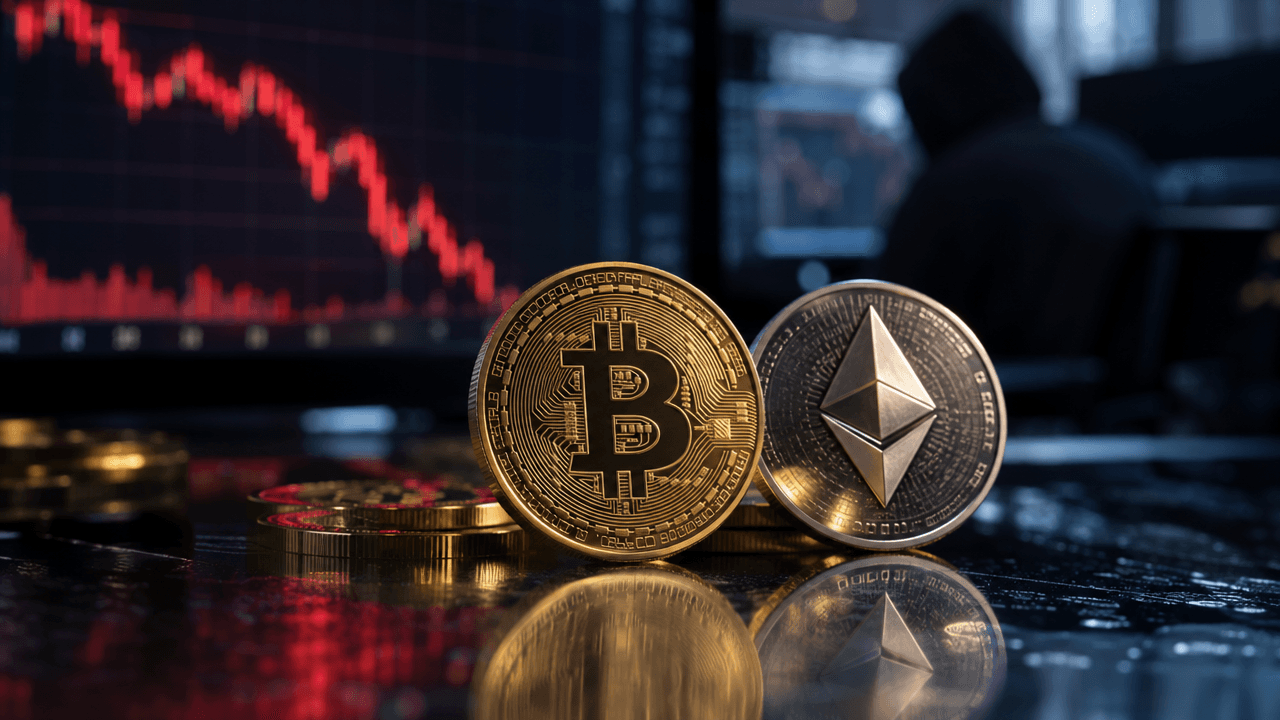
Bitcoin and Ether came under sharp pressure after reports of a potential Binance security breach intensified anxiety across digital-asset markets. Both cryptocurrencies were reported down roughly 4% overnight, while traders moved away from riskier positions and assessed whether the incident could create broader stress across exchanges, stablecoins, and decentralized finance.
At the time of the initial reports, the incident had not been independently confirmed. Binance said it was investigating a potential security issue, while early statements indicated that user funds had not been confirmed as affected. That uncertainty was enough to trigger a rapid repricing because Binance is one of the world’s largest crypto trading venues and plays a central role in global market liquidity.
Subsequent reporting described the event as a major cyber heist, with Binance estimating an impact of approximately $6.3 billion. The exchange said the initial investigation pointed to a compromised employee device and unauthorized withdrawal transactions, while also stating that it had found no evidence of a private-key leak. [3]
Why Rumors Moved Bitcoin And Ether
Crypto markets often react to uncertainty before the facts are fully established. When a major exchange is rumored to have been compromised, traders cannot immediately determine whether the issue is isolated, whether withdrawals could be interrupted, or whether forced selling may follow. As a result, market participants frequently reduce exposure first and investigate the details later.
Bitcoin reportedly fell about 4.1% to approximately $77,446, while Ether declined about 4.4% to roughly $2,230. Binance’s BNB token suffered a larger decline of around 6%, reflecting its closer connection to the exchange and the company’s operating environment. [9]
The reaction also illustrates Bitcoin’s changing role in the market. Although it is often viewed as a relatively established digital asset, Bitcoin can still sell off alongside speculative tokens when the broader crypto ecosystem experiences a confidence shock. Ether may be especially sensitive when stolen assets are believed to move through Ethereum-based wallets or decentralized applications.
What An Exchange Security Event Means For Traders
An exchange breach creates several separate risks. The first is direct custody risk: customers may temporarily lose access to deposits or withdrawals. The second is liquidity risk. If many users attempt to withdraw funds at the same time, order books can become thinner, spreads can widen, and prices can move more aggressively.
The third risk is contagion. Crypto markets are interconnected through stablecoins, lending protocols, derivatives platforms, and shared liquidity providers. A security incident at one large venue can therefore affect assets that were not directly involved in the breach.
Initial reports said that approximately $3 billion in assets had been frozen and that Binance intended to cover losses. [9] Later reporting stated that stablecoin issuers had also frozen significant amounts connected with the incident, demonstrating how centralized entities can intervene quickly when suspicious wallet activity is identified. [6]
For traders, this does not eliminate risk. Frozen assets may reduce the amount available to attackers, but the market can still face volatility from fear, forced deleveraging, and uncertainty over which wallets or protocols were exposed.
How To Interpret The Market Signal
A sharp overnight decline does not automatically prove that Bitcoin or Ether has entered a lasting bear trend. The move may represent a short-term risk repricing rather than a change in the long-term investment case. Traders should distinguish between the initial headline reaction and the follow-through that occurs after verified information becomes available.
Important signals include whether withdrawals remain open, whether customer balances are fully honored, whether blockchain investigators identify continuing transfers, and whether other exchanges report unusual activity. Price behavior is also informative. A market that stabilizes after official clarification may be absorbing the shock. A market that continues to make lower highs and lower lows may be signaling broader concerns about liquidity and confidence.
Derivatives data can add context. Rising funding stress, a jump in liquidations, or unusually high implied volatility may indicate that leverage—not just spot selling—is driving the decline. Traders should also monitor the spread between exchange prices, because abnormal differences can reveal localized liquidity problems.
Practical Steps For Simfi Traders
Simulated finance provides a useful environment for studying this type of event without putting capital at risk. Traders can recreate the scenario by tracking Bitcoin, Ether, BNB, and major stablecoins across several time intervals.
First, record the initial move and compare it with the reaction after official announcements. This helps separate headline volatility from sustained trend development. Second, test position sizing. A trade that looks reasonable under normal volatility may be dangerously large during a security scare.
Third, use predefined risk controls. Stop-loss levels, maximum daily loss limits, and exposure caps can prevent one unexpected headline from overwhelming an entire strategy. Traders should also avoid assuming that a lower price is automatically a buying opportunity.
Finally, compare centralized-exchange risk with self-custody and decentralized-market risks. Each approach has different vulnerabilities. Centralized venues may offer liquidity and customer support but introduce custodial dependence. Decentralized systems can reduce reliance on one intermediary while exposing users to smart-contract, oracle, and liquidity risks.
The Bigger Lesson For Crypto Markets
The Binance episode shows how quickly confidence can become a market variable. A report that begins as an unconfirmed rumor can produce billions of dollars in repricing before investigators establish the facts. Even when an exchange promises to cover losses, traders may still demand a higher risk premium until operations, reserves, and wallet activity become clearer.
For Bitcoin and Ether, the immediate pressure may fade if withdrawals function normally and losses remain contained. However, the event reinforces a lasting principle: in crypto markets, security infrastructure and liquidity are part of the asset thesis—not separate from it.
The most disciplined response is neither panic nor complacency. Verify information through official channels, reduce leverage, monitor liquidity, and let confirmed evidence—not social-media speculation—drive decisions. In a market where uncertainty can move prices faster than fundamentals, process remains one of the trader’s most valuable advantages.