
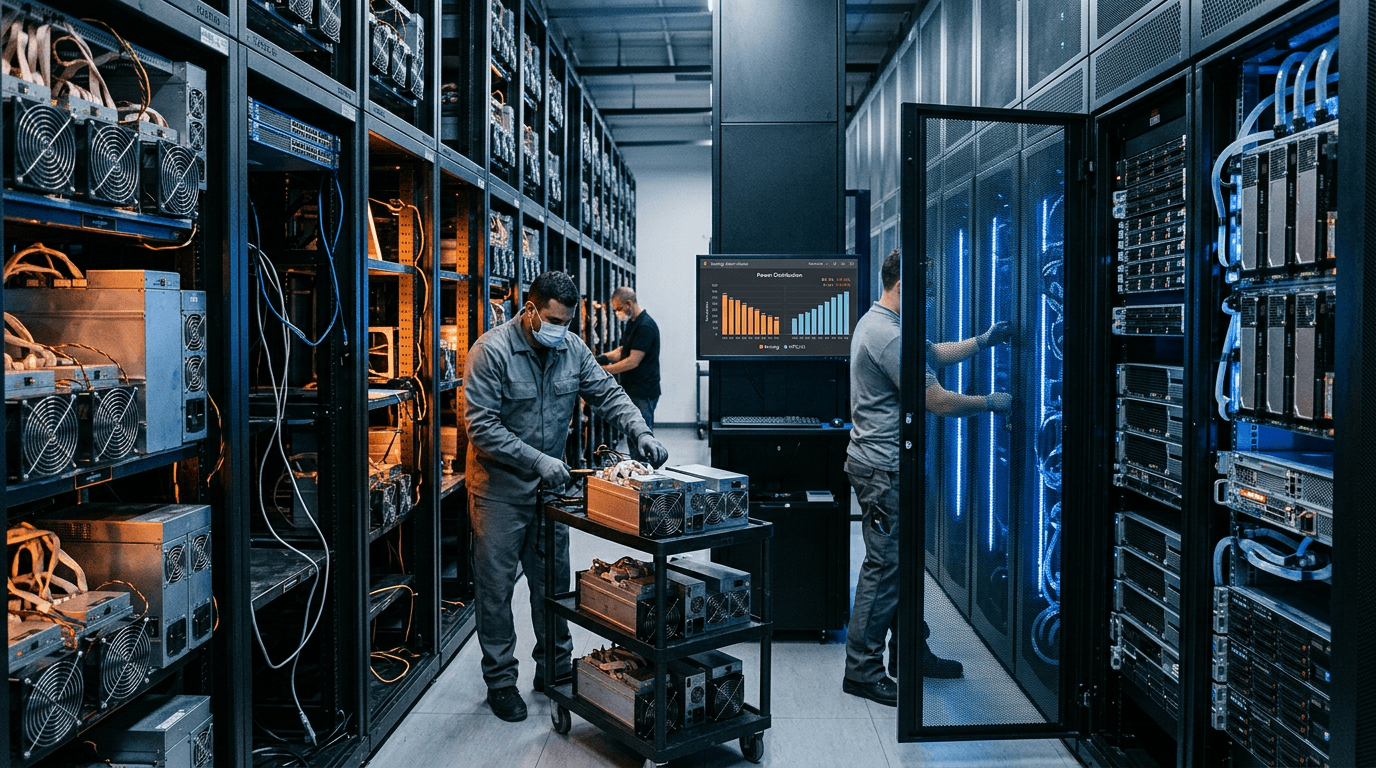
Public Bitcoin miners are quietly reshaping the digital infrastructure landscape, cutting their realized Bitcoin hashrate by 13.4% as they redirect power, racks, and data halls toward artificial intelligence (AI) and high‑performance computing (HPC) workloads[1][2][4]. This pivot is less an exit from Bitcoin than a capital reallocation toward steadier, higher‑margin compute markets, with direct implications for mining economics, network security narratives, and listed mining equities[3][6][13].
Miners Dial Back Hashrate
Over the past two quarters, a cohort of publicly traded miners saw realized hashrate fall from roughly 368 exahashes per second (EH/s) in Q4 2025 to about 319 EH/s in Q2 2026, a decline of 13.4%[1][2][11]. These operators include many of the largest U.S.‑listed names, whose aggregate hashrate has been trimmed as fleets are decommissioned and sites retooled for GPU‑heavy compute clusters[6][10][14]. In several cases, non‑mining revenue from AI and HPC data‑center services has already overtaken traditional block‑reward income[2][3].
Importantly, public miners account for only around 20–30% of global Bitcoin hashrate, so their 13.4% pullback translates to an estimated 3–4% reduction in total network power[6][8]. Broader network measures show hashrate drifting down from a late‑2025 peak above 1 zettahash per second (ZH/s) toward ranges near 850–940 EH/s through 2026, consistent with a mid‑single‑digit percentage decline[3][8][13]. This is the first sustained drop in network hashrate since 2020, marking a break in a multi‑year up‑only trend driven by cheap capital and aggressive expansion[7][9].
Why Ai And Hpc Beat Bitcoin Margins
The rationale behind the pivot is straightforward: AI and HPC tenants can pay materially more per megawatt than Bitcoin mining can sustain post‑halving and under volatile energy prices[3][7][13]. Analysts estimate that AI training clusters and HPC workloads will pay three to five times more per megawatt‑hour than mining operations, often under multi‑year contracts with minimum payment guarantees[3][12][13]. That contrasts sharply with stochastic block rewards and a revenue curve that can be squeezed whenever Bitcoin price, difficulty, and energy costs move against miners simultaneously[5][7][15].
Across listed miners, more than $70 billion in cumulative AI and HPC contracts have already been announced, with projections that some operators could derive up to 70% of their 2026 revenue from non‑mining compute services[3][13]. Companies like Core Scientific and TeraWulf have reported quarters in which AI and HPC data‑center income exceeded mining revenue, highlighting how quickly the business mix can flip once power and cooling are optimized for GPU clusters[2][3]. For boards and equity investors, this is attractive: longer‑duration leases, visible cash flows, and less dependence on Bitcoin’s cycle.
From an infrastructure standpoint, mining farms and AI data centers are cousins rather than strangers. The same high‑capacity substations, robust cooling systems, and secure data halls can be repurposed from ASIC fleets to GPU racks with targeted capex rather than complete rebuilds[6][10][12]. In some reported cases, U.S. miners have signed 10‑ to 15‑year agreements with hyperscale AI clients, effectively converting what was once speculative hashpower into annuity‑like hosting revenue[12][14].
Impact On Bitcoin Network And Market Perception
Any reduction in hashrate naturally prompts questions about Bitcoin’s security. In practice, the protocol’s difficulty adjustment is designed to absorb changes in network power, and recent difficulty moves show that mechanism working as expected[5][7][9]. Difficulty declined by about 7.76% in one of the larger 2026 downward adjustments, followed by a subsequent upward move as hashrate stabilized, keeping block times anchored around the 10‑minute target[5][7]. A 3–4% net hashrate reduction from public miners sits well within the range that the adjustment can smooth over in one or two epochs[6][9].
The more meaningful impact is on sentiment and sector positioning. For some observers, miners leaving Bitcoin for AI feeds a narrative that block‑reward economics are structurally broken after successive halvings and rising energy costs[7][9][15]. For others, it signals maturation: mining‑native operators are becoming diversified digital infrastructure providers, using Bitcoin as one line of business rather than their sole product[3][10][12]. In equities markets, that shift is already visible in valuations, with “compute infrastructure” stories often rewarded more richly than pure mining plays[3][10][14].
For traders, these dynamics can translate into dispersion within the mining cohort. Firms that successfully pivot to AI/HPC and secure long‑term contracts may trade more like data‑center REITs or tech infrastructure stocks, while those remaining heavily exposed to block‑reward cycles will continue to behave as leveraged bets on Bitcoin price and difficulty[3][13][14]. Understanding each company’s revenue mix, contract profile, and power strategy becomes critical when building thematic baskets or hedging exposure.
What This Means For Traders And Simfi Users
The 13.4% hashrate cut by public miners is a reminder that Bitcoin’s security model and mining economics are part of a broader energy and compute market, not a closed system[1][3][6]. For discretionary traders, three practical angles stand out. First, monitor network metrics alongside price: shifts in hashrate, difficulty, and fee revenue can hint at miner stress or relief before it shows up in earnings[5][7][15]. Second, differentiate between miners that are pivoting successfully and those that may be left behind with older, less efficient fleets[3][10][14]. Third, consider how AI‑linked cash flows might dampen volatility in some miner equities, altering their correlation with Bitcoin itself[3][13].
In a simulated trading environment, this theme is ideal for scenario testing. For example, users can model portfolios where Bitcoin price rises but mining margins compress due to higher energy costs, or where AI contract wins boost specific miners even as network hashrate drifts lower[7][9][13]. They can also explore stress scenarios in which difficulty adjustments lag, transaction fees fail to pick up, or regulatory changes affect energy markets, and then test how diversified, AI‑pivoted miners behave versus pure‑play operators[5][7][9]. This kind of experimentation helps traders build intuition around how infrastructure narratives translate into price action.
CONCLUSION: MINING ENTERS THE MULTI‑REVENUE ERA
Public Bitcoin miners cutting hashrate by 13.4% as they pivot toward AI and HPC marks a new chapter in the sector’s evolution[1][2][4]. Rather than signaling an abrupt retreat from Bitcoin, it reflects a rational hunt for more stable, higher‑value compute revenue in a world where zettahash‑scale mining competes directly with AI clusters for megawatts and silicon[3][8][13]. Bitcoin’s protocol continues to adjust, keeping block production cadence intact, even as the composition of the capital that secures the network gradually changes[5][6][9].
For market participants, the key is not to overreact to headline hashrate drops, but to track where the capital is going and how business models are adapting. Listed miners are becoming hybrid infrastructure operators, balancing Bitcoin exposure with AI and HPC contracts, and their equities will increasingly trade on that blended profile[3][10][14]. In that sense, the current pivot is less a warning siren and more a sign that the mining industry is moving into a multi‑revenue era—one where understanding energy, compute, and contract structure is just as important as reading the Bitcoin chart.