
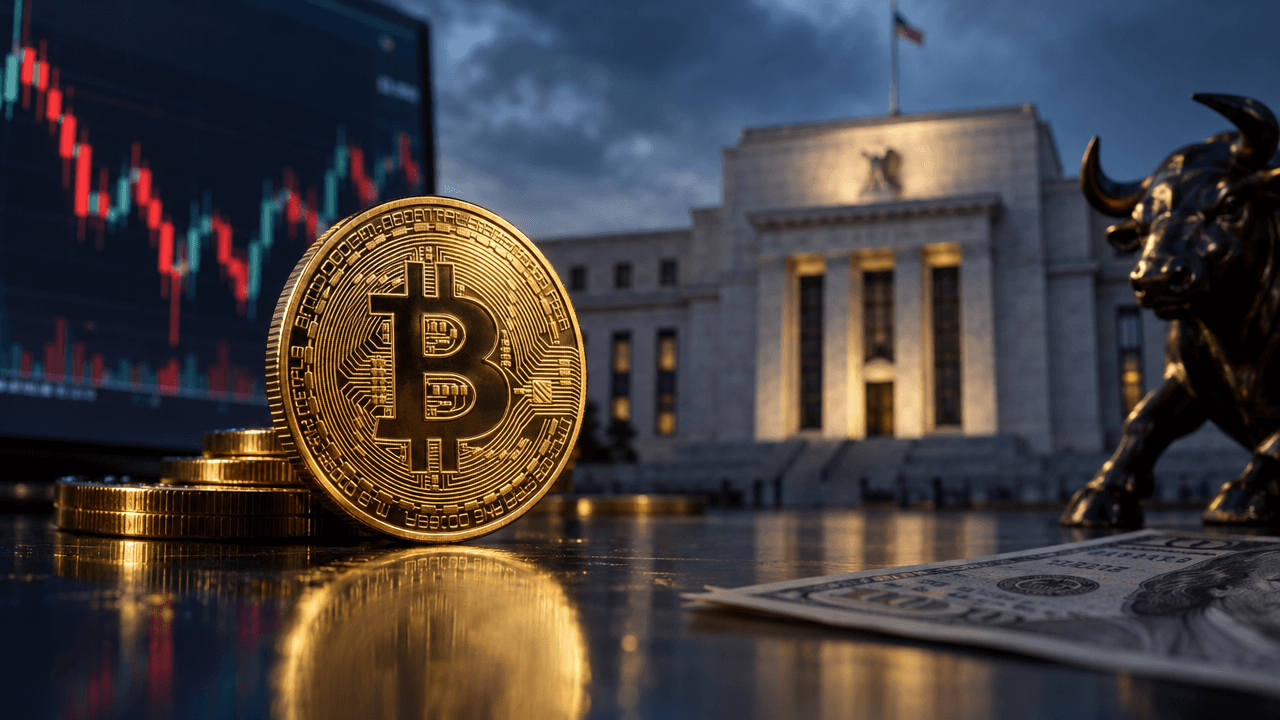
Bitcoin remains subdued near $80,600 as traders wait for the Federal Reserve’s latest interest-rate decision and assess whether higher bond yields and a firmer US dollar will continue to limit demand for risk assets. The cryptocurrency slipped approximately 0.1% to about $80,628, a modest move that reflects hesitation rather than a decisive shift in market direction.
The immediate question is whether Bitcoin can regain momentum after struggling to sustain a stronger recovery above the $80,000 area. With macroeconomic policy dominating sentiment, traders appear reluctant to establish large positions before the Fed communicates its view on inflation, employment, and the future path of interest rates.
The Federal Reserve In Focus
The Fed’s decision is important because interest rates influence the relative attractiveness of nearly every major asset class. When rates remain high, cash and government bonds can offer more competitive returns. That can reduce the incentive to hold assets such as Bitcoin, which does not generate contractual interest income.
Markets largely expect policymakers to leave rates unchanged at the current meeting, but the accompanying statement and press conference may matter more than the decision itself. Investors will be watching for clues about whether another rate increase could be considered later in the year. Market expectations have reportedly centered on a potential December hike, making the Fed’s tone especially relevant for cryptocurrencies. [2][9]
A hawkish message could push Treasury yields and the dollar higher. Conversely, a more measured message could ease financial conditions and give risk assets room to recover. This creates a situation in which Bitcoin may react sharply even if the central bank delivers the outcome that traders already anticipate.
Why Yields And The Dollar Matter
Higher Treasury yields increase the opportunity cost of owning Bitcoin. If investors can earn comparatively attractive returns from government debt, they may demand a stronger reason to allocate capital to more volatile assets. Higher yields can also raise borrowing costs and reduce liquidity throughout financial markets.
The US dollar has a similar influence. Bitcoin is generally priced in dollars, so a stronger dollar can create additional pressure on dollar-denominated commodities and alternative assets. A rising dollar may also reflect a preference for liquidity and safety, particularly when investors are concerned about inflation, economic growth, or policy uncertainty.
Recent market commentary has linked elevated yields and dollar strength with weaker enthusiasm for speculative assets. The 10-year Treasury yield has remained close to historically important levels for current market conditions, while the dollar has held near a recent high. Together, those factors help explain why Bitcoin’s price action has been restrained despite the cryptocurrency remaining above $80,000. [11][12]
A subdued market does not necessarily mean that investors have abandoned Bitcoin. It may instead indicate that traders are waiting for a clearer catalyst before committing to the next major move.
Key Levels And Market Structure
The $80,000 level remains psychologically significant. Bitcoin’s ability to hold above it may help stabilize sentiment, while a sustained break below could encourage short-term sellers to target lower support zones. Some market analysis has identified approximately $79,000 as an important area to monitor if the Fed adopts a more hawkish position. [11]
On the upside, Bitcoin needs to reclaim recent intraday highs and attract stronger buying volume before a recovery can be considered convincing. A brief move higher on thin liquidity may not represent a durable trend reversal. Traders should distinguish between a headline-driven reaction and a sustained change in market structure.
Volatility may increase after the Fed announcement. Price swings can be amplified when leveraged positions are concentrated around widely watched levels. A sudden move in either direction could trigger stop orders, liquidations, and rapid follow-through. This is why experienced traders often focus on confirmation rather than reacting to the first price spike.
Practical Takeaways For Traders
First, reduce the temptation to predict the exact wording of the Fed’s statement. Instead, prepare scenarios. A hawkish outcome could support the dollar and yields while pressuring Bitcoin. A neutral outcome may produce an initial whipsaw before the market chooses a direction. A dovish outcome could help risk assets, provided investors interpret it as supportive rather than a response to deteriorating economic conditions.
Second, monitor Bitcoin alongside the dollar index, Treasury yields, and major equity benchmarks. Crypto-specific headlines are important, but the current environment demonstrates how strongly Bitcoin can respond to broader financial conditions. Correlation is not constant, yet simultaneous moves in yields, the dollar, and equities can provide useful context.
Third, manage position size around major economic events. Wider spreads, rapid price changes, and unexpected reversals can make otherwise reasonable trades difficult to execute. Using defined risk levels and avoiding excessive leverage can be more valuable than trying to capture every short-term fluctuation.
For SimFi traders, this event offers a useful exercise in disciplined decision-making. Traders can build a pre-event plan, define bullish and bearish scenarios, and review whether their response was based on evidence or emotion. The objective is not simply to guess the next candle, but to develop a repeatable process for handling uncertainty.
Conclusion
Bitcoin’s position near $80,600 reflects a market waiting for direction. The small decline to approximately $80,628 signals limited momentum as traders balance support above $80,000 against pressure from higher yields and a stronger dollar. [1][2]
The Federal Reserve’s decision and its forward guidance are likely to determine whether Bitcoin remains range-bound or begins a larger move. Until that uncertainty clears, patience, scenario planning, and careful risk management may be more valuable than aggressive positioning. Bitcoin’s next major trend will depend not only on crypto demand, but also on how investors interpret the changing cost of money across global markets.