
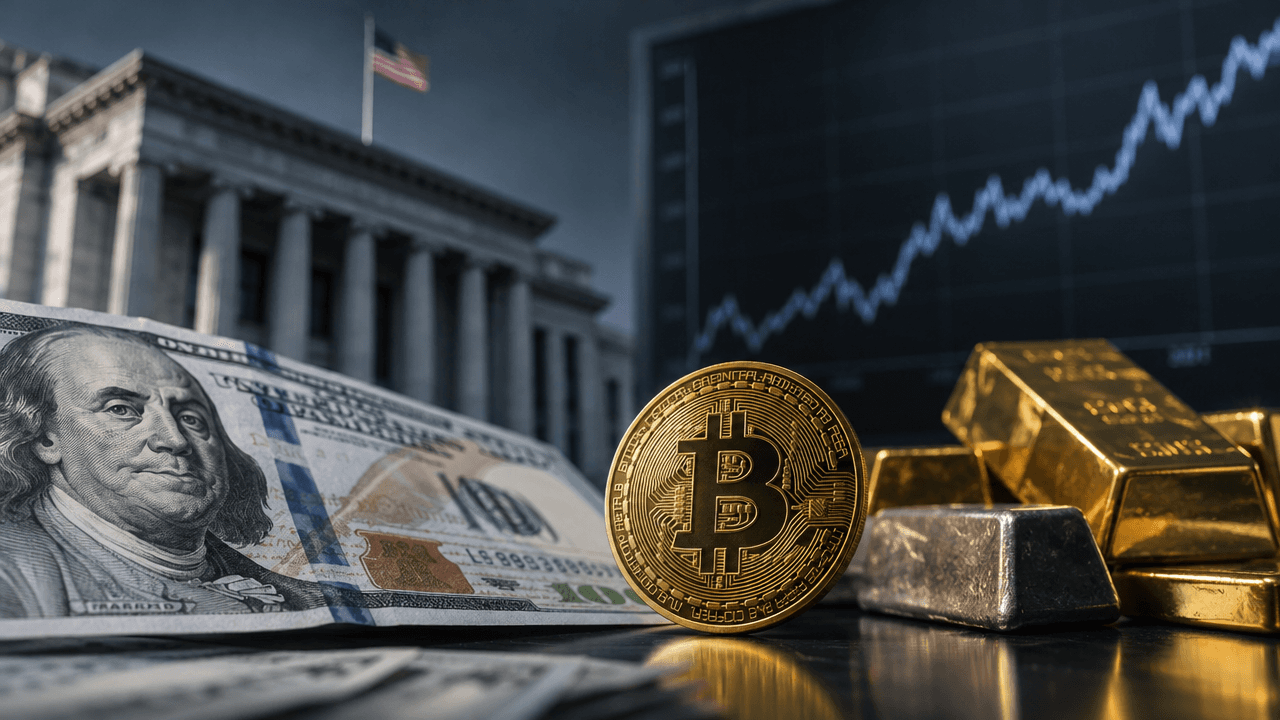
A stronger U.S. dollar is tightening financial conditions across global markets, and risk-sensitive assets are feeling the pressure. Bitcoin traded near $64,600 on November 18, remaining below the closely watched $65,000 level, while gold and silver also extended their declines. The latest market move highlights how currency strength, rising Treasury yields and changing Federal Reserve expectations can affect assets that investors often group together as alternatives to traditional money.
THE DOLLAR’S MARKET-WIDE EFFECT
The U.S. dollar is more than a currency quote on a foreign-exchange screen. It is the pricing unit for Bitcoin, gold, silver, oil and many other globally traded assets. When the dollar appreciates, these assets can become more expensive for buyers using other currencies. That can reduce demand even when the underlying investment case has not fundamentally changed.
The recent advance in the Dollar Index has coincided with broad weakness across crypto and precious metals. The index reached approximately 103.69, its highest level since April 2025, as traders responded to stronger inflation concerns and expectations that U.S. interest rates could remain elevated. [2]
Dollar strength also tends to reflect a preference for liquidity and safety. During periods of uncertainty, investors may sell volatile or non-yielding assets and hold more cash or short-term dollar instruments instead. This creates a feedback loop: demand for dollars pushes the currency higher, while the stronger currency adds another source of pressure to international assets.
Why Treasury Yields Matter
The second major force is the rise in Treasury yields. The 10-year Treasury yield recently moved from about 4.84% to 5.10%, while Bitcoin fell roughly 15% during the broader selloff period. Gold declined about 8.4% and silver about 12.5% over the same stretch. [4]
Higher yields change the opportunity cost of holding assets that do not pay interest. Gold does not produce a coupon, and Bitcoin does not distribute income in the way a bond does. When investors can earn more from relatively liquid government debt, they may demand a larger potential return before accepting the volatility of crypto or the price risk of precious metals.
Yields also influence valuation through expectations. If traders believe the Federal Reserve will keep policy restrictive, future cash flows and speculative investments tend to be discounted more heavily. This does not guarantee that Bitcoin or metals will fall, but it can make rallies harder to sustain and encourage traders to reduce leverage.
BITCOIN’S $65,000 TEST
Bitcoin’s move near $64,600 places the $65,000 level at the center of short-term market attention. The cryptocurrency was recently reported to be around three-month lows, with dollar strength, higher-rate expectations and muted sentiment keeping buyers cautious. [15]
Round numbers often attract orders from both buyers and sellers. A sustained recovery above $65,000 could suggest that some participants are willing to absorb the current macroeconomic headwinds. On the other hand, repeated failures below that level may reinforce the view that sellers remain in control.
Traders should avoid treating one price threshold as a complete market signal. Bitcoin can move sharply in either direction because of derivatives positioning, liquidations, exchange flows and changes in risk appetite. A more useful approach is to observe whether price recovers alongside improving breadth, stronger spot demand and easing Treasury yields. A brief move above resistance without those supporting factors may prove fragile.
Precious Metals Lose Their Safe-haven Glow
Gold and silver are often viewed as defensive assets, but defensive does not mean immune to selling. Gold fell below $3,800 per ounce on November 18, while silver traded near $45.70 after another decline. [1][4]
Precious metals can come under pressure when investors need to raise cash, when real yields increase or when the dollar strengthens quickly. Gold’s lack of income becomes more important when inflation-adjusted bond yields rise. Silver is additionally influenced by industrial demand, making it vulnerable to concerns about global growth as well as currency and interest-rate conditions.
The current selloff is a useful reminder that asset labels can oversimplify market behavior. Gold may protect purchasing power over long periods, but it can still decline during a rapid rise in yields. Bitcoin may be viewed as a hedge against monetary debasement by some investors, yet it generally behaves like a high-volatility risk asset when liquidity tightens.
Practical Takeaways For Traders
First, monitor the dollar and Treasury yields alongside crypto and metals rather than analyzing each chart in isolation. A rising Dollar Index and 10-year yield can serve as an important warning that macro conditions are becoming less supportive.
Second, separate trend confirmation from short-term noise. Watch whether Bitcoin can reclaim and hold $65,000, whether gold can stabilize after breaking below key psychological levels, and whether silver begins to outperform. Price recovery supported by falling yields would be more constructive than a rally occurring while macro pressure intensifies.
Third, manage exposure carefully. Strong correlations can increase portfolio risk when several positions are driven by the same factor. Holding Bitcoin, gold and silver does not necessarily provide effective diversification if all three are responding to dollar strength and higher rates.
Finally, avoid assuming that a Federal Reserve policy shift is guaranteed to rescue markets. Expectations can change quickly, and traders may price a policy pivot well before it occurs. Position sizing, defined risk and patience remain more dependable tools than trying to predict the next central-bank headline.
Conclusion
Dollar strength is currently acting as a common headwind for Bitcoin, gold and silver. With the 10-year Treasury yield near 5%, investors have more incentive to favor income-producing dollar assets, while higher-rate expectations are limiting demand for alternatives.
The pressure may ease if inflation cools, yields decline or the Federal Reserve adopts a less restrictive stance. Until then, traders should treat the dollar, Treasury market and major price levels as connected parts of the same market system. The key lesson is not that crypto or precious metals have lost their long-term purpose, but that even popular hedges can struggle when liquidity contracts and the world’s dominant currency is rising.